Experience of a 2020 Graduate

Every year when we passed a class, be it Kindergarten, 4th grade or 10th grade, we feel like we’ve grown and moved onto bigger things in life. Our teachers always made us feel like a wiser, more responsible person every time we moved up a class. When we graduated from school, a deep sorrow along with excitement for experiencing college life filled us. Passing the 12th grade is the ultimate goodbye from our friends and family, our teachers, the school we’ve been in for years, and the city we grew up in. Never did our previous years’ graduates were stuck in a limbo, out of school but not in a college. A long gap with nothing to do in it, no motivation and no goal. 

Every day of 11th and 12th, we heard our teachers and parents tell us the importance of the stream we choose and the things we learn in the duration of these two years. The final year of school, 12th grade is the most important year of the entire school life in terms of both academics and fun. 

From the very first day of 12th, we are told to study hard as it will play a great role in determining the college we get into and the career we choose. Even though it is the last year of school life, our focus remains more on our marks, completion of our syllabus, multiple coaching or tuition classes, and comparing our score to others. We forget to spend some of our time doing what we’ll actually miss and remember, hanging out with friends, extracurricular activities, going to the canteen, roaming around in the school, and so much more. 

The 2020 graduates have had the worst farewell or introduction into college. Some of us couldn’t even give the exams we had prepared for with all our might. When we were done with our exams, there was a long waiting period. All of the plans, going on a trip, having the time of our lives, were unsuccessful as we couldn’t even leave our houses. 

Having spent the last seven months in isolation, with uncertainty about our future, has really affected our mental health. Those who have taken admission into colleges have to adapt themselves to online college life with many hours spent in front of their laptops. Those who have not yet taken admission are also under a lot of stress as they are wasting away the important time of their life.

Competitive exams such as NEET (National Eligibility Cum Entrance Test), JEE (Joint Entrance Examination), CLAT (Common Law Admission Test), et cetera were postponed which severely stressed out the ones who had been preparing for these exams for the past two years. 

The results were delayed and the admission processes in some colleges have still not begun which is making the graduates anxious. This is in stark contrast to all the previous years’ experience which was full of joy and excitement, not stress and anxiety. 

Hopefully, everything will be back to as it was before!
Relevance of Vocational Education in India


Vocational education primarily deals with skill developmentaimed at increasing the employability of an individual. It is also known as Career and Technical Education (CTE) and as Vocational Education and Training (TVET). In consists of several practical courses that help people in building skills and experience which would be directly beneficial in a certain career path. In times of economic crisis, such as now, unemployment rises exponentially. In such a scenario where uncertainty looms over the youth’s future, vocational education serves as a safety net for many. While some vocational courses are offered at secondary and senior secondary levels in school, vocational education primarily takes place in post-secondary and college level. A 2019 report by the World Bank highlighted the importance of vocational education as a means for workers to compete in changing labour markets. 

The labour market is evolving at a fast speed, and with most employers now demand knowledge of practical skills from their workers. Enrolling in vocational courses would not only benefit those who wish to add certain skills to their resume, but also to those individuals who wish to start earning as soon as possible. In a country as fraught with economic inequalities as India, many out-of-school adults wish to start earning as soon as possible. For a majority of India’s youth, mainstream education after grade twelve serves little purpose. They wish to learn skills that would guarantee employment in a short time, primarily because of a lack of resources that could fund higher education. There is, however, another demographic that stands to gain from vocational education. Individuals who are clear about their career path can take up skill-centric courses that would contribute to their training for a prospective job. For instance, those who wish to pursue a career in flying may directly enrol in aviation programmes without pursuing an academic degree. 

The government of India recognises the role of education and skill-development in economic growth. As a result, several institutions across India are either partially or wholly funded by the Central government and various State governments. Industrial Training Institutes or ITIs offer full-time vocational courses, and they are provided recognition and certification by the Ministry of Labour, Government of India. Some several colleges and universities also offer part-time vocational courses, sometimes through distance learning. However, the government needs to streamline the courses offered by various national and state-level institutions for the youth to become more compatible with the existing job market. The critical elements of existing vocational training programs need to be modified even as these programs are made more flexible to accommodate the dynamic labour market which is vulnerable to changes due to forces of globalisation acting upon it. Issues specific to the Indian context also need to be taken up, such as high drop-out rate, lack of partnerships with the private sector, untrained and underqualified teaching faculty and red-tapism. In addition to this, the focus should be there on building an accessible channel of continuous skill up-gradation so that the workforce could update its skills and not become obsolete after the passage of some time.

Teachers During the Pandemic


Teachers during the pandemic

The outbreak of the novel coronavirus has significantly affected all sectors including the education sector, the agriculture sector, the industrial sector, and our economy in its entirety. This unforeseen virus has single-handedly disrupted the entire world, from every country’s economy to everyone’s professional as well as personal life. One of the sectors which have been deeply affected is the education sector. Schools have been working offline efficiently for a long time and expecting a fluid switch from offline classes to e-learning is not practical. Most of the schools and the students are not well-equipped with technology to conduct classes regularly, administer tests, organise co-curricular activities, et cetera. Teachers now have to work double the amount they did with the same, if not less, salary. 

Here are some problems that teachers are facing in our country:

• Technological Gap

On one hand, the previous generation is not familiar with technology and on the other, the present generation excels in this area. All their existing curriculum plans are no longer applicable for online learning, thus, they have had to opt for new timetables and plans which may or may not be favourable for them. Learning your way around new applications, especially at the risk of your job, is not an easy task. Upon that, teachers are also made to feel embarrassed because of their lack of knowledge in this area. 

• Unemployment or fall in salary

In these difficult times, teachers are facing financial problems. Due to classes no longer being conducted in many schools or shut down of local schools, teachers and other employees are losing their jobs. The sports department is not engaged in teaching or other activities due to the lockdown and social distancing protocols which do not allow sports. Many teachers have been cut and their work given to others, overburdening them while leaving the others unemployed. Some educational institutions are reducing the salaries of their employees, or simply making them work by not giving them their well-deserved pay. 

• Household chores

India, a country which follows a largely patriarchal system, has about 70 female teachers per a hundred men. Women in our country are expected to attend to all the household chores. Many teachers of this age also have kids, whom they need to handle during the classes as well. Thus, teachers, both male and female, are overburdened with work. Having classes 6 days a week and handling your house are not easy tasks, especially with the added stress of the pandemic and the uncertain future. 

• Bullying

Students are taking advantage of the anonymity that the internet provides. Disrupting classes, passing snide comments, making fun of the teacher, et cetera are very common these days. Students do it out of fun or boredom, what they do not realise is the deep mental effects bullying has on others. Teachers are already pressurised by the schools and the demand to quickly adapt to new teaching methods, they also have to go through this. 

Elementary class teachers are finding it difficult to engage students. Their screen time is increasing and as teaching takes up most of their day, their physical exercise has reduced. Social isolation and all these factors together are negatively affecting our teachers. Let’s take a vow to be kinder to them as they are surely doing their best! 

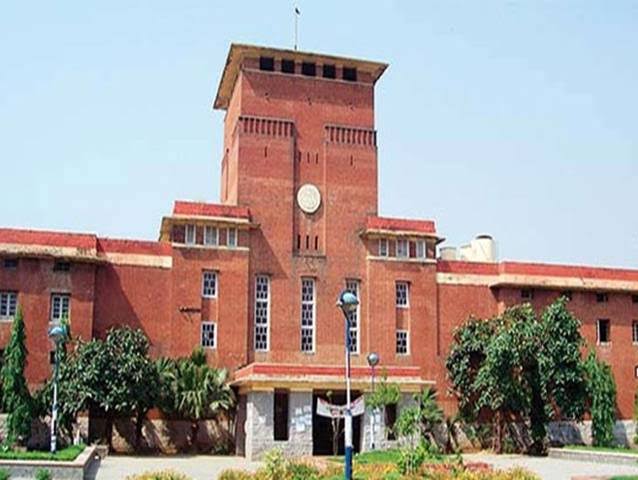
University of Delhi to promote intermediate students with backlog for next semester.

New Delhi: University of Delhi has issued promotion criteria for intermediate semester students of undergraduate and postgraduate courses. According to an official notification, all UG and PG students (except for the Council Mandatory course, including the Non-Collegiate Women’s Education Board (NCWEB) and the School of Open Learning (SOL)), students will be allowed to pursue those subjects , In which they have failed.

“Students will be allowed to pursue subjects in which they failed in one semester or year and will be promoted next year,” an official statement said.

“However, such students may approve the syllabus for the examination in which they failed or in which they were absent, when the examinations are conducted by semester and term next year,” the statement said.

DU said that students in the second semester (part I) or fourth semester (part II) of undergraduate and postgraduate courses are eligible for promotion under the criteria.

Registered with the School of Open Learning and Noncollegiate Women’s Education Board (NCWEB) for second year UG courses under the annual mode and second semester (1 year), first year UG students under Choice Based Credit System (CBCS) Delhi. The university said that the School of Open Learning (SOL) is also eligible for promotion.

University of Delhi further stated that this provision is applicable only for the current academic session (2019-20) in view of COVID-19 epidemic. Courses administered by statutory regulatory bodies or councils will not be covered under this provision.

NEET 2020 ANSWER KEY RELEASED

Amid strict precautions, the National Testing Agency conducted the medical entrance exam NEET on September 13 across the country. The 
NEET answer key
 2020 has been released by the NTA on its portal on Saturday i.e., September 26.


Candidates who appeared for the exam can visit the official website of NTA NEET — ntaneet.nic.in — to check and obtain the 
NEET 2020
 answer key. Candidates can obtain the 
NEET 2020 answer key
 from the link given below.


The National Testing Agency has now uploaded the advance answer keys for candidates for all the sets (E1- E6, F1- F6, G1-G6, H1-H6) for their information. The candidates are advised to go through the same and keep themselves ready for challenges of the draft answer keys which will be published shortly.

Candidates should note that the notice inviting challenge of the keys will be released later. The official notice released regarding the answer key reads “Please note that this public notice is not for inviting challenge of the keys which will be done later on, and for that proper notice will be issued. Therefore, kindly do not email your responses or clarification regarding the Keys and please wait for the process of raising challenges for the same.

Nearly 15 lakh students appeared for the three-hour-long exam held at over 3,900 centres. In view of the COVID-19 pandemic, the exam was conducted with stringent checks and protocols like students queuing up as per their designated time slots, adhering to social distancing norms, etc.

Although the exam commenced at 2 pm, the entry to exam centres started at 11 am. Different slots were allotted to students for the entry to ensure the staggered movement and maintain social distancing. The exam originally scheduled for May 3, has been deferred twice due to pandemic, first, it was postponed to July 26, and then to September 13.

How can we improve online education?


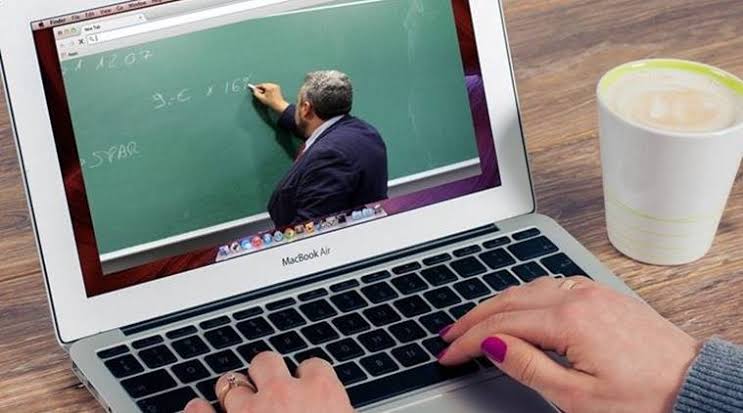
Due to the ongoing pandemic, our laptops have become our teachers. The already backward education system took a serious hit when offline schooling had to suddenly shift to online education. The lack of infrastructure and preparedness for this sudden shift has severely affected the quality of education in today’s world. The reach of the education sector has decreased largely amid the global outbreak of the novel Coronavirus. Private schools have managed to stay afloat with the new developments in this sector, however, public schools have become the Titanic in this situation. With half of the students out of their schools and having minimum access to education, how to improve online education is a topic of utmost importance. To widen the reach of education, we need to make changes simultaneously in multiple directions. 

•Mode of Communication 

Some modifications in our mode of communication can help reach more students. Instead of using video calling apps such as Zoom, Google Meet, Microsoft Team, et cetera which require fast internet network and attendance in real-time, switching to WhatsApp audio notes and sharing worksheets as well as pdfs which require fewer megabytes. This will help them to go over the class multiple times in case they don’t understand a particular topic and will not require them to attend a class at a particular time. 

•Interactive education

After each lesson, an interactive worksheet, homework or test should be administered. When teaching a primary class, interaction works the best. Using pictures, descriptive texts, direct questions and answers, interactive graphics, et cetera would certainly engage students more into their studies. Making teachers available on call for a specific period of time to solve their queries will also encourage them to study and not give up once they fail to understand something. 

•Mental Health

From old to young, all minds have been negatively impacted by the disruption of their routines, lack of human interaction leading to feelings of loneliness, uncertainty in life, fear of a newly introduced deadly virus and much more. The school going students, who are in their formative years, can develop stress and anxiety. Recent news has also brought into light suicide incidents among students because they did not have access to education and felt that their life had come to a halt, along with many other issues. In these days, mental health awareness holds more importance than any other subject. Teaching students about how to improve their mental health, how to seek help, how to identify problematic thought patterns, and other things they ought to know should be made a priority in their syllabus. 

Following a more inclusive approach, to accommodate the underprivileged section of the society is a must in these days. The government should appropriate more funds to the educational sector as they are much needed to build a proper infrastructure for online education. It is the youth that is our future and it is them we should consider our greatest assets. Holistic education would lead to a better society and help in bringing about the changes that are much needed in the world. 

Educate. Empower. 

Mental Health and Competitive Exams

India’s youth is pushed into participating in a rat race for entry into engineering and medical colleges, which is a whirlpool of broken dreams and identities. Students are groomed to prepare for entrance exams like NEET and JEE, from very young ages. Parents spend lakhs on coaching institutions that enrol children as young as ten years old. The journey to top medical and engineer colleges is filled with cutthroat competition and sleepless nights devoid of age-appropriate activities and socialisation. Many, despite preparing for years, fail to crack these entrance exams, and they often succumb to mental illnesses and stress-related ailments. This statement can be corroborated by a recent study by the National Health and Neuroscience, which found that one in every five teens suffer from some kind of mental illness. 

At any given point in time, millions of students fight with their peers to emerge on top, an exercise that proves to be futile for all but a few. Society expects excellence from all, leaving no room for average lifestyles and humble aspirations. Performances that are no worse than what would be expected from an average student inspire shame and admonishment from demanding parents and mentors. Students are expected to sacrifice their social life and coming-of-age experiences and devote their youth to the pursuit of ranks. Failure is simply unacceptable both to parents and to students who find themselves robbed of their childhood and their dreams. The result is that students are conditioned to be more afraid of failure than death itself. 

Entrance exams are winner-takes-all games where a handful of students monopolise the best institutions in our country. The stakes are high for students and thus, their stress levels skyrocket. Anxiety and depression are common among students, who are told to ignore them and soldier on. Society views health through a reductionist lens, only acknowledging physical diseases. Quality of life and mental health are equally ignored by parents and teachers who push students to touch the sky regardless of their inherent intersects and abilities. Deaths by suicide among students are spiking even as we, as a society, fail to re-evaluate the systemic failure of our education system. Why is it that we fail to free our children from the shackles of our own unfulfilled dreams and unrealistic expectations?

It is important for students to forge meaningful relationships with their peers and their family. A strong social support system is needed for a child to bounce back from psychological distress caused by competitive exams. Students should be allowed to choose their own vocation instead of conforming to the medicine-engineering binary that has been imposed on them. Failure should be treated not only as normal but as a welcome experience that teaches valuable lessons to students. Even the students who succeed in entrance exams are not free from the toll the preparation takes on their mental health. Students in esteemed institutions fail to cope with the stress that comes with living in a high-stress environment, and may even choose to end their lives to escape the never-ending spiral into progressively building expectations.

BIHAR SCHOOLS TO OPEN PARTIALLY FROM 28TH SEPTEMBER FOR HIGHER CLASSES

Schools in Bihar will partially reopen from September 28, for students of Class 9 to Class 12 belonging to non-containment zones. An order issued by the state education department on Tuesday said that Classes 9-12 students will be allowed to visit schools for seeking academic guidance, following health advisories and SOPs issued by the Central Government.

However, hostels and coaching institutes in the state will continue to remain closed. Classes 9-12 students visiting schools will be subject to written consent from parents, the order said.

Bihar School Reopening Guidelines & SOPs

  1. No students or teachers from containment zones to be permitted to attend the school
  2. Proper sanitization protocol, as laid out by the Health Ministry, has to be followed before the schools reopen and thereafter.
  3. Only 50 per cent teaching and non teaching staff allowed to schools on any given day
  4. Only one third of students allowed to attend classes
  5. School management would be required to prepare a schedule for the classes such that students are allowed to attend the classes for two days in a week
  6. Wearing for face mask is mandatory for students whilst in schools – in classrooms as well as on the campus
  7. Instructions to manage social distancing properly to be provided to students and strictly maintained
  8. Students will have to carry their own hand sanitisers and wash their hands at regular intervals

Impact of COVID on personal life.


“Kya se kya hogyaaa” if you are an Indian, you must have use this sentence to explain this lockdown. Still, we are not able to collect that when and how it happened. More than 7 months in home, after staying away for this many days huh!! Wasn’t a dream for all of us and also was a real challenge, isn’t it?

This blog is for those who were out from there home town and had to return back. Actually, I guess many of us has returned, but, those who didn’t are lucky and also not so lucky.  Like everything has pros and cons of it and both has to be faced by every individual in respect of there action.

Let me first clear that we are not going to discuss about the business world and COVID impact on it because when we say business we mean surviving through ups and downs with tactics and making profit. But, the great impact of it was felt in every individuals life and I’m sure that something has changed in every one of us. So, I’m gonna talk about that according to my experience and level of thinking. You are free to judge here.

So, Dec 2019 has started and everyone was excited for the coming year. We can say that 2019 was little rough for all of us till that time when we were hoping for 2020. We heard about the COVID that time but we were not soo serious about it because we all have thought about it as some kind of regular flue which will be gone in few days.
But, as we entered 2020 we came to know that it is not going to end soon. And them march 2020 came when govt announced total lockdown in country.

Some of us still didn’t BELIVED that this was really happing, but soon we all. And then second news we got about work from home.
Hush! What a relief that was. Now, work and family was together. For some days it was like best thing to do but after that it became a trouble. As, staying at hom for work.e and still not able to have a good time really makes you uncomfortable, isn’t it?. We all must have started felling left out from certain things, while there were many things which again started to build up. People started working on their bonds and relationship stuffs  with there loved ones. but, it also make them distracted from there work. And at last they all understood that office was best because that place had full concentration for work.

Now, let’s see the bachelor side of view. How lockdown or COVID put an impact on them?. I guess, pretty well because they are adjustable. They got some break from everything. Yeah! Even though they didn’t have such hard job to do but still for a class 1 student it’s class 1st syllabus what is hard for them. And they also weren’t getting paid. What really didn’t worked for them is not meeting there friends daily and staying in house. These bachelors have hot blood so they can’t just sit at one place for long time. And second thing was now they were under restrictions. Those who were not living with there parents from many years will be getting that being with them after so many days for these many days was a kind of trouble, right?. Like we weren’t far from them but living 24hr with them after many days needs some kind of adjustment and understanding after living alone with all the pockets money. But, at last we all came out of it and I’m pretty sure now it will be difficult to live alone again, na!.

Overall we can say that this COVID was a drastic things but it also did some good things which can’t be ignored.

So, leaving you all here with a question, How you felt this COVID impacted on personal life? Tell us below in comment section about your answer.

See yaa..

ABUSING A TEACHER WAS NEVER COOL

Covid-19 struck us without a warning and left all educational institutions scrambling to respond to its urgencies. It has also created a need to creatively deal with such unforeseen and once-in-a-century catastrophic events that are being called the ‘new normal’.

Educational institutions deserve appreciation for a quick response to the lockdown restrictions amid the pandemic. Their readiness has resulted in a wave of online classes for learners of every level, ranging from course subjects, co-curricular areas such as fine and performing arts to mental wellness and physical fitness.

Bullying by students, argumentative parents who often peep into classes, and distracted children — these are just some of the challenges teachers face during online classes.

While teachers in private schools primarily complain about online bullying by students during video calls, their government counterparts claim the biggest challenge is reaching students who belong to the economically weaker section.

Students are bored in their homes which often results in them doing mischievous activities for entertainment.  They share links of online classes that are sent to them by their teachers. They also tend to create Zoom IDs in random, unidentifiable names and troll teachers. Some switch off their camera and call teachers by their names from these IDs, some use them to send memes to teachers.

Teachers also claim that student’s relatives use the link to log into the class and “see what the teacher looks like, what she teaches and how she speaks”.

As per foreign media reports, Singapore banned some video conferencing applications used for teaching after hackers posted obscene images during classes.

Students who bully teachers, relate it with being cool and laugh it out, in the process what they don’t realize is how much embarrassment the teacher must have felt. 

However, with no clue yet on when institutes can reopen, teachers say they are trying their best to get past the hurdles which often means just ignoring undisciplined behavior.

UGC RELEASES ACADEMIC CALENDAR FOR UG AND PG 2020-21 SESSION

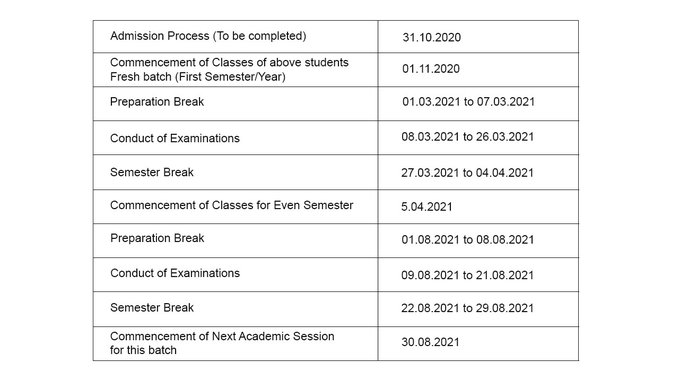
University Grants Commission, UGC has directed all the varsities to start the classes for the new sessions from November 1 onwards, as per the revised academic calendar approved by UGC on Monday. The first-year classes for undergraduate and postgraduate courses can begin in November. The varsities have been asked to wrap up the admission schedule by October 30.

Union Education Minister, Dr Ramesh Pokhriyal Nishank took to his official Twitter handle and made the important announcement. In his tweet, Dr Ramesh Pokhriyal Nishank said, ‘In view of the COVID-19 pandemic, the Commission has accepted the Report of the Committee and approved the @ugc_india Guidelines on Academic Calendar for the First Year of Under-Graduate and Post-Graduate Students of the Universities for the Session 2020-21.’ He also shared the suggested UGC new academic calendar 2020.


According to the suggested calendar, the classes for first-year students oof UGC undergraduate courses and UGC postgraduate courses will start from November 1, 2020, and the exams will be held from March 8, 2021, to March 26, 2021. Earlier UGC had advised that the new academic session of 2020-2021 should begin in September. However, due to the rising number of COVID-19 cases in India, the UGC calendar has been revised. Here is a look at Dr Ramesh Pokhriyal Nishank’s Twitter and important dates of the suggested UGC new academic calendar 2020.

To avoid financial hardship being faced by the parents due to lockdown and related factors, a full refund of fees will be made on account of all cancellation of admissions/ migration of students, up to 30.11.2020, for this very session as a special case.#UGCGuidelines                                      — Dr. Ramesh Pokhriyal Nishank (@DrRPNishank) September 22, 2020

In a separate tweet, the minister also noted that to avoid financial burden being faced by parents due to lockdown and related factors, a full refund will be made on account of all cancellation of admissions/ migration of students, up to 30 November.

Meanwhile, the Supreme Court on Tuesday asked the Central Board of Secondary Education (CBSE) to declare the results of compartment exams as soon as possible and coordinate with the University Grants Commission (UGC) to enable around two lakh students passing out in these exams to apply in colleges in the current academic year.

Education and Knowledge; Indian youth needs both and also need to know the meaning between the two

Article by – Shishir Tripathi

Intern at Hariyali Foundation
In Collaboration with
Educational News

The basic life skills like speaking and writing are told to a kid by the parents and the school too so that the student should not get into any type of difficulty in Academics in future. Not all but only few kids get it wholly along with a blend of etiquettes, manners and healthy interpersonal skills.


Even at present not only teenagers and youngsters, some middle aged people too don’t really know whether they are really educated or not. Those who are just knowledgeable might be getting confused in these words. Let’s make it more clear and simple.

Knowledge is simply the process of acquiring facts and information through a teacher in a school or a tuition teacher and learning skills along with the information written in books. By Going to a school a kid can become a knowledgeable person in future but he cannot become an educated man.

Oops, getting heavier and blur to understand! Let’s now remove the curtain from what does it mean by education and being educated.

Education is a wider concept; it’s like an enlightening experience in a person’s life. Some children are blessed to have parents and teachers too who educate them by telling them the basic values to be followed in life. The way how to talk an elder person, how to speak in such way that the elder person’s respect must not reduces, how to behave with friends and family socially, what to say to a boy or girl, why to share things, how to help the needy people how to understand someone else’s feelings, how to empathize with people and many more things are covered under this single word ‘education’

A person can be illiterate but he or she can be educated whereas a knowledgeable person, who is a post graduate from a reputed institute, doesn’t mean that he or she is educated in true sense. People from a very long time have been using the words knowledge and education together but there’s a big hidden difference in both of these words.
In these evolving times, human values and etiquettes are actually lost somewhere in between the figures showing growth, GDP, profits, revenue, etc. Children, when they grow up, mistreat their parents and elders and send them to old aged homes. A brother kills the other brother just because of a piece of land or some countable notes. A student misbehaves with a teacher who implants all the knowledge and facts in his brain. A boy speaks ill words to a girl and throws acid on her face to destroy her beauty who simply just not accepted his proposal. A group of young lads troubles the old man who carries his household stuff purchased from his limited pension. A person steals a scooter standing with a key in market. A son who not at all replies to his parent’s questions. A daughter who thinks her mother is so old fashioned to be taken to a party nearby.

Actually, the basic problem is how the child grows up. What is being told him, what is the environment he encounters, when he is appreciated, for what he is appreciated and a lot more incidents and people shape a person into a well developed human being with good etiquettes, habits and hence good demeanor.

Therefore, it is equally important for the parents, schools and people who are around a child.

Getting him learn how to respect others, how to appreciate others, how to talk to people, how to behave in public is all that is needed for a better world with good sensible souls. If parents and people ignore the importance of inculcation of good habits in the children, then not only the children’s’ life get hampered but an individual raised differently will also became for the society and his family too.


That is why it was rightly mentioned on a page named ‘kalam_se_kaleje_tak’ on Instagram that –
“You can be very knowledgeable but that doesn’t mean you are educated in true sense”.

SCHOOLS REOPEN from today, state wise status

After a long gap of 6months due to the coronavirus pandemic, schools of some states have decided to reopen the gate of the educational institution for students of classes 9-12, on a voluntary basis . All the guidelines provided by the government for unlock 4 will be followed in the process.


The union home ministry has a set of rules for schools to follow when reopen. Students and teachers residing in containment zones are not permitted to attend schools. Only 50% of the teaching and non-teaching staff are allowed to operate, while students only from classes 9 to 12 can attend, on voluntary basis. Students who would attend have to get a permission slip signed by their parents or guardians. Schools that decide to reopen will have to continue online classes for students that stay at home.


It is mandatory for Schools which are reopening to have thermal scanners at the entrance, so that students, teachers and other staff can enter only after temperature checks. Schools have been advised to operate separate gates for entry and exit, although it is not compulsory. Most importantly, everyone entering the school premises have to wear face masks, and sanitise their hands or wash them following the 20-second rule on a regular basis.

Here is the state wise status of school reopening :

Andhra Pradesh
Schools in Andhra Pradesh for classes from 9th standard to Intermediate second year are likely to reopen from September 21. Schools, colleges, educational and coaching institutions will continue to remain shut for students and regular class activity up to September 30.


Assam
The Assam government on Wednesday issued the SoPs for reopening of schools and colleges in the state from September 21, adhering to Covid-19 protocols. After six months from the date of closure of schools due to the pandemic, the state secondary education department has notified the SOPs for reopening of educational institutions in Assam from classes 9 to 12.


Bihar
Schools in the city are making all arrangements to ensure safety of students as the Centre has allowed partial resumption of activities for students of classes 9 to 12 from September 21 as part of Unlock 4.0.


Chandigarh
Class 9 to 12 students are allowed at schools from today on a voluntary basis, for taking guidance from teachers.


Goa
Most stakeholders in the field of education on Thursday said that Classes IX-XII could begin from September 21, even as they expressed concern over ferrying students via Bal Raths and addressed parents’ apprehensions about schools resuming during the height of the Covid-19 pandemic.


Haryana
Students of classes 9 to 12 will be allowed to visit their schools from September 21 in Haryana on a voluntary basis for academic help.


Himachal Pradesh
Schools reopen in the state after the Govt allowed students of Class 9 to 12 to visit schools from September 21 on a voluntary basis, for taking guidance from teachers.


Jharkhand
There is no clarity yet. Government is still to take a call. Although education department had drafted a proposal for staggered opening from September 21, but it was not approved by state government. Any decision on it will be taken only after month end


Karnataka
The Department of Public Instruction issued the order on Saturday. It is in the view of the Union Government’s order permitting students from classes nine to 12 to visit schools to meet teachers and get their doubts cleared. However, the state government issued an order on Saturday saying that students here won’t be permitted to visit school and PU college campuses till September end or further orders which will be issued after reviewing the developing situation.


Meghalaya
Education minister Lahkmen Rymbui on Friday said that the schools in Meghalaya which are shut for six months due to the Covid-19 pandemic will partially reopen from next week for students to meet teachers to clarify their doubts. The schools will be open for students of class 9 to 12 to meet teachers to clear their doubts but there will be no regular classes and no classroom session, he added.


Although states like, Uttar Pradesh, West Bengal, Gujarat, Kerala, Odisha, Uttarakhand, and Tamil Nadu, will not reopen schools from 21st September.

Kerela and Gujarat are not willing to rush into opening schools.
Odisha chief minister Naveen Patnaik has declared closure of schools till durga puja.
Uttar Pradesh and Uttarakhand in both the states schools will not reopen as the states saw a surge of COVID-19 cases.
Tamil Nadu has decided to reopen schools only when the coronavirus outbreak will be brought under control.
West Bengal schools are closed till 30th September, after which the Chief Minister Mamta Banerjee will make a decision.

The pressure of being extraordinary and it’s affect.

3 idiot was not only an iconic movie on a very good content but it has many dialogue that hit or felt by everyone. And one of the most famous dialogue goes “Life is a race, agar tezz nhi bhago ge to koi kuchal ke aage chala jayega”. Let’s talk about that.

I want to be a very a good writer, singer, actor, or anything else. We use to say this when we were a kid, yeah! we were a kid. Because now it’s not like ” I want to be very good” it is like, I want to be the only good. And that perfectly explain,we are now grown up. There’s nothing bad in it, but, we lost that touch of goodness inside us.

No matter how good you do your work, there is someone who does better then you. Like there’s an axe for every tree. You can’t be the only one among the crowd. There will be someone better then you. And it is not like you Don’t know that, still you are not able to accept that. That’s the main problem. And you are a part of this society. What you think is what this society get build.

Becoming an extraordinary among ordinary. This is the final goal of every single one. But, you know what, you personally never dreamed of this. It is what society gives you. It is what only society praise. This is what happens when you live in a society which sucks.

Being an excellent version in your field is not wrong, but, asking every one to be that is. We all know that every human has a same ear, eyes , brain, and other body parts. Still, there are some who are born or living there live without them. Same way it is not right to ask two brain to perform in the same manner because they can’t.

Just like asking elephant to swim because a fish can. We live in a society which runs behind those things which is already done and try to improvise it every time. Like a sheep in a crowd and still hate to call themself a sheep.

If only a person get appreciated for there work without comparing from others. Then this society will improve. When there is a comparison in self rather then doing it with others. Then only this society is going to improvise. Actually this society want to be perfect society. And there can’t be any perfection if you can’t accept the flaws. Because flaws are part of you. They exist in you.

So, tell me what do you think about this in the comment section bellow.

See yaa..

Courses and Career: Peaking Into Some Lesser Explored Ones

Selecting a future line of study and eventually profession can sometimes become a bit stressful. Or bland. If not many options are known. We all, at some point of time, have dreamt of doing something unique, or tread on, as Robert Frost’s poem title beautifully captures, ‘The Road Not Taken’. Hence, you are being presented with a collection of courses of scientific discipline, which is not mainstream, yet.

  • Ethical Hacking: Wait a second before judging this profession! It is hacking, yes, but for a good cause. Ethical hacking, also known as penetration testing, is used to test the security and susceptibility of an organization’s network to a breach. This usually results in data theft, identity thefts and other cyber crimes. So, the job of an ethical hacker is to identify and possibly, help to rectify the more weak openings in a network. Though, this course can be more unambiguously classified under IT, but in recent times, the subject has carved its own niche in the market, with an ever increasing demand. Ethical hacking courses usually also include other forms of security to impart an holistic understanding of IT security.
  • Geology: One common misconception about this branch of science is that this deals only with rocks. But in reality, it does not! Geology aims to provide a more in depth understanding about the physical and structural development of Earth. It inter relates various disciplines of science in relation to Earth. Geology also encompasses the study of materials and components making up the Earth, including living organisms. It is a lesser known fact, but geology is a vast and diverse study, overlapping with various scientific disciplines. Hence, the geologists have no dearth of options to consider while embarking on a professional journey.
  • Urban planning: Unplanned expansion of a settlement leads to many short and long term issues. And in today’s world, space crunch is a very real problem. So large scale developments need to be planned to have optimum utility and also not cause much harm to the surrounding environment. Here comes in the job of urban planner. The individual might be responsible for things like sustainable designing, good connectivity with other locations, optimum structures with respect to geographical location and climatic conditions, land use planning etc. 
  • Astrobiology: Sounds interesting, right? And it is! Astrobiology deals with the study of the scope of extraterrestrial life in the Universe. The study includes origin, evolution, distribution and future possibility of life across the unending stretch of cosmos. Astrobiologists, alongside other individuals from disciplines like astroecology, astrogeology and biochemistry, analyze these possibilities based on whatever knowledge is obtained about other planets and planetary systems.
  • Pisciculture: India, with an abundance of water bodies, also has a large population of fish consumers. And, obviously with growing demand, sometimes it’s hard to keep up with a constant supply. Hence like the Green Revolution, Blue Revolution happened too in India. It aimed at the development of the aquatic industry, for various purposes. Pisciculture, also known as fish farming, focuses mainly at rearing and breeding fishes in an economic manner, usually as a source of food. Optimum use of water bodies (usually fish tanks or enclosures) is also an important aspect, so that maximum cultivation can be done at minimum permissible limits.