Journalism and Politics

 The relationship between journalism and politics is intricate and significant, with each having a profound impact on the other.


  1. Information Dissemination: Journalism plays a vital role in informing the public about political events, policies, and decisions. It serves as a bridge between the government and the people by providing accurate and timely information.

  2. Watchdog Function: Journalists act as watchdogs, holding political leaders and institutions accountable. Investigative journalism uncovers corruption, malpractice, and misuse of power, fostering transparency and accountability in governance.

  3. Shaping Public Opinion: Media coverage can influence public opinion on political matters. The way news is framed, presented, and emphasized can sway public perceptions of politicians, policies, and current events.

  4. Access to Information: Journalists rely on access to information from political sources to report accurately. Governments and politicians control the flow of information, and conflicts often arise over transparency and the right to access certain information.

  5. Media Bias and Objectivity: Political biases can influence media coverage. Some outlets may have inherent biases based on their ownership, funding sources, or political affiliations, impacting the objectivity of their reporting.

  6. Press Freedom: The relationship between journalism and politics can be contentious in regions where press freedom is restricted. Governments may attempt to control or censor the media, suppressing critical reporting and limiting journalistic freedoms.

  7. Political Communication: Politicians use media outlets to communicate their agendas, policies, and messages to the public. They often engage in media strategies to shape their public image and gain support.

  8. Ethical Considerations: Journalistic ethics come into play when reporting on political matters. Issues such as accuracy, fairness, and the balance between public interest and privacy need to be carefully navigated.

The dynamics between journalism and politics are complex, with both playing pivotal roles in shaping societies. A free and responsible press is essential for democracy, as it ensures an informed citizenry capable of making well-informed decisions and holding leaders accountable. However, the relationship can also be fraught with challenges, including issues of bias, manipulation, and the struggle for control over information dissemination.

Media and entertainment industry to make a matchless mark

 Union Minister of Commerce and Industry, Textiles and Consumer Affairs, Food and Public Distribution, Shri Piyush Goyal said that the media and entertainment industry will make a mark that will be matchless in the Amrit Kaal poised to be the defining moments for India. During his address at the FICCI Frames 2023, the Minister lauded the industry for its commitment to take Indian cinema on the global map.

The Minister said that the government under the visionary leadership of the Prime Minister, Shri Narendra Modi is supportive to all the efforts by the media and entertainment industry to expand the frontiers of the sector globally and reach the remotest corners of the world. Shri Goyal said that the media and entertainment industry can disseminate the message to the world that India is on the pathway to become a developed nation by 2047. He also said that India as the fastest growing economy of the world along with an unparalleled talent and skill base at a very competitive price offers unmatched opportunities for economic development and business growth to the world.

The Minister appreciated the industry for efficiently adopting modern technologies and cited the example of widespread use of smartphones as cameras. Shri Goyal said that the media and entertainment industry will grow by leaps and bounds with the emergence of digital platforms. Shri Piyush Goyal lauded the Indian VFX companies involved in Hollywood movies like Avatar. He said that startups are contributing to the growth of this sector significantly.

The Minister noted that the media and entertainment industry can showcase to the world, the New India of today and boost the economy, helping the country reach a new audience, influencing opinions, and spreading positivity. He said that this positivity encourages people, government and businesses to be more aspirational and look at the future with greater hope demanding better lifestyles and better business opportunities.

Shri Goyal said that the media and entertainment industry are the cultural ambassadors of India and have given a unique identity to India. He highlighted that the media and entertainment industry has a huge potential to connect people, businesses and nations leading to a better understanding and appreciation of different cultures and conditions across the world.

The Minister said that the world is also appreciating Indian art and culture and the recent Oscar Awards for the ‘Naatu-Naatu’ song and the ‘Elephant Whisperers’ showcase this global appreciation. Shri Goyal said that these Awards helped India convey a social message that sustainability is at the core of Indian culture and tradition. He said that the message of Naari Shakti was also effectively conveyed as the Awards highlighted that Indian women of substance are defining the New India. Shri Goyal said that these achievements are boosting the morale of billions of people.

Shri Piyush Goyal noted that the theme ‘inspire, innovate and immerse’, is relevant to the current times as it reflects the vibrancy demonstrated by the media and entertainment industry. He said that the theme also resonates with the belief that creativity can indeed enhance commerce. He said that the industry acts as a key pillar of India’s cultural identity and cultural heritage. The Minister noted that FICCI Frames has now become an established platform in the media and entertainment sector showcasing to the world what India truly represents.

The Minister said that every artist can dream and every dreamer can succeed in New India and urged the media and entertainment industry to build an industry which entertains, empowers, enlightens and inspires the whole nation, in this journey of progress and prosperity.

***

Journalism And Its Benefits


What is journalism?


The practice of journalism requires collecting, researching,
synthesizing, and presenting news and information. Additionally, it is a
byproduct of these actions.

Certain distinguishable traits and practices make journalism
distinct from other pursuits and outcomes. These characteristics not only set
journalism apart from other types of communication, but also make it essential
in democracies. History demonstrates that a society tends to have more news and
information the more democratic it is.


Benefits of Journalism


1.   You may
get to travel

Since it’s difficult to cover news globally,
However, working as a sports or entertainment journalist occasionally allows
you to travel extensively.


While exploring and moving around, you can talk
about current events. Who doesn’t enjoy travelling, right? This, in my opinion,
is one of the greatest advantages of journalism
.


2.   You can
meet different people


No matter what profession you are in, exposure
is crucial for your personal development. When you work in journalism, you are
exposed to many different things, which aids in your recognition.


 Meeting all of those folks enables you to make
some really great friends as well as realize how relative life is and how our
way of life back home is merely one of many other lives that people celebrate
across the world.


3.   You can
share your ideas


The
capacity to further your opinions and convictions is another benefit of working
as a journalist. In general, you can publish anything you want as long as it
abides by local laws, especially if you’re a freelance journalist who doesn’t
work for a media company. 
As a
result, if you see something you disagree with, you could become more conscious
of it and thereby feel better.


4.   You can
cover a variety of genres


In
general, journalism offers you a wide range of topics on which to write. You
can never learn everything because there are so many new things introduced
every day.

As a
result, you won’t eve
r run out of topics to write about, and you’ll have the
freedom to focus on the subjects you think will be most important to and
interesting to your readers.

The field
of journalism is not standardized. In fact, you will pick up fresh information
every day because you will be speaking with a range of people.


5.   You will
never find it boring

If you work as a newscaster, you won’t become
bored. They have a wide range of jobs and frequently interact with different
people, so I’m confident they’ll always have topics of conversation.


Additionally, you typically work in unfamiliar
environments and face problems every day. Journalism is one of the never-ending
careers as a result, so if you’re curious and want to be surprised, being a
journalism specialist can be the best choice for you.


6.   You can
create your new comfort zone


A great way to step outside of your comfort zone
is to become a journalist. Because we humans are generally afraid of making a
mistake, we tend to want to stay in our comfort zone and refrain from trying
too many new things
.


This might be exceedingly limiting, though, as
character development occurs solely as a result of new experiences. In
journalism, you must be willing to speak with people you otherwise would not
have. Throughout your work, you’ll also discover some unexpected items.

Media as the Fourth Pillar of Democracy

 Media as the Fourth Pillar of Democracy

As the largest democracy, India is considered a role model for a large number of developing countries. We have state and central governments elected by the people. We have a government run by our own elected representatives, known as Members of Legislative Assembly (MLAs) in the state and Members of Parliament (MPs) at the center. The democratic government has three pillars:

a) A Legislature: State Assemblies and Parliament, responsible for framing laws and deciding the way we run our affairs.

b) An Executive: The Governor, the Chief Minister, and the Ministers who run the state and the President, Prime Minister, and the Council of Ministers who run the country.

c) A Judiciary: The Supreme Court, High Courts, and other courts decide whether laws and constitutional provisions are followed by the elected governments.

The fourth pillar of Democracy:

Media work to provide information about what is happening in our surroundings. Media keep an eye on everything happening in the nation and it is the fastest way to know about current happening and other relevant information. Media is considered the fourth pillar of democracy. It plays an important role as play by the legislature, executive, and judiciary in the functioning of a democratic country. As these three pillars run the government of the country for the welfare and development of all the people, the media also work for the same.

 In a democracy, the people should know what the three institutions, namely the Legislature, the Executive, and the Judiciary are doing for the welfare of the people. These institutions in turn need to know how the people are reacting to what they are doing. This can be only possible through the media because media is the easiest way to disseminate information quickly and easily across the country.

The government can’t spread the information about the decision they made or new policies they made, to individual people of the country. And it is also not possible for the citizens of the country to keep an eye on every decision-making of government. So, the media is the only way to connect both. The main role of the media is to act as a bridge between the people and the government.

Media can spread the information about government through TV news, newspaper, website, or social media platform, which help people to get in touch with what is happening in the administration. In the same way, the government can know about the needs, demands, thoughts, and problems of people. This helps them to work for the betterment of the nation. Media also work to expose corruption and raise social issues. Thus, the media play a great role in the functioning of the country.

Post-traumatic Stress Disorder.

Post-traumatic stress disorder (PTSD) is an phychological disorder that a person can face who has experienced or witnessed a traumatic event such as a natural disaster, terrorist attack, war/combat, rape, or death, sexual violence or serious injury.

People with PTSD have intense and annoying thoughts and feelings associated with their experience that last long after the traumatic event is over. One may relive the event through flashbacks and nightmares. They may feel sad, afraid, or angry. And they may feel separated or alienated from others. People with PTSD can avoid situations and people that are reminiscent of traumatic events and have a strong negative reaction to mundane things such as loud noises and accidental contact.

According to reports in context to United States, about 3.6% of people about 5.2 million adults develop PTSD in time of last year , and an estimated 7.8 million Americans will develop Women are more likely to develop PTSD than men. This may be because their are high chances that women are more likely to be victims of domestic violence, abuse and rape.

Symptoms:
• Intrusive thought: Intrusive thoughts such as repeated involuntary reminders. A miserable dream; or a flashback of a traumatic event. Flashbacks are so vivid that people feel like they are remembering or seeing the traumatic experience in front of them.
• Avoidance: Avoiding the memory of traumatic events may include avoiding people, places, activities, objects, and situations that can cause disastrous memory. People may try not to remember or think about traumatic events. They may resist talking about what happened and how it makes them feel.
• Mood changes and Behaviour : Negative thoughts and feelings that lead to persistent and distorted beliefs about oneself and others, such as not being able to remember important aspects of traumatic events. Distorted thoughts about the cause or effect of an event can lead to false accusations of yourself or others. Persistent fear, fear, anger, guilt, or shame. There is much less interest in the activities that I enjoyed before. Feeling alienated or alienated from others; or unable to experience positive emotions (lack of happiness or satisfaction).

Treatment:
It is important to note that not everyone who experiences trauma develops PTSD, and not everyone who develops PTSD requires psychiatric treatment. For some people, the symptoms of PTSD disappear over time. Others are better with the help of their support system (family, friends,etc) . However, many people with PTSD need specialized medical treatment to help recover from psychological stress. It is important to remember that trauma which causes the PTSD can lead to serious distress. The sooner a person is treated, the more likely one can recover fast from PTSD.
Psychiatrists and other mental health professionals use several effective ( authorized and proven) methods to help people recover from PTSD. Both talk therapy and medical dosage provide effective evidence-based treatment for PTSD.

What You Should Know About Media Consolidation

As consumers of various media, have you ever questioned who owns most of the media you come across? With some quick research, you will be able to learn that a lot of the media companies you know belong to the same group of media owners. This phenomenon of media companies falling into the control of fewer individuals and organizations is known as Media Consolidation. We also call it Media Conglomeration or Concentration of Media Ownership. Comcast, The Walt Disney Company, AT&T, and Paramount Pictures are the largest media conglomerates in the world today.

The media industry can be a monopolistic or oligopolistic structure. If it is a monopoly, a single firm dominates a particular industry. Microsoft had an antitrust suit filed against it in 1998, accusing it of monopolistic practices that made it very difficult for users to uninstall Internet Explorer and use any other browser on their computer, monopolizing the personal computer market. Google has also faced lawsuits against its monopoly over all other search engines. Oligopoly, on the other hand, refers to a few firms dominating an industry. When a few firms control the media industry with large-scale companies getting rid of competitors by buying or forcing them out, it is known as media oligopoly. In such an industry structure, a lot of mergers occur. When a media company buys out another company for control of their resources to increase revenue and viewership, it is a media merger.

Many consider the increasing media consolidation to be a threat to media pluralism. As media ownership gets concentrated, it reduces the plurality of political, social and cultural points of view. A lot of these commercially-driven media care more about their advertisers than their viewers. Their focus tends to be on facilitating maximum profits than on public affairs or true journalism. In a lot of cases, powerful corporations have a great influence on mainstream media. In fact, many multinational corporations own media outlets and stations. These media outlets can be greatly affected by various corporate interests. Large media houses also come under attack for their biased political views. Media companies may act biased towards particular political parties and it can affect the content they show the viewers. They may choose to omit or not cover stories and events that can offend their political views, advertisers or owners. This means that there are less diverse voices and opinions available in the media for the general public. The concentration of media ownership thus opposes the opportunity of citizens to make an informed decision and provides fewer opportunities for minorities and others to voice out their opinions.

The well-known American multinational company, Disney or The Walt Disney Company, is one of the largest conglomerates, owning numerous film studios (Walt Disney Pictures and Animation Studios, Pixar, Marvel Studios, Searchlight Pictures, 20th Century Studios), broadcasting networks (ABC Network, Disney Channel, ESPN, National Geographic, FX), streaming services (Disney+, Star+, ESPN+, Hotstar, Hulu), publishing, merchandising, music and theme parks.

In India, Zee Entertainment Enterprises is a large media conglomerate, operating 45 channels worldwide. Its subsidiaries include the film production and distribution studio, Zee Studios, the music label, Zee Music, the news and regional entertainment channel, Zee News, and a Spanish-language Bollywood film channel targeting Latin America, Zee Munda. The company merged with Sony Pictures Network India in September 2021, which itself is a subsidiary of the mass media conglomerate, Sony Pictures Entertainment.     


PORTRAYAL OF WOMEN IN INDIAN MEDIA

Media plays such a major role in the lives of human beings. Over the last decade, media has become a powerful tool that mirrors social life of commoners and celebrities. However, the role that media plays in portraying gender democracy is still a matter of debate. Media has a significant impact on how social and cultural norms relating to women form and evolve. Over the past couple of decades audiences have been exposed to women in strong and independent roles in the media. This propagates the sense that western modernity and increased presence of free market promotes gender equality in a India.

PORTRAYAL OF WOMEN IN DAILY SOAPS

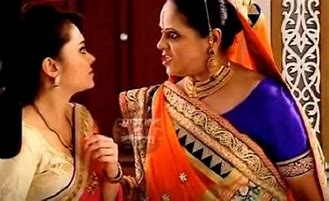
  • It does seem a little bizarre to see contemporary TV serials and soaps projecting women more as models of expensive costumes, jewellery or heavy sarees. 
  • Moreover, the stereotypes used such as a wronged wife, a dominating mother-in-law, bitter relationships between sister-in-laws, portray women in conflicting roles.
  •  Also, daily soaps fail to include all the career options that are now being taken up by Indian women, new modes of lifestyle being adopted and remain stuck up in certain deep-rooted notions that are hard to be erased.
Mother-in-laws are often portrayed as ill wishers of the daughter-in-laws

PORTRAYAL OF WOMEN IN ADVERTISEMENTS

PAST SCENARIOPRESENT SCENARIO
1. In the past, women were portrayed as subjects of mockery and were allotted with submissive roles in television commercials. 1. In the present scenario, women are often shown playing lead roles in television commercials.
2. Women were deliberately depicted subordinate to their male counterparts. 2. Males and females are equally portrayed in brand endorsements.
3. The looks of a women were made use of, to endorse a product. Hence, females were said to be openly objectified in advertisements. 3. Women are rarely seen doing stereotypical roles, instead they are shown as heads of a family, position holders at workplace, achievers of glory in sports and ultimately independent.
TVC IN THE PAST ‘Stereotypical role’
CURRENT TVC – ‘Portrayal of gender equality’

PORTRAYAL OF WOMEN IN MOVIES

  • Bollywood has shaped and expressed the changing scenarios of modern India.
  • It has influenced the way in which people perceive various aspects of the society. 
  •  Despite the progress that bollywood films have made and the, things haven not changed much for Indian women, as objectification of women still continues in most of the Indian movies.
  • In many movies of present times, female characters are needlessly under represented. Also, publisizing vulgar lyrics and dances in the name of item songs is very derogatory for women.
  •  Women are shown as helpless victims or cunning villains. Generally, the lead hero is the one who solves everyone’s including heroine’s problems.
  • Movies depict actresses as unrealistically beautiful. This causes a lot of trauma and insecurity in the female audience. Laymen are generally unaware about the number of beautification surgeries and make up procedures which the actresses undergo to look perfect.
  • In movies, stalking and eve-teasing is depicted as love in Indian movies. In many movies, female characters are attracted towards these abusers. Due to this, several young men indulge into harassing women in the name of love.
Stalking and eve teasing is often normalized in Bollywood movies

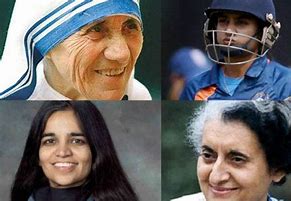
In conclusion, we can say that media has successfully stereotyped women in a negative way. It is true that women’s participation and presentation has advanced in various dimensions of social and political life but we still have a long way to go. It is high time that we learn to voice our disapproval against such practices and stand up for positive portrayals of women. The real women inspirations of India shall be depicted on all such platforms.

The admirable women of India

International news flow after the end of colonialism


The mass media are seen today as playing a key role in enhancing globalization, facilitating culture exchange and multiple flows of information and image between countries through international news broadcasts, television programming, new technologies, film and music. If before the 1990’s mainstream media systems in most countries of the world were relatively national in scope, since then most communication media have become increasingly global, extending their reach beyond the nation-state to conquer audiences worldwide.

International flows of information have been largely
assisted by the development of global capitalism, new technologies and the increasing commercialisation of global television, which has occurred as a consequence of the deregulation policies adopted by various countries in Europe and the US in order to permit the proliferation of cable and satellite channels. Globalization theorists have discussed how the cultural dimension of globalization has exercised a profound impact on the whole globalization process.

The rapid expansion of global communications in the 21st century can be traced back to the mechanical advancements of technologies during the course of the 18th and 19th centuries, which started mainly with the invention of the telegraph in 1837, and included the growth in postal services, cross-border telephone and radio communications and the creation of a modern mass circulation press in Europe. It was however the evolution of technologies capable of transmitting messages via electromagnetic waves that marked a turning point in advancing the globalization of
communications.

The emergence of international news agencies in the 19th century, such as Reuters, paved the way for the beginnings of a global system of codification. Nonetheless, it was not until the 1960’s, with the launch of the first geo-stationary communication satellites, that communication by electromagnetic transmission became fully global, thus
making the globalization of communications a distinctive phenomena of the 20th century.

Key theories in international communications grew out of international relation studies. The “modernization” or development” theory in the area of communication research
emerged in the Cold War context and were largely preoccupied with the ways in which the media could help transform traditional societies to include them into the capitalism orbit. Among the key theorists in this tradition was Wilbur Schramm with his sponsored UNESCO work, Mass Media and national development – the role of information in the developing countries.

The idea was that international communication media could be used
as a tool to transfer the political-economic model of the West to the growing independent societies of the South. Schramm’s views was that the mass media could be used by elites to
raise the ambitions of the populations in developing countries, who would cease to be narrow-minded and conformist and would be active in their own self-development. The dependency theories the 1960’s and 1970’s were perceived as an alternative approach grounded in neo-Marxism, and which adopted a theoretical framework that saw
capitalism and inequality as a key perspective in understanding the impact of power relations on global communications. According to the argument, transnational corporations based in the North engaged in a web of interdependency with the economies of the South, setting the terms of global trade, dominating markets, production and labour.

Dependency theorists and Latin American scholars argued that these economic relations worked within an exploitative dependency model that promoted American capitalist mentality in developing countries (Mattelart, 1979). Development was thus shaped in a way that benefitted largely the developed nations, maintaining the peripheral countries in a continuous position of dependence. Latin American scholars stressed that it was Western
media companies that were reaping the rewards of the modernization programmes, and that they were actually reaching out to the South in order to conquer new markets for their
products.

Globalization is thus seen as having consequences for the distribution of power and wealth both within and between countries. Cultural imperialism theories of the 1970’s and 1980’s highlighted how the media in developing countries imported foreign news, cultural and television genre formats (i.e. talk-shows, sitcoms) and also values of capitalist consumerism and individualism. The core critique of the imperialism thesis was that the
developing countries had established a relationship of subordination.

Written by : Ananya Kaushal

IT Rules: Indian Media Cheer Court Order

A few Indian media on Monday cheered a court arrange over the end of the week which put on hold a portion of modern rules looking for to direct substance on computerized news websites, calling the move critical for press opportunity in India. The Bombay Tall Court put on hold the execution of rules that advanced news media would got to compulsorily take after the code of conduct laid down by the Press Board of India, a self-regulating press guard dog, and the country’s cable TV code. The court ruled taking after petitions recorded by a news site and a writer.

It moreover put on hold a three-tier administrative structure for advanced news media counting an oversight instrument by the government government, a run the show which started concerns it would check the capacity of news outlets to report freely and was seen by numerous as portion of government endeavors to curb within the media.

The wide reach of the 2021 rules “bring around a chilling impact” on the flexibility of discourse and expression of the media, the court said, including that the rules moreover go past the scope of India’s Data Innovation Act. “The Bombay High Court arrange remaining the foremost upsetting portion of the government’s unused IT Rules as they apply to digital news media may be a shot within the arm for press flexibility,” said Siddharth Varadarajan, the establishing editor of free news site The Wire.

“The government was endeavoring to pressgang advanced news into an official straitjacket but the court has properly put a end to this process.” A last hearing within the case is planned for September 27.

India sketched out its unused substance directions – Middle person Rules and Computerized Media Morals Code – in February and the rules, which the government said are legitimately enforceable, got to be successful end-May. The rules – generally pointed at directing huge social media firms such as Facebook and Twitter, and for supervising computerized news media – have driven to a pontoon of lawful challenges counting from news organisations. The non-profit, which runs The Wire, has moreover challenged the unused rules within the Delhi Tall court and the case is due to be listened afterward this month.

The impact of Social Media Influencers on Sales

The way social media influencers directly or indirectly influence publicity and promotion somehow also influence the sales of a brand. Some of the ways in which social media influencers impact sales are:

1. Help in Consumer Research Phase:

Nowadays, market is mostly “consumer-oriented”. Consumers search and research, read reviews about a brand and hence they want someone trusted and experts who will voice their opinions, concerns and recommendations. Influencers play a vital role in spreading the word of mouth and recommendations thereby increasing sales.

2.Help in increasing Return on Investment:

Social Media Influencers help in achieving a relatively high Return on Investments than other factors. It is because of low capital investment. Other forms of advertisement or marketing tools require huge capital whereas dealings with Social media Influencer can be fixed just on a simple phone call.

3.Content Creation helps in increased Sales:

Influencers create meaningful and exciting content that sometimes evoke interest in the viewer to buy the product. Apart from this, Influencers also work on multiple social media accounts and this helps them to reach wide and diverse audience. This is also very helpful for increasing sales in a business.

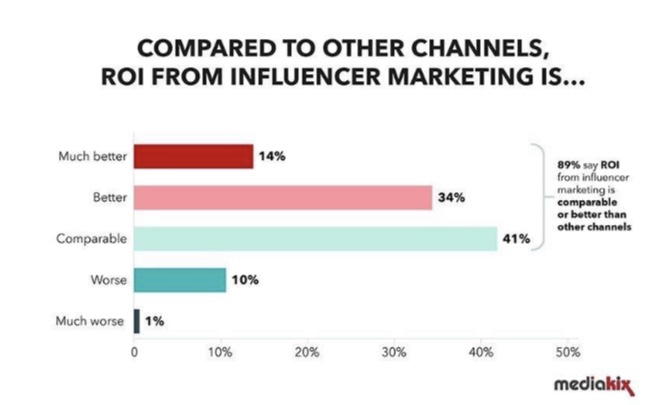
In a recent survey by Mediakix, a famous influencer marketing agency, about 89% of respondents say Return on Investment from Social Media Influencers is better than other channels.

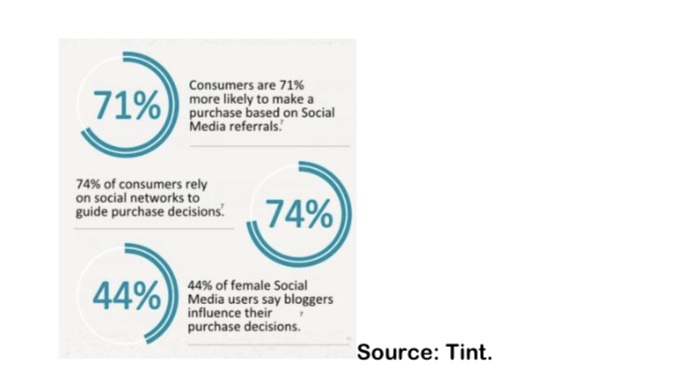
In another survey by Tint, 71% of respondents told that they rely on social media referrals for purchase decisions.

Some Examples:

1) Glossier, USA.

The USA based beauty brand has built its brand image by entirely relying on Social Media Influencers and other forms of digital marketing. They rely heavily on influencers as they send new products to influencers before the products are even launched so that influencers identify the flaws and suggest improvements (if they require) and thereafter the brand makes the changes accordingly.

2)Daniel Wellington, Sweden

This company was able to tap the “business opportunity” and it proved out to be quite fruitful for them. They broke into the Indian market by solely relying on Social Media Influencers. It is a watch brand company sends its new products to big social media influencers in India and enjoys extreme profits and sales. They were able to see India as a good market due to the country’s vast population.

Conclusion:

Social Media Influencer marketing or the Influencer marketing has become the fastest growing trend in communication in last few years. The key factors involved to be a good influencer are trust and credibility in the message. Latest studies and research have proved that social media influencers contribute to a business’s growth in a very positive manner in terms of promotion, publicity, sales and ROI. Many assume this marketing tool is temporary and will extinct in few years, however only time can say it.

RTI ACT and Investigative Journalism.

Just like citizens, the RTI act has enabled lot many journalists in the country to investigate regarding their concerned issues. RTI act over the years has become an important weapon for journalists to divulge hidden and lesser known information. RTI act has become so crucial and an “everyday thing” for some journalists that they have build their entire career out of it.

Some of the famous cases where RTI act has helped journalists in their investigation procedure are:

1) Chhatrapati Shivaji Memorial Project by journalist Mr. Vishwas Waghmode:

Mr. Waghmode, a journalist at the time in The Indian Express investigated the controversial Chhatrapati Shivaji Memorial project. According to him, the initial cost quoted by the contractor was Rs.3826 crores which was supposed to be the lowest bid as opposed to the government’s bid which was Rs.2500 crores. The government in order to resolve this issue set up a committee led by the chief secretary in order to renegotiate the cost which successfully got the cost down to the government’s estimate of Rs.2500 crores. Mr.Waghmode in connection with this case stated that the rules do not allow renegotiation but rather they are supposed to issue fresh tenders. He further added that the opposition was alleging the government had reduced the height of the statue in order to reduce the cost which the government vehemently denied.

In order to have the “genuine information”, he took the help of RTI act. Mr. Waghmode discovered and revealed how the government had in reality decreased the height of the statue and the horse by 7.5m. But in order to show that the height of the statue was not reduced, they had instead increased the height of the sword by 7.5m. He further revealed that since the sword was straight, the amount of money required to build the sword was quite less when compared to the reduction in height and that in turn helped them reduce the cost by a substantial amount.

RESULT:

When all of this came into the public eye, the State Government could not justify why the height of the sword was increased and was in deep shame.

2) HONORARY DOCTORATE SCAM by Shyamlal Yadav.

When we talk about investigative journalism in India, we can never ignore this name, that is, Shyamlal Yadav. In 2018, Mr. Shyamlal Yadav in The Indian Express published a series of investigative reports on how India has emerged as one of the biggest markets for “predatory” publishers of substandard research journals.


On February 6, 2018, The Indian Express scrutinised over 500 RTI applications filed over 470 higher educational institutions to find that monitoring authorities, and hundreds of politicians and bureaucrats were awarded such degrees between 1997 and 2017.

The list for instance included former director of IISC, who received 18 honorary doctorates from public universities between 2006 and 2012 when he was chairman of NAAC’s EC. The list also had several UGC chairmen who had such degrees during their tenure.


RESULT:
Rules were made by higher authorities in 2019 after the investigative report via RTI files whereby NAAC officials, family weren’t allowed to accept honorary doctorates from institutions under their watch. RTI was used to dig out crucial facts in this case.

3) Discontinuation of LIC policies by Shyamlal Yadav

Shyamlal Yadav got information through RTI from Life Insurance Corporation (LIC) that there were 59 million insurance policies those were lapsed permanently due to discontinuance of premium. And the premium deposited since then had become LIC property. Despite many efforts LIC did not provide the info on total money deposited against those policies till the date they lapsed. As a result, Indian Express published the story about the discontinuation.


RESULT:


Within 25 days of publication of the story, LIC issued fresh
advertisements regarding renewal of policies.

4) Streams of Filth by Shyamlal Yadav:

This was an investigation by Shyamlal Yadav regarding water pollution in India that took over one year. About 39 RTI applications regarding expenses by Government on water projects were filed.
It came into notice that large amount of money was spent by Government for water purification projects but there was little effect on nation’s lifelines.
The story was published in The Indian Express and was selected by UNESCO as one of the 20 best Investigative pieces in the world.


RESULT:
Central Pollution Control Board said the rivers of India are not just polluted but severely toxic.

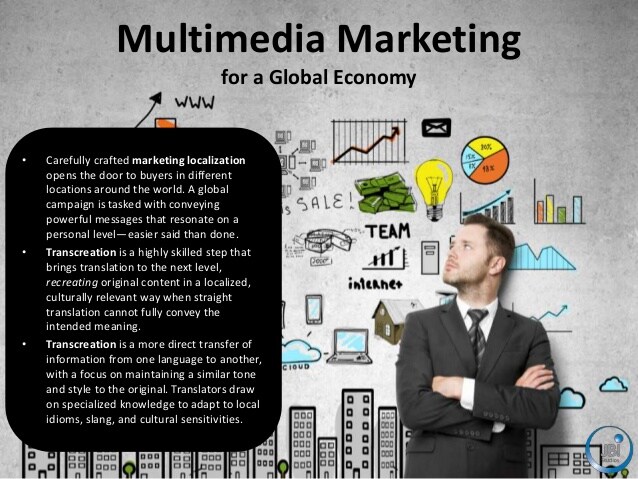
MULTIMIDEA IN MARKRETING

Services | Enforcer Web Solutions & Multimedia Marketing

Advertising has become very prevalent in our daily lives , so for a product to stand apart , it is very essential to present it in a dynamic , visually stimulating manner to grab the attention of consumers . The business world is slowly rejecting run of the mill tradition methods (such as placing ads in yellow pages , distributing pamphlets , etc.) and adopting solutions from the electronic era . Only companies with a nerve to radically change their marketing strategies for the new millennium will survive and be able to cater to ever- changing customer’s mindset . Applications of multimedia in the marketing field include the following :

  • Presentations for launching the products of a company . Reaching the target audience with necessary technical services or products requires clear communication stating the benefits and features , outlining its applications and any other product -related details , all presented in a well- designed and interactive manner so that the users can be familiarized faster . Multimedia presentations helps in motivating , informing and captivating audiences via PCs , laptops , plasma screens or kiosks delivered via CD-ROM or the Internet .
  • Multimedia is used to create interactive product catalogues , training tutorials , buyer guides and information directories with adequate search and navigation facilities to guide the user to easily trace the desired information . A buyer guide can list the nearly dealers , a comparison of the top brands , maps of the city and other helpful guest services .
  • E-mail advertising or placing banner ads on the internet is an extremely cost -effective method of launching a product , promoting an event or selling services . Effective use of multimedia in advertising can make potential clients sit up and make notice .
  • Multimedia applications help in building brand loyalty as well as improving sales .Brand loyalty will be improved as the users are provided a custom application which entertains ; informs or assists them .
  • Graphical elements , animations , as well as audio and video can be used to more effectively deliver sales instructional or marketing messages , thereby differentiating a firm from its competitors .

World Sports Journalist Day: a tribute to those who make Sports beautiful!

Sports be it soccer, cricket or baseball or any other has some or the other time played a role in some of our lives. But sometimes we just overlook those who make our sports look more spicy and enthusiastic before us.

Significance:

In 1994, International Sports Press Association established July 2 as “World Sports Journalist Day” as the organisation was found on July 2, 1924 and this was an effort made to honour sports journalists all over the world.

Sports Journalists do a lot of work before, dyeing and after sports matches, all of which are often overlooked. They’ve always played an integral part in transferring the information pertaining to sports to their ever loving audiences.

History of Sports Journalism.

Sports Journalism started in early 1800s when sports was beginning to get itself presented as a separate section in Western Newspapers. In early 1800s only elites could afford newspapers and as a result information relating to sports were restricted to horse riding or boxing , that is, the sports that were typically meant for elites.

In 20th century, New York Herald and New York World were two of the world’s first newspapers to cover sports journalism separately and have a complete full time sports department.

Slowly, the need and love for sports started to increase among the masses and that is why there was the demand for all together separate sports channels in television like ESPN and sports magazines like Sports Illustrated.

Digital Era and Sports Journalism.

Online Sports Journalism started when ESPN created its first ever sports website in the world in 1995. During initial years, only broad topics relating to sports were covered in Digital Sports but as internet expanded all over the world, many big and small bloggers, internet channels, web portals began covering all single and minutest topics relating to sports.

A majority of big and small websites are completely dedicated to sports and they also at times charge subscription fee from their readers. Search Engines like Google or Bing also provide information relating to sports during those days which are important for a particular sport.

Issues faced by Sports Journalists.

1) Deadline Pressures:

Sports journalists face deadline pressures than any other beat reporters as sports matches generally happen in late noon or in the evening and as a result reporters who’re covering sports or writers who’re into sports have to manage completion of work in shortest time possible.

2) Political Pressures

There has been an interlinking of sports and politics in the past. And if this is so, how can the media be kept away? Sports Journalists face lots of threats by certain sports associations that expect the journalists to cover sport matches in their own way and they also expect journalists to shape the public opinion.

3) Accusations of low objectivity:

Sports Journalists have also been accused of favouring or promoting their own favourite teams or players in the past. Some have also been accused of giving more preference to their home teams and this is one more challenge they face in the sports world.

In any way, Sports Journalists do a lot for their audiences to make the sport matches more interesting and entertainment their viewers or readers throughout and even after the matches. It’s important for us to celebrate them and honour them genuinely.

Construction of a Conscious Youth & Society

Article by – Shishir Tripathi
Intern at Hariyali Foundation
In collaboration with
Educational News

In the present times where unnecessary issues are given extra weightage or extra attention by social media houses and the news channels, it has become so important for the youth, for the country men to open up their eyes and start discussing and focusing upon the Vital issues.

Now, what are these vital issues? Some learned people will argue that vital issues for different people are altogether different so the person writing such an article can affix some vital issues for the entire society. This article should be read upon as a piece of informative writing that will be helpful for the nation, for the economy and for the society.

At present, after the slowdown that lasted in the economy in the last quarter of the year 2019 and in the starting of 2020, the economy has really survived a lot. And as the economy was ready to get up and move upon with sane speed as earlier, Corona virus came into the scene and turned the situation even more pathetic. The Nationwide lockdown that happened in the country for slowing down the speed of the virus, turned to be an evil for the employment of daily-wage workers. Workers and laborers are thrown out of the job and due to no work; the unemployed population of the nation is falling into the dark ocean of Depression and Anxiety.

On July 1, 2020, the Railway Ministry announced that 151 trains in 109 pairs of routes will be operated by private sectors. The vital issues like privatization of Indian Railways are needed to be discussed by the youth and the government should be asked by the youth that what are the motives and the vision of the government behind this privatization.

In the monsoon session of the parliament, there was no question hour in the parliament. Question Hour is the first hour of a sitting session of India’s Lok Sabha devoted to questions that Members of Parliament raise about any aspect of administrative activity. The concerned Minister is obliged to answer to the Parliament, either orally or in writing, depending on the type of question raised. Now there will be no one to question the government in its proceedings and actions. It’s like a free hand to government to o anything, anytime without anyone to question it.

The Corona patients are worst hit during these days. The hospitals are not admitting the new patients by arguing the unavailability of beds or ventilators. The middle and lower middle class has to run from one hospital to other but nobody cares because the politicians and the rich people are sitting in their air conditioned cars and offices. Who cares?

Same goes for the fourth pillar of the democracy, the Media. At present, almost 90% of the News channels are focusing upon their TRPs by showing news on unnecessary topics and silly rhyming news. It’s like a brain wash of the people that the media is doing by showing such pathetic news, that too one sided. The news channels and media houses never get tired of praising the governments in power and always news that is in the right of the ruling party. It, like the news has become so toxic to hear that even some people are planning to close their TV sets jut because of the disgusting and useless news debates and all the noise that occurs on the News channels.

No one is at present talking about the issues discussed above. Whether people have started fearing that discussing such issues will make them unwanted by the so called ideal society at present.

Hence, it is an alarming situation for the Indian youth and get up and hold the command of the Nation so that the basic essence of India should not get lost just in the name of advancements and important(in actually silly and unimportant) news. It’s the time to save the nation and the natural heritage too. It’s the time to save India from being psychologically enslaved, politically subjugated and culturally disarmed.

Healthy politics is needed to be played by the leaders so that they can build a new India even stronger with stronger beliefs and ethics.
It’s the time to wake up India and stand for the rights of the nation and the rights of the society.

WHAT IS INDIAN MEDIA DOING?

The purpose of media in a nation is to provide information and knowledge to the people of the country. Media is regarded to be the most reliable means of information for the masses. There is no uncertainty about it that media plays an essential part in broadcasting information and facts, it keeps us informed regarding the happening across the world. The media acts as a link within the residents and the administration of the nation act as a third eye to the government, it draws clarity between the people and the state. News media is the fourth pillar of the democracy, be it a print media or television/ radio its main objective is to spread information with unbiased news without any modification or restriction, because people believe what they know, see and hear from these media platforms and manage to develop views and beliefs based on the data they are perceiving.


Indian media has been known for its reliable and substantial influence on the social, economical and political aspects of the country. In recent years the practice of funded news and increase in TRP has destroyed the faith across the media drastically, and because of this, the biggest victim turns out to be the Indian constitutionalism. The system of exerting money and supports from the corporate houses, politicians, administration, and big organizations, so that the media could show beneficial news concerning them has become a general practice in the press and is ruining the integrity of a journalist. Even if some of the media organizations or reporters want to present the right information to the people, they are always shut by the warning or threatening calls .


From the past two months where Indian TV channels mainly national ones have developed a fascination for one particular section of news – the demise of Bollywood star Sushant Singh Rajput. No matter however trivial or impossible, the Indian news media has left no stone unturned while broadcasting on Rajput’s death while there is other news like continuous rapes in Uttar Pradesh, the aftermath of floods in Assam, Ladakh issues, etc.


Most of the TV-news channels undividedly feed the desires of their political leaders and build the narratives to promote their political publicity. Paid news is dropping moral norms of journalism and day by day, the trust of the people on media platforms is disintegrating. The news commentators sitting on the ease of their AC studios and involving in undesirable discourse upon particular splinter group are accused of the current position of crisis in the nation. The Indian media now bears a severe crisis of reliability. If it does not improve itself, it will find its greatest asset going quickly depreciated and ultimately disappearing. Stripped of authenticity, sincerity, and trustworthiness, the media will desist to value to huge numbers of people lacking as a source of shoddy entertainment. Its high time now and we should stop this inconsistency before it causes more damage to the nation. Simply debar these news channels as we don’t need the help of news channels for biased opinions.