Every student wants to join a dream college or university.
After schooling, we desire to join a top college or university for the security of our feature
Is a college the same thing as a university? What does “liberal arts” mean? Why are some colleges called public and others private? Here are the basics of the types of colleges.
Let me know about NIT AGARTALA
Institute is committed to developing highly competent young Engineers, Scientists, and Management Professionals to cater to the ever-increasing techno-managerial needs of national and international standards fulfilling professional ethics and societal commitment.
MISSIONS
• To produce techno-managerial human resources in line with global needs, offering a state-of-the-art facility, research, and engineering and allied disciplines.
• To enhance the effectiveness of technical education with innovative systems and devising a mechanism to facilitate the application of research findings to solve real problems of industries/academics.
• To nurture and sustain an academic ambience conducive to the development of intellectually capable and committed professionals so that effective growth is obtained for the region’s economic development and the nation as a whole.
• To establish as the corridor of higher education for the South East Asian countries.
EDUCATION SYSTEM
Presently the Institute offers eight UG courses and PG courses in several fields along with Post Doctoral Fellowships. This Institute is autonomous under NIT being act passed by the parliament.
The Institute recently introduced a new curriculum in IITs where more elective subjects are being offered to make the system flexible. Previously, the Institute used to follow the mark based system of evaluation, but have been switching over to a credit-based system to keep track of the global evaluation methods. Industrial training, Undertaking projects are parts of the education system and students are also encouraged to take various activities for social development through NSS and NCC.
Initiatives
The Institute recently has been converted from State Engineering College to National Institute of Technology. The total seats have been increased from 250 to 420 for the academic session 2007-2008. Recently three Under Graduate courses has been introduced in Electrical & Electronics Engineering, Transportation Engineering and Production Engineering. The Civil Engineering Department will start a PG programme in Structural Engineering to fulfil the requirement of the State. The nonresidential campus is to be made residential with the reopening of two boys hostels and one girl’s hostel for the students admitted for the session 2007-2008. A master plan is under preparation for 335 acres of land where a new campus will be built with modern facilities for the overall requirement of the Institute. The Institute is getting a 33 VK dedicated power supply through Tripura State Electricity Corporation Limited for uninterrupted power supply in the campus. The R. D. Department of Govt. of Tripura took total renovation work of the existing buildings after conversion to NIT. The Institute has also obtained a grant of 12 crore rupees from DoNER for the development of infrastructures like the extension of the Library Building, an extension of the Academic Building, the Centralized Computer Centre, a new water treatment plant and boys and girls common room. The campus is now totally connected through Wi-Fi with WiMAX wireless backbone and all e-journal facilities are available in the digital library of NIT Agartala.
The Paris Agreement is a legally binding international treaty on climate change. It was adopted by 196 Parties at COP 21 in Paris, on 12 December 2015 and entered into force on 4 November 2016.
Its goal is to limit global warming to well below 2, preferably to 1.5 degrees Celsius, compared to pre-industrial levels.
To achieve this long-term temperature goal, countries aim to reach global peaking of greenhouse gas emissions as soon as possible to achieve a climate neutral world by mid-century.
How does it work ?
The Paris Agreement works on a 5- year cycle of increasingly ambitious climate action carried out by countries. By 2020, countries submit their plans for climate action known as nationally determined contributions.
In their NDCs, countries communicate actions they will take to reduce their Greenhouse Gas emissions in order to reach the goals of the Paris Agreement. Countries also communicate in the NDCs actions they will take to build resilience to adapt to the impacts of rising temperatures.
To better frame the efforts towards the long-term goal, the Paris Agreement invites countries to formulate and submit by 2020 long-term low greenhouse gas emission development strategies (LT-LEDS).
LT-LEDS provide the long-term horizon to the NDCs. Unlike NDCs, they are not mandatory. Nevertheless, they place the NDCs into the context of countries’ long-term planning and development priorities, providing a vision and direction for future development.
How are countries supporting one another ?
The Paris Agreement reaffirms that developed countries should take the lead in providing financial assistance to countries that are less endowed and more vulnerable, while for the first time also encouraging voluntary contributions by other Parties. Climate finance is needed for mitigation, because large-scale investments are required to significantly reduce emissions. Climate finance is equally important for adaptation, as significant financial resources are needed to adapt to the adverse effects and reduce the impacts of a changing climate.
The Paris Agreement speaks of the vision of fully realizing technology development and transfer for both improving resilience to climate change and reducing GHG emissions. It establishes a technology framework to provide overarching guidance to the well-functioning Technology Mechanism. The mechanism is accelerating technology development and transfer through it’s policy and implementation arms.
Not all developing countries have sufficient capacities to deal with many of the challenges brought by climate change. As a result, the Paris Agreement places great emphasis on climate-related capacity-building for developing countries and requests all developed countries to enhance support for capacity-building actions in developing countries.
How it tracks progress made by countries ?
With the Paris Agreement, countries established an enhanced transparency framework (ETF). Under ETF, starting in 2024, countries will report transparently on actions taken and progress in climate change mitigation, adaptation measures and support provided or received. It also provides for international procedures for the review of the submitted reports.
The information gathered through the ETF will feed into the Global stocktake which will assess the collective progress towards the long-term climate goals.
The mirror is the real you, where you run to prove it not. Not only mirror shows your external appearance also it shows how your thoughts and attitude be. Even a accused can confess his feel of guilt on the court, but a man doesn’t on mirror. Lot of people don’t ever look at windows, as they try to hide their original in themselves.
The mirror can question you anytime, it has the power to touch your soul where nobody cannot. The mirror influence either you in good or bad ways but it runs through you. Mirror knows a demon behind your smile and an angel behind your anger.
The mirror smiles on you if you smiles at seeing it or it cries if you’re in tears. It will not only helps you to beautify your skin,hair it also influences your habit. If you’re in love, then definitely you’ll always with a mirror. If you’re in depression, then you’ll never take a look on it.
Literally you’re naked before the mirror, your cunning skills, your intelligence, your knowledge, your everything fails before a mirror. You can’t hide anything from it. So try to be yourself whatever the situation demands. You should be only,the you.
We’ve been through this pandemic since 2019. It’s only in January 2020 we came to know about it, too late to take any precautions as such. The nation started to witness a huge number deaths and got to understand the severity of this virus. The only option left for the government was a nationwide lock down. On the evening of March 24, 2020, the government of India under Prime Minister Narendra Modi, announced a nationwide lockdown for 21 days, i.e till 14th April 2020, but was extended further for months.
This affected the nation in a drastic manner with the downfall in the economy of the country, rise in unemployment, poverty, theft and robbery. Everything brought into the nation a complete chaos. It not only affected the country economically but also the mental health of the people. The suicide rate during the pandemic has increased drastically. We humans need companions. Maintaining social distance and not to talk and meet anyone in person is really difficult for a normal human. It’s just that we are not use to, though it has become a new normal now.
The education system collapsed completely during this pandemic. Online mode of education can never replace the offline mode, no matter how much technically capable we become. Never in the history had matriculation and intermediate examination be cancelled. Now as it has, students have taken things so lightly that examination don’t fear them anymore. Children now, are the future of our country. What will these students grow up and do? How will our country develop further? Will our country be safe in their hands? We don’t have an answer to these. This pandemic no matter how soon we wish to end, is going to have a long term effect on everybody’s life.
‘COVID third wave to hit India in August’
A research report has predicted that India may witness the third wave of COVID-19 in mid-August 2021, raising the alarm bells for policymakers and citizens. The research claims that the COVID third wave peak will arrive in the month of September 2021. According to the SBI report, the global data shows that on average, peak COVID-19 cases reached during the third wave are nearly twice or 1.7 times those from the second wave of the pandemic.
Are we ready for the next wave to hit? Everything that’s happeningto happen once again?
No, right? The people of our country are not at all, though the government is arranging for beds, oxygen and all other necessities. The people on the other hand are planning trips and vacations. Just a month ago, people were struggling to get oxygen and a bed at the hospital. Now the same people are struggling to get rooms at a resort in Manali.
India registered 43,393 new COVID-19 cases today from peak of 4 lakhs in the 3rd week of May. 44,459 recoveries, and 911 deaths in the last 24 hours, as per the latest update by the Health Ministry this morning. As per the data shared by the Ministry of Health and Family Welfare (MoHFW), there has been been a slowdown in the downward trend of daily COVID infections and a slight increase in the positivity rate. Yet, third wave is knocking the door. Beware!
Vaccination
The only way you can be a little safe during the third wave is through vaccination. Though it’s very difficult to get your slots booked, try and vaccinate yourself as soon as possible. Vaccination too cannot protect you from the virus completely. Go out only if necessary and wear masks properly. It’s better to stay away from crowded places to avoid being caught by the virus.
Climate change encompasses not only rising average temperatures but also extreme weather events, shifting wildlife populations and habitats, rising seas, and a range of other impacts. All of those changes are emerging as humans continue to add heat-trapping greenhouse gases to the atmosphere, changing the rhythms of climate that all living things have come to rely on.
The “greenhouse effect” is the warming that happens when certain gases in Earth’s atmosphere trap heat. These gases let in light but keep heat from escaping, like the glass walls of a greenhouse, hence the name. humans have increased the amount of carbon dioxide in the atmosphere by more than a third since the Industrial Revolution. Changes that have historically taken thousands of years are now happening over the course of decades.
EFFECTS OF CLIMATE CHANGE ON OUR FUTURE
The direct consequences of man-made climate change include:
rising maximum temperatures
rising minimum temperatures
rising sea levels
higher ocean temperatures
an increase in heavy precipitation (heavy rain and hail)
shrinking glaciers
thawing permafrost
The indirect consequences of climate change, which directly affect us humans and our environment, include:
an increase in hunger and water crises, especially in developing countries
health risks through rising air temperatures and heatwaves
economic implications of dealing with secondary damage related to climate change
increasing spread of pests and pathogens
loss of biodiversity due to limited adaptability and adaptability speed of flora and fauna
ocean acidification due to increased HCO3 concentrations in the water as a consequence of increased CO₂ concentrations
the need for adaptation in all areas (e.g. agriculture, forestry, energy, infrastructure, tourism, etc.)
Exercise is the miracle cure we have all been waiting for. It is free, easy to start, has few side effects when done properly, and does not need a prescription. If exercise were a drug, it would be the most cost-effective medicine of all time.
Being physically active has an overwhelming number of attached benefits, such as helping you maintain a healthy weight, strengthening your heart, improving lung function, and reducing your risk for coronary heart disease. Furthermore, physical activity lowers your risk of depression, cognitive decline, diabetes, and cancer.
1.RunKeeper:
RunKeeper tracks walks, runs, and any other physical activity. From the casual stroller to the 5K runner and those building up to a marathon, this GPS app boasts a community of 50 million users and is suitable for everyone. You can build, save, and discover new routes with GPS to keep your workout stimulating.
Whether your goal is to train for a race, lose weight, orhit a particular pace target, RunKeeper can help you to plan your route to get there. The My Plan dashboard provides custom training plans based on your answers to a series of questions, or there are ready-made schedules that can be selected.
It is easy to stay motivated with RunKeeper. You can join challenges to push yourself, win rewards for your workouts, and share your progress with friends. You can also create your own challenges, invite friends to join you, and encourage and cheer each other on along the way.
2. Strava:
Strava aspires to connect the world’s athletes by providing an inspiring experience minus the junk posts you might find on other social networks. They say that you might join Strava for the app’s tracking ability, but you will stay for their motivating and competitive community. Strava is our top pick for social training.
Strava’s community involves millions of cyclists, runners, active adventurers, and pros that record their activities. Strava’s activity tracking provides key statistics such as speed, pace, distance, elevation gained, and calories burned during and after exercise. An interactive map of your activity is also displayed.
You can compare your performance with other users and connect with the community, as well as share highlights of your activity, stories, and showcase photos of the best moments from your run or ride. Encouragement and motivation can be gained or given through comments and kudos. A bit of friendly competition can also be injected into your workout by shooting for the best time on the leaderboard.
3. Yoga Studio:
Yoga Studio is the most highly recommended yoga app and for a good reason. With more than 70 ready-made yoga and meditation classes with levels ranging from beginner to advanced and lasting from 15 to 60 minutes, there is something for everyone.
You can customize classes and choose whether you want to focus on strength, balance, flexibility, relaxation, or a combination of all four. The commentary provides clear and easy-to-follow instructions on how to do a pose and how to move from one pose seamlessly to the next.
With step-by-step instructions of more than 280 poses, plus their benefits, modifications, variations, and cautions of those poses, you have an instant yoga library in your pocket. You can also sync classes with your phone calendar to make sure you can fit regular yoga practice into your busy schedule.
4. Sworkit:
Sworkit is a simple and customizable workout app rated number 1 by the American College of Sports Medicine for quality of instructional exercise standards. Sworkit has delivered more than 40 million workouts to people of all levels of fitness.
After entering your personal data, you can select your motives and goals to make sure every second counts. The workout dashboard introduces numerous exercises for strength, cardio, yoga, and stretching demonstrated by your coach. Individual exercises can be viewed using the custom dashboard to compile your personalized workout.
You can choose workout plans to become “Leaner,” “Fitter,” or “Stronger,” and each of the three categories contain workouts, which are free for 7 days, for the beginner, intermediate, and advanced.
5. J&J Official 7 Minute Workout:
The J&J Official 7 Minute Workout is a science-based workout method designed by Chris Jordan, director of exercise physiology at the Johnson & Johnson Human Performance Institute. The app is centered around research on HIIT and circuit training that shows that short bursts of hard exercise with short recoveries can improve aerobic fitness quickly.
Setup is fast. You can jump straight into a 7-minute workout, or 9.07 minutes with a warmup. Swiping between workout views on the slick interface displays time, video, or music, which can be selected from your phone music library. You can also give a thumbs up or thumbs down for exercises that you like or dislike.
Browsing through the video tutorials teaches you how to perform each of the 72 exercises safely and effectively. Your progression is tracked in the performance dashboard to indicate the days, number of cycles completed, and effort. A snapshot of your training can be shared with your friends to help keep you motivated, or perhaps to involve a little healthy competition.
6. Couch to 5K:
Couch to 5K helps you go from couch potato to running 5K in just 9 weeks by following their easy and fun training plan. The app is designed for complete beginners to spend around 20 to 30 minutes working out, three times per week, to get 5K-ready.
The race training tools allow you to log your workouts and share progress on Facebook. Your distance and pace progress can be monitored in the graphs section, and workouts can be manually entered if you train on a treadmill.
The app syncs with your phone’s playlists so that you can listen to your favorite tracks while running.
7. JEFIT: Workout Tracker Gym Log:
JEFIT is the essential app for gym-goers. Say goodbye to pen and paper for good, and use JEFIT to log the weight and repetitions on each gym machine in one-click. JEFIT enables you to track your workout routines and your rest time, and log and graph all body measurements as you progress.
If you are a gym beginner, JEFIT provides you with more than 60 routines devised by the JEFIT team, or you can access more than 2,000 community-created plans to get you started. An exercise dashboard displays an excess of 1,300 exercises for weight lifting equipment and cardio machines, and it provides visual step-by-step instructions on how to complete the exercises, as well as useful tips.
JEFIT has an active workout community. There are millions of other users to connect with, or you can add friends to keep you motivated and on track. You can share your training progress with the community and compare statistics.
8. Zombies, Run!:
Zombies, Run! is an immersive running game and audio adventure. Upon installation, you are presented with a story detailing that you are runner en route to one of humanity’s last remaining outposts after the zombie epidemic. Your job is to gather supplies, rescue survivors, and defend their homes.
By running in a park, walking trails, or even jogging on a treadmill, you can save hundreds of lives and discover the truth about the zombie apocalypse. Your mission and music channels play through your headphones, and if you are chased by zombies, you must speed up.
The first four missions are free, and a new mission can be unlocked each week. Upgrading to Pro unlocks unlimited access to more than 260 missions and interval training. If you want to get your heart racing and have an adrenalin rush, this is the app for you.
9. Charity Miles:
If you fancy making a real difference with your training, Charity Miles is for you. By going out to grab a coffee, walking your dog, biking around the neighborhood, or shoveling some snow, not only will your health benefit from being physically active, but charities will also benefit too.
On setup, you can select from more than 40 charities to support. Once you start your activity, you are sponsored by a brand to complete your task. Your activity, distance, duration, and the total amount earned by the community for your chosen charity is displayed on the dashboard.
As all physical activity contributes to charity, you will be motivated to go that extra mile and move more. As a bonus, you will also increase your fitness levels and improve your health. The more steps you do, the more you earn; “Every Mile Matters.”
10. CARROT Fit:
CARROT Fit is the fun way to get fit with your sadistic computer-generated coach. CARROT has one goal – “to transform your flabby carcass into a Grade A specimen of the human race” – and will stop at nothing to achieve her objective. CARROT bribes, inspires, threatens, and ridicules, saying, “You will get fit – or else!”
The app is based on the same 7-minute science-based method as the J&J Official 7 Minute Workout. However, those 7 minutes are sweat-and-pop-culture soaked, involving activity such as Celebrity Face Punches, Dragon Mating Dances, and Mt. Doom Climbs. You can take part in 30 seconds of punishing exercise, followed by 10 seconds rest, “just in case you need to hydrate, catch your breath, or vomit into a bucket.”
CARROT tracks how many steps you have taken and your weight loss, as well as displays your workouts on a calendar. CARROT will pass judgment on your progress. If CARROT is upset by your progress, her harsh demeanor has a 74.9 percent chance of making you cry. However, if CARROT is impressed by your progress, she will reward you with app upgrades and permission to watch a friend eat a bag of potato chips, and she may even present you with cat facts. Lucky you!
We know the term “city “that is on the ground,but there is another term when associated with the term city gives of a thrilling vibes and piques the curiosity of people and the term is “UNDERGROUND”
“Underground city” it is a city which is literally as the name says underneath the ground. So today we are going to discuss about a city called “Derinkuyu”.
From viator.com
It is an ancient multi-levelunderground city in Turkey.
It is the deepest excavated underground city in Cappadocia and a stunning wonder.
The city is said extends to a depth of 200 feet and could have sheltered as many as 20,000 people together.
Derinkuyu city is famous for its capacity to hold thousands of families that is one of the highest among many underground cities that were found.
It’s said that this city dwelling not only could hold thousands of people, but also contained everything an entire population would need to survive any crises.
There are numerous subterranean dwellings and secret tunnel passages that were used as shelters.
From:Getyourguide
The underground city at Derinkuyu could be closed from the inside with large stone doors enhancing the security measures up a notch and each floor could be closed off separately.
It had aminities such as wine and oil presses, stables, cellars, storage rooms, refectories, and chapels.
On the second floor is a spacious room with a barrel-vaulted ceilings ,and rooms were used as a religious school and for study purposes.
There is a series of vertical staircases between the 3rd and 4 th floor leading to the church located at lowest level.
From:Shutterstock
There is a large 55-metre ventilation shaft a which seemed to provide water to both the villagers above and, if the outside world was not accessible, to those in hiding.
What fascinates me is how did they build this city without having any access to the technology and designed it beautifully and they took all kinds off possibilities into account making a city which is anytime ready to face any kind of problem.
It is said to be one of the top most tourist destinations in Turkey. You can also visit this by booking tickets in a trusted website.
As per the Reserve Bank of India (RBI), a loan is considered a “bad loan”, or an NPA when the interest due for any quarter is not fully paid within 90 days from the end of the quarter. However, this time period may vary based on the terms and conditions agreed upon by the bank and the borrower.
When a bank offers a loan, it charges interest on the amount, which is why it is regarded as an asset to the bank. When the borrower stops paying the interest, or the principal, or both, the lender loses money. Such a loan then becomes a non-performing asset (NPA) for the bank. The banking industry in India is seriously affected by the NPA crisis with the rising number of defaulters.
he economic fallout of the pandemic is expected to push up non-performing assets (NPAs) of the banking sector, Reserve Bank of India (RBI) said on Friday, estimating the ratio of gross NPAs may rise to 12.5% by March next year, in a baseline scenario. The central bank’s Financial Stability report (FSR), noted the NPA ratio could jump to as high a level as 14.7% in the event of severe stress.
the report reveals that nearly half of the outstanding credit till April 30, was under moratorium, somewhat higher than estimates provided by bankers. A total of 48.6% customers by number and 50.1% by value had made use of the moratorium till April 30. While 66.6% of borrowers at state-owned banks opted for the deferral, the share for customers at private sector banks was 49.2%. Non-banking financial companies (NBFCs) had granted a moratorium to 49% of their customers.
The level of deferrals, availed of by borrowers, is being closely monitored as it reflects the potential stress in the system. Analysts at Macquarie had estimated the extent of loans under moratorium at 25-30% at the end of May. “The regulatory dispensations that the pandemic has necessitated in terms of the moratorium on loan instalments and deferment of interest payments may have implications for the financial health of banks going forward,” RBI cautioned.
Banks have observed there is a declining trend in the number of borrowers who want to delay repayments. HDFC said the share of its retail loan book, under moratorium, was down to 7% as of June 15 from 21% in May. Axis Bank reported that 9.7% of its outstanding loan book was under moratorium as of June 30; in April this number was 25%.
Human intelligence is the intellectual capability of humans, which is marked by complex cognitive feats and high levels of motivation and self-awareness.Through intelligence, humans possess the cognitive abilities to learn, form concepts, understand, apply logic, and reason, including the capacities to recognize patterns, plan, innovate, solve problems, make decisions, retain information, and use language to communicate. There are conflicting ideas about how intelligence is measured, ranging from the idea that intelligence is fixed upon birth, or that it is malleable and can change depending on an individual’s mindset and efforts.Several subcategories of intelligence, such as emotional intelligence or social intelligence, are heavily debated as to whether they are traditional forms of intelligence.They are generally thought to be distinct processes that occur, though there is speculation that they tie into traditional intelligence more than previously suspected.
Various definitions of intelligence tend to converge around similar notions designed to capture the essence of this psychological factor. Jensennotes Carl Bereiter’s definition of intelligence: “what you use when you don’t know what to do” (p 111). After their extensive survey, Snyderman and Rothmanunderscored reasoning, problem solving, and learning as crucial for intelligence. The “mainstream science on intelligence” report coordinated by Gottfredsonhighlights reasoning, planning, solving problems, thinking abstractly, comprehending complex ideas, learning quickly, and learning from experience. The American Psychological Association (APA) report on intelligence acknowledges that “individuals differ from one another in their ability to understand complex ideas, to adapt effectively to the environment, to learn from experience, to engage in various forms of reasoning, to overcome obstacles by taking thought.
For more than a century, psychologists have developed hundreds of tests for the standardized measurement of intelligence with varying degrees of reliability and validityThe resulting measures allowed for the organization of taxonomies identifying minor and major cognitive abilities. J. B. Carroll,for example, proposed a threestratum theory of intelligence after the extensive reanalysis of more than 400 datasets with thousands of subjects from almost 20 different countries around the world.shows a simplified depiction of the taxonomy of cognitive abilities.
This survey of factor analytic studies supports the view that intelligence has a hierarchical structure (ie, like a pyramid). There is strong evidence for a factor representing general intelligence (g) located at the apex of the hierarchy (stratum III). This g factor provides an index of the level of difficulty that an individual can handle in performing induction, reasoning, visualization, or language comprehension tests. At a lower order in the hierarchy (stratum II), several broad ability factors are distinguished: fluid intelligence, crystallized intelligence, general memory, visual perception, auditory perception, retrieval, or cognitive speed. Lastly, stratum I is based on specific abilities, such as induction, lexical knowledge, associative memory, spatial relations, general sound discrimination, or ideational fluency.
Artificial Intelligence:-
INTRODUCTION:-
Artificial intelligence (AI), the ability of a digital computer or computer-controlled robot to perform tasks commonly associated with intelligent beings. The term is frequently applied to the project of developing systems endowed with the intellectual processes characteristic of humans, such as the ability to reason, discover meaning, generalize, or learn from past experience. Since the development of the digital computer in the 1940s, it has been demonstrated that computers can be programmed to carry out very complex tasks—as, for example, discovering proofs for mathematical theorems or playing chess—with great proficiency. Still, despite continuing advances in computer processing speed and memory capacity, there are as yet no programs that can match human flexibility over wider domains or in tasks requiring much everyday knowledge. On the other hand, some programs have attained the performance levels of human experts and professionals in performing certain specific tasks, so that artificial intelligence in this limited sense is found in applications as diverse as medical diagnosis, computer search engines, and voice or handwriting recognition.
Today, Artificial Intelligence is a very popular subject that is widely discussed in the technology and business circles. Many experts and industry analysts argue that AI or machine learning is the future – but if we look around, we are convinced that it’s not the future – it is the present.With the advancement in technology, we are already connected to AI in one way or the other – whether it is Siri, Watson or Alexa. Yes, the technology is in its initial phase and more and more companies are investing resources in machine learning, indicating a robust growth in AI products and apps in the near future.
The following statistics will give you an idea of growth!
– In 2014, more than $300 million was invested in AI startups, showing an increase of 300%, compared to the previous year (Bloomberg)
– By 2018, 6 billion connected devices will proactively ask for support. (Gartner)
– By the end of 2018, “customer digital assistants” will recognize customers by face and voice across channels and partners (Gartner)
– Artificial intelligence will replace 16% of American jobs by the end of the decade (Forrester)
– 15% of Apple phone owners’ users use Siri’s voice recognition capabilities. (BGR)
Unlike general perception, artificial intelligence is not limited to just IT or technology industry; instead, it is being extensively used in other areas such as medical, business, education, law, and manufacturing.
In the following, we are listing down 9 very intelligent AI solutions that we are using today, marketing machine learning as a present thing – not the future.
Siri
Tesla
Cogito
Netflix
Pandora
Nest (Google)
Boxever
Flying Drones
Echo
1. Siri
Siri is one of the most popular personal assistant offered by Apple in iPhone and iPad. The friendly female voice-activated assistant interacts with the user on a daily routine. She assists us to find information, get directions, send messages, make voice calls, open applications and add events to the calendar.Siri uses machine-learning technology in order to get smarter and capable-to-understand natural language questions and requests. It is surely one of the most iconic examples of machine learning abilities of gadgets.
2. Tesla
Not only smartphones but automobiles are also shifting towards Artificial Intelligence. Tesla is something you are missing if you are a car geek. This is one of the best automobiles available until now. The car has not only been able to achieve many accolades but also features like self-driving, predictive capabilities, and absolute technological innovation.If you are a technology geek and dreamt of owning a car like shown in Hollywood movies, Tesla is one you need in your garage. The car is getting smarter day by day through over the air updates.
3. Cogito
Cogito originally co-founded by Dr. Sandy and Joshua is one of the best examples of the behavioral version to improve the intelligence of customer support representatives, currently on the market. The company is a synthesis of machine learning and behavioral science to enhance customer collaboration for phone professionals.Cogito is applicable on millions of voice calls that take place on a daily basis. The AI solution analyzes the human voice and provides real-time guidance to enhance behavior.
5. Pandora
Pandora is one of the most popular and highly demanded tech solutions that exist. It is also called the DNA of music. Depending on 400 musical characteristics, the team of expert musicians individually analyzes the song. The system is also good at recommending the track record for recommending songs that would never get noticed, despite people’s liking.
6. Nest (Google)
Nest was one of the most famous and successful artificial intelligence startups and it was acquired by Google in 2014 for $3.2 billion. The Nest Learning Thermostat uses behavioral algorithms to save energy based on your behavior and schedule.It employs a very intelligent machine learning process that learns the temperature you like and programs itself in about a week. Moreover, it will automatically turn off to save energy, if nobody is at home.In fact, it is a combination of both – artificial intelligence as well as Bluetooth low-energy because some components of this solution will use BLE services and solutions.
7. Boxever
Boxever is a company that heavily relies on machine learning to enhance the customer experience in the travel industry and conveys micro-moments or experiences that can please the customers.Boxover significantly improves customer engagement through machine learning and Artificial Intelligence to rule the playing field, helping customers to find new ways and make memorable journeys.
8. Flying Drones
The flying drones are already shipping products to customers home – though on a test mode. They indicate a powerful machine learning system that can translate the environment into a 3D model through sensors and video cameras.The sensors and cameras are able to notice the position of the drones in the room by attaching them to the ceiling. Trajectory generation algorithm guides the drone on how and where to move. Using a Wi-Fi system, we can control the drones and use them for specific purposes – product delivery, video-making, or news reporting.
9. Echo
Echo was launched by Amazon, which is getting smarter and adding new features. It is a revolutionary product that can help you to search the web for information, schedule appointments, shop, control lights, switches, thermostats, answers questions, reads audiobooks, reports traffic and weather, gives info on local businesses, provides sports scores and schedules, and more using the Alexa Voice Service
Conclusion
Artificial Intelligence is gaining popularity at a quicker pace; influencing the way we live, interact, and improve customer experience. There is much more to come in the coming years with more improvements, development, and governance.
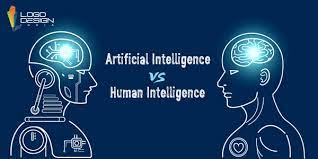
Difference Between Artificial Intelligence and Human Intelligence
Artificial Intelligence: Artificial Intelligence is based on the human insights that can be decided in a way that can machine can effortlessly actualize the tasks, from the basic to those that are indeed more complex. The reason for manufactured insights is learning, problem-solving, reasoning, and perception. This term may be connected to any machines which show related to a human intellect such as examination and decision-making and increments the efficiency. AI covers assignments like robotics, control systems, face recognition, scheduling, data mining, and numerous others.
Human Intelligence: Human intelligence or the behaviour of the human being has come to past experiences and the doings based upon situation, environment. And it is completely based upon the ability to change his/her own surroundings through knowledge which we gained. It gives diverse sorts of information. It can provide data on things related to the particular aptitude and knowledge, which can be another human subject, or, within the case of locators and spies, diplomatic data to which they had to get to. So, after concluding all it can give data on interpersonal connections and arrange of interest.
Below is a table of differences between Artificial intelligence and Human intelligence:
Feature
Artificial Intelligence
Human Intelligence
Emergence
AI is an advancement made by human insights; its early improvement is credited to Norbert Weiner who theorized on criticism mechanisms.
On the other hand, human creatures are made with the intrinsic capacity to think, reason, review, etc.
Pace/Rate of AI and human
As compared to people, computers can handle more data at a speedier rate. For occurrence, in the event that the human intellect can solve a math problem in 5 minutes, AI can solve 10 problems in a minute.
In terms of speed human cannot beat the speed of AI, or, machines.
Decision Making
AI is profoundly objective in choice making because it analyzes based on absolutely accumulated data.
Human’s choices may be affected by subjective components which are not based on figures alone.
Perfection
AI frequently produces precise comes about because it capacities based on a set of modified rules.
For human insights, there’s more often than not a room for “human error” as certain subtle elements may be missed at one point or the other.
Energy Consumption
Modern computer generally uses 2 watts energy.
On the other hand, human brains uses about 25 watts
Modification of AI and Human
AI takes much more time to adjust to unused changes.
Human insights can be adaptable in reaction to the changes to its environment. This makes individuals able to memorize and ace different skills.
Versatility
AI can as it were perform less assignments at the same time as a framework can as it were learn duties one at a time.
The human judgment skills underpins multitasking as prove by differing and concurrent roles.
Social Networking
AI has not aced the capacity to choose up on related social and enthusiastic cues.
On the other hand, as social creatures, people are much way better at social interaction since they can prepare theoretical data, have self-awareness, and are delicate to others’ feelings.
Mysticism is a word derived from the Greek word ‘Mysticos’ which refers to the belief that a person has the potential to achieve oneness with the god. Spirituality and mystics have been around for a long time. It’s a part of humanity that defines a diviner affinity to the belief that God is watching over us and our ultimate goal in this life is to achieve oneness with God. Over the years, there have been several religions that have emerged all over the world, but one of the key differences that separates a spiritual mystic from the others is the fact that they have the tendency to break away from tradition and hence, other forms of religious practices which were considered the norm.
I watch the clouds rupture.
Mira says, nothing can harm him.
This passion has yet
to be slaked.
-Mirabai (Clouds)
A mystic might take on any sort of relationship with the God and it is not restricted to the traditional hierarchical relationship where God is the supreme force who rules over the devotees. The devotees might choose friendship, teacher-student bond, familial bonding or even romantic companionship with their God. Thus, the concept of Bridal mysticism isn’t a new one. It has been around for several ages and is a true form of devotion where a devotee loves their god as they would love their beloved.
Let him kiss me with the kisses of his mouth! For your love is more delightful than wine.
-Song of Solomon (1:2)
The mode of bridal mysticism is so unique, for it negates all the humane all the societal constraints that denies sexuality to women. Bridal Mysticism has no such earthly constraints, it celebrates and even glorifies the bodily union between a devotee and their god, for sexual union is considered to be one of the divinest methods of indicating oneness with God. In this relationship, it is not just the devotee who expresses love, they also understand that their God loves them similarly, just as passionately. The love that persists between the devotee and the heavenly one is pure and true.
If I adore You out of fear of Hell, burn me in Hell!
If I adore you out of desire for Paradise,
Lock me out of Paradise.
But if I adore you for Yourself alone,
Do not deny to me Your eternal beauty.”
-Rabia Al Basri
Bridal mysticism is a practice that can be seen all over the world across all religions. In Christianity, the most explicit, yet the purest form of Bridal mysticism can be found in ‘Songs of Solomon’; a collection of love poems that has been included in the first testament. In it, two lovers go through a series of events that includes periods of blissful union as well as separation. It has been interpreted in several ways over the years, but the love that is cherished between the lover and her beloved is pure. In Hinduism, we see clear indications of Bridal mysticism in the poems of Mirabai from northern India and Antal from southern India. Both of the women adored and loved the Hindu God Lord Krishna. Like any couples, they express their love, grief, jealousy and fiery passion to their beloved God and relish in the devotion that flows through them. In Islam, the Sufi mystics are known for their poetic works which are brimmed with their love for God. Sufi saints like Rabia spoke of a divine selfless love for God which criticised those who loved God out of fear.
Bridal mysticism is also not gender specific. There are numerous instances of devotees from all genders expressing a romantic love, despite the conventional norms. Bridal Mysticism is thus one of the purest forms of devotion that solidifies the bond between a God and their devotee.
The COVID-19 pandemic continues to adversely impact lives, livelihoods, and the economy in India, with a devastating second wave wreaking havoc even as the threat of a third wave looms large. Rising uncertainty has reduced consumer and business confidence. This follows an economic slowdown during the three years preceding the pandemic. With investments and trade performance weak, the Indian economy was firing mainly on consumption, which the first and second waves of the pandemic have hit badly.
Renewed restrictions to curb the current coronavirus wave have stalled economic activity, leaving many millions out of work and pushing economists – who have broadly been bullish – to downgrade their views for the second time since early April
India’s unemployment rate soared to a near one-year-high of 14.73% in the week ending May 23, according to the Center for Monitoring Indian Economy (CMIE), reflecting the impact of the economic slowdown.
The Reserve Bank of India has kept its monetary policy loose, including several liquidity measures, and was expected to stay on an easy course for this fiscal year.
While calls have increased for more fiscal stimulus to speed up the economic healing, the government has limited space to respond to challenges posed by the health crisis.
“If the Indian government increases spending … it will probably prevent a loss in economic output in the short term, but this simultaneously puts more pressure on the sustainability of debt in the longer term, essentially mortgaging their future,” said Rabobank’s Eijkelenburg.
“India’s policymakers find themselves between a rock and a hard place when it comes to decisions on additional fiscal stimulus.”
Experts expressed apprehensions about the emergence of new and more virulent strains of the novel coronavirus, which might necessitate the re-imposition of lockdowns across the country, leading to a further (and possibly dramatic) reduction in growth estimates and adding to dampening demand. Complicating matters further is the fact that, as one economist noted, it is not known how consumers and households will react following the end of the second wave: How would household savings be impacted? Will consumers be reticent about spending again?
India’s already stressed banking sector, which is saddled with legacy non-performing assets, remains of concern. Experts fear a fresh wave of bankruptcies that add stress to the books of commercial banks, and that loan repayment schedules could be further delayed. India’s non-banking financial sector – which has traditionally lent to small and medium enterprises likely to be most affected by first and second wave lockdowns – could also contribute to the stress on the banks that lend to them. Similar fears hold about how pressure on microfinance institutions could systemically affect the banking sector.
Born in 1927 in Tehri district in what is now Uttarakhand, Bahuguna grew up surrounded by sal, oak and fir trees and sweeping pasture lands. Bahuguna, who died with Covid-19 on Thursday aged 94, was known the world over as the man who taught Indians to hug trees to protect the environment. He was one of the main leaders of the Chipko movement in northern India in the 1970s. In Hindi, chipko literally means “hugging”.
A devastating flood in Uttarakhand in 1970 had come as a rude awakening for villagers. Three years later, Bahuguna and fellow activists began embracing trees. Young men took an oath in blood to protect nature.Very soon, women in the Himalayas became an integral part of the movement too, embracing trees and tying rakhis – a symbolic red thread tied around a brother’s wrist during the Hindu festival of Raksha Bandhan – onto the bark of trees. They walked in the snow and took away tools from loggers to stop felling.
Bahuguna, who grew up in the Himalayas, connected the dots well. He wrote that deforestation led to erosion of fertile land and pushed the men out of the villages to look for jobs in cities.
This left women to “bear all the responsibilities of collecting fodder, firewood and water, apart from farming”. Not surprisingly, the Chipko movement became an important milestone in the fight to secure women’s rights.
Over the years, Bahuguna, with his flowing beard and trademark bandana, went from strength to strength. College students and women joined him in greater numbers. They staged peaceful demonstrations, hugged trees and went on fasts.
It yielded results: a fast in 1981 led to a 15-year ban on commercial felling of trees in Uttarakahand. Two years later, he marched 4,000km (2,500 miles) in the Himalayas to draw attention to environmental degradation.
In 1992 he shaved his head and went on a fast to protest at the Tehri dam, India’s tallest. He was among those who lost their ancestral homes due to its construction.
Bahuguna was a charismatic ascetic, a spartan man of Gandhian principles. He lived in a small ashram, denounced violence and was essentially non-political. He believed in self-reliance and not in “so much foreign trade”. He despised materialism.
To become energy secure in a “non-violent and permanent society”, he said, India needed to produce biogas from human waste, harvest solar and wind energy and hydro power from the run of the river. Improve machines so they consume less energy, he suggested.
OYO Rooms was started as Oravel in 2011 by the then 18-year-old Ritesh Agarwal. After graduating from the Peter Thiel Fellowship program, Oravel pivoted to Oyo Rooms – a chain of branded budget hotels across several cities in India. OYO Rooms is the country’s largest budget hotel chain with about 1 million rooms in 23,000 hotels all over India.The company is backed by investors like the Softbank Group, Greenoaks Capital, Sequoia Capital, and Lightspeed India and is one of the leading startup unicorns in the hotel industry.
The teenage boy – Ritesh Agarwal is the young Founder & CEO of OYO Rooms – the fastest-growing branded network of hotels offline & online. A college dropout, who once wanted to sit for an engineering exam, Ritesh today heads among the most valuable start-up by a person who never studied beyond school. The journey of our hero began rather early than normal!
Born to a humble family in Cuttack, his journey of becoming a successful entrepreneur wasn’t a very smooth one. In fact, in the era of start-ups, he had to face certain difficulties in trying to battle it out to make his unconventional idea work.
To pursue his passion for becoming an entrepreneur, he enrolled in the Indian School of Business & Finance, Delhi but left college mid-way to start his own company. He was hesitant about his decision but from the beginning, he was very clear about what he wanted to do and took some tough choices to accomplish his dreams.
Ritesh was born to a business class family in Bissam Cuttack in Orissa and attended the Sacred Heart School in Rayagada, Orissa. During the growing up days in Rayagada, Odisha, it was all about fun and learning for him but his ways were rather unconventional from those of other kids. His fun elements included screwing around with the computer and trying hard to find opportunities to make mistakes so that he could learn new stuff. And doing that he gained a keen interest in software!
This started with the idea of it, moved on to know about it and then the hunger just went on increasing. To quench his thirst, he borrowed his elder brother’s books for programming. Some of the basic languages like Basic and Pascal were taught in the school itself and the rest he managed to learn from Google. He even sold sim cards to survive, afraid his family would end his entrepreneurial dreams and summon him back home to Odisha if they knew of his struggles.
In Kota(Rajasthan), where he was ostensibly preparing for his IIT entrance exams, Ritesh says he couldn’t wait every weekend to slip out to Delhi and meet those doing their own thing. This 19-year-old had traveled for months staying at budget hotels, attended customer calls every day, and immersed himself in every possible experience to learn about budget hotel customers and their expectations. That was the kind of on-the-ground learning that helped him pivot Oravel to Oyo.
He has traveled all over the country and during such travels, discovered the problem with budget hotels. At the age of 17, he launched Oravel travels, modeled after Airbnb, which later branched out to become OYO rooms. Soon he discovered that the problem with budget hotels was bigger than just availability, so, to counter other issues, he launched OYO.
In 2014; the company raised Rs. 4 Cr from Lightspeed Venture Partners (LSVP) and DSG Consumer Partners, at a pre-money valuation (valuation of a company before investment or financing) of Rs 14 Cr. What motivated Ritesh, even more, was that by now the company was clocking gross bookings of more than Rs.1 Cr. per month.
Since then; OYO Rooms has gone on to become India’s first technology-driven network of standardized branded budget hotels and has also widely expanded its presence to 20,000+ hotels and more than 1 million rooms in 337 cities like Delhi, Gurgaon, Noida, Bangalore, Mumbai, Pune, Goa, Jaipur, Hyderabad, etc.
Additionally, their OYO Rooms mobile app has been downloaded more than 10 million times and more than 5 million bookings have been made so far. The app ranks amongst the best-rated apps on Google Play Store and has also been listed as one of the top three apps in the ‘Travel & Local’ category.
The company has also raised another $25 Million from Lightspeed, Sequoia and others. In the latest news, OYO’s founder Ritesh Agarwal has purchased $2 billion in shares from venture capital firms Sequoia Capital and Lightspeed venture partners.
Goods and service tax is indirect tax or consumption tax that are employed on goods and services in India the goods and service tax is imposed on every step in the production process it is collected from point of conception and not the point of origin like previous taxes it is comprehensive multistage and destination based tax. The tax rates rules and regulations are governed by the GST council which consists of the financial ministers of the central government and all the states. GST are divided into 0% 5% 12% 18% 28% rate of taxes. There is a special rate of 0.25 percent On rough precious and semi precious stone and 3% on gold. Pre GST the statutory tax rate for most goods where about 26.5% post GST most of the goods are expected to be in the rate of 18% tax range.
The GST replaced existing multiple taxes live it by the central and state government positive outcome of the GST includes the travel time in interstate moment drop by 20% because of disbanding of interstate check post. The Asim Pargupta committee which was put in place back end technologies and logistics later came to be known as GST network. Later came or for rolling out a uniform taxation regime in the country. The GST was strongly opposed by the opposition Indian National Congress it is one of the few sessions that have been held by the parliament where a panel of federal and state financial ministers decided to revise GST rates on 28 goods and 53 services the party’s reported that they found virtually no differences between the GST and existing taxation system they argued that the GST would increase existing rate on commodities like daily goods while reducing rates on luxury items and also affected for the middle lower middle and four income groups importantly. The reverse charge mechanism is where the GST liable fish on the receiver a tax on the behalf of unregistered smaller materials and services suppliers. And the goods get the eligibility of income taxes which are not enjoyed by the under jasta dealers.
Alcohol for human consumption petrol and petroleum products like petroleum Crude high speed Diesel motor spirit natural gas aviation turbine fuel and no GST applicability. Revenue distribution that are earned from GST were equally shared in interstate seller and buyer on 50-50 basis between the central and respective state governments. The GST council is the governing body of 33 members consisting of two members from Central and 31 members from 28 states and three union territories with legislature the GST council is an Apex member committee to modify reconcile or to procure any law or regulation based on the contacts of GST tax in India. The GST council is responsible for any revision or a enactment of rules aur any rate changes of the goods and services. The gstn software air is developed by the the Infosys technology and information technology network that provides the computer resources is maintained by NIC, goods and service tax network (GSTN) economic profit organisation formed for creating a a sophisticated network accessible to stakeholders government and taxpayers to access information from single source portal. The value addition in case of manufacturers make biscuits by sugar flour another for materials for manufacturing of biscuits the manufacturer then sells the biscuits to the warehouse and then the process continues till the biscuits reaches the final stage the GST is lived on the value addition such as the monetary value added at its States to achieve the final sale to the end customer.
Since the GST tax is the point of conception centre tax revenue will go to the the Karnataka not to Maharashtra. The advantage of goods and service tax are details to remove the cascading effect to tax higher threshold for goods and service tax registration composition scheme for small business simple online facility for GST compliance increased efficiency in logistics helps in single price reduction some of the disadvantage of goods and service tax are increase in cost of software adapting to a complete online access in system GST will mean an increase in operational cost. Some of the indirect taxes are Central excise duty cess state VAT Central sales tax purchase tax luxury tax entertainment tax and taxes on advertisement
Disability etiquette is a set of guidelines dealing specifically with how to approach persons with disabilities . Before knowing about disability etiquettes , it is essential to understand certain basic things such as if someone has a disability don’t assume he/she needs help . In fact , adults with disabilities wants to be treated as an independent persons , So offer help only if the person with disability seems to need it . Physical contact should be avoided . Always speak directly to the person with a disability , not to his/her friend . Persons with disabilities are the best judge of what they can or can’t do .
General Disability Etiquettes
The general disability etiquettes are stated below :
Always put the person first , i.e., say ‘person with disability ‘ rather than ‘disabled person’ . Always avoid the outdated words like handicapped , retarded , physically challenged or differently – abled . For example , refer to ‘person who are blind ‘ rather than ‘ blind person ‘.
In case of introduction to a person with a disability , it is appropriate to shake hands .
When you meet a person with a visual impairment , always identify yourself and others who may be with you .
Leaning or hanging on a person ‘s wheelchair should always be avoided because such act is generally considered annoying . In fact , the chair is the part of the personal body space of the person who uses it.
Always listen carefully as well as attentively when you are having conversations with a person who has difficulty in speaking . Have patience and wait for the person to finish rather than correcting or speaking for that person . Generally , ask short questions that require short time .
When talking with a person who is on a wheelchair or person who uses crutches , keep yourself at eye level in front of the person to facilitate the talk .
To get the attention of a person who is deaf or having hearing impairment , tap the person on the shoulder or wave your hand . You should look directly at the person and speak clearly .
Never patronize person who use wheelchairs by patting them on the head or shoulder .
Always introduce yourself to persons who are blind using your name .
Always avoid asking personal questions to an individual who is differently-abled .
Always give additional time to a person with any disability to do or to say something .
Always have conversation at a normal tone of voice . Don’t talk in high pitch to such individuals .
Don’t pretend to understand if you are facing problem in doing so .
If you need to leave a person who is blind , inform him that you are leaving and ask him if he needs anything before you leave .



































You must be logged in to post a comment.