Centre to decide on CBSE Class 12th Board exams by 1st of June; states asked to give their feedback by tomorrow

The Centre will examine suggestions received from various State Governments this week and convey further information in this regard to the students by or before the 1st of June.

Defence Minister Rajnath Singh yesterday chaired a national consultation to discuss conduct of Class 12 exams and professional courses entrance exams.

The discussions were held on two issues.

The board exams to be conducted for Class 12th by the Central Board of Secondary Education and other State Boards and the All-India Entrance examinations for various higher education institutions and professional courses.

Various options regarding the methodology, process, duration and timings of the exams were discussed.

During the meeting, Education Minister Ramesh Pokhriyal Nishank said the entire country has come together to ensure the safety and academic welfare of the students and smooth functioning of the education system.

He expressed confidence that the government will be able to arrive at an informed, and collaborative decision regarding Class 12 board exams and remove uncertainty among students and parents.

Mr Pokhriyal said that despite challenges posed by Covid-19, the Government has left no stone unturned to successfully bring education to online mode.

The Minister discussed the importance of the Class 12th board exams and the All India Entrance exams in shaping the future and defining the careers of students.

He said keeping in view the present circumstances, government decided to cancel the CBSE Board examinations of Class 10th and evaluate through internal assessment but Class-12th examinations are very important to decide the future of a student.

He also expressed his gratitude to the Defence Minister for giving his time and valuable suggestions relating to the exams.

He thanked Union Ministers Smriti Irani and Prakash Javadekar for attending the meeting.

While summing up, Mr Rajnath Singh thanked all the participants for putting forth their positive suggestions on the proposals for conducting examinations.

He requested States and UTs to submit other suggestions, if any, to the Ministry of Education by 25th May.

PM Modi reviews preparations to deal with Cyclone Yaas; asks officials to ensure safe & timely evacuation of people from high-risk areas

Prime Minister Narendra Modi has directed all concerned departments to ensure timely evacuation of those involved in off-shore activities in view of Cyclone Yaas which is expected to cross West Bengal and north Odisha coasts on Wednesday evening.

He also instructed officers to work in close coordination with states to ensure safe evacuation of people from high-risk areas.

Mr Modi took a high level meeting yesterday to review the preparedness of States and Central Ministries and Agencies concerned to deal with the situation arising out of Cyclone ‘Yaas’.

He spoke about the need to ensure that time duration of outages of power supply and communication network are minimum and are restored swiftly.

The Prime Minister also asked officials to ensure proper coordination and planning with state governments to ensure no disruptions in Covid treatment and vaccination in hospitals.

Mr Modi directed officials that advisories and instructions on do’s and dont’s during the cyclone be made available in easily understandable local language to citizens of the affected districts.

He spoke about the need to involve various stakeholders like coastal communities, industries, etc by directly reaching out to them and sensitising them.

During the meeting, India Meteorological Department, IMD informed that Cyclone Yaas is likely to intensify into a “very severe cyclonic storm” and is expected to cross the Odisha and the West Bengal coasts on Wednesday evening with the wind speed ranging 155 to 165 kilometers per hour gusting to 185 kilometers per hour.

It is likely to cause heavy rainfall in the coastal districts of West Bengal and north Odisha.

IMD has also warned of storm surge of about 2 to 4 metres in costal areas of West Bengal and Odisha.

The Prime Minister was informed that the Cabinet Secretary has taken a meeting of National Crisis Management Committee on Saturday with Chief Secretaries of all the Coastal States and UTs and Central Ministries and Agencies concerned.

Home Ministry is reviewing the situation 24×7 and is in touch with the State Governments and UTs and the Central Agencies concerned.

NDRF has pre-positioned 46 teams which are equipped with boats, tree-cutters, telecom equipments etc. in 5 States and UT.

In addition, 13 teams are being airlifted today for deployment and has kept 10 teams on standby.

Indian Coast Guard and the Navy have deployed ships and helicopters for relief, search and rescue operations.

Air Force and Engineer task force units of Army, with boats and rescue equipment, are on standby for deployment.

Seven ships with Humanitarian Assistance and Disaster Relief Units are on standby along western coast.

Ministry of Petroleum and Natural Gas has taken measures to secure all oil installations in the sea and to bring back their shipping vessels to safe harbour.

Ministry of Power has activated emergency response systems and is keeping in readiness transformers, DG sets and equipments etc. for immediate restoration of electricity.

Ministry of Telecom is keeping all the telecom towers and exchanges under constant watch and is fully geared to restore telecom network.

Health Ministry has issued advisory to the Sates and UTs, likely to be affected, for health sector preparedness and response on COVID in affected areas.

Ministry of Port, Shipping and Waterways has taken measures to secure all shipping vessels and has deployed emergency vessels, Tugs.

The meeting was attended by Home Minister, Amit Shah, Principal Secretary to Prime Minister, Minister of State for Home, Cabinet Secretary, Secretaries of Ministries and Departments of Home, Telecommunications, Fisheries, Civil Aviation, Power, Ports, Shipping and Waterways, Earth Sciences, Chairman Railway Board, Members and Member Secretary of NDMA, DGs of IMD and NDRF and senior officers of PMO and Home Ministry.

Cyclone Yaas to make landfall at north Odisha – West Bengal coast between Paradip and Sagar Island on Wednesday evening

The depression over the East Central Bay of Bengal has intensified into a deep depression. It is likely to deepen into a cyclonic storm today and further into a very severe cyclonic storm by tomorrow. Indian Meteorological Department has said that it may cross North Odisha-West Bengal coast on Wednesday.

According to the IMD, it now lies centred at about 540 kilometres south- south east of Paradeep in Odisha. AIR correspondent reports that backgrounded against the preliminary cyclonic forecast of a wind speed between 120 to 165 kilometres per hour, heavy to very heavy rainfall between 250 to 300 millimetres and accompanying storm surges between 3 to 4 metres, the Odisha Government is ready with all the preemptive and preparatory plans to face the probable cyclone, should the landfall happen anywhere near the North Odisha coast.

While primacy would be given to prompt evacuation of vulnerable people in vulnerable places , including those living in low lying areas, the government has also made adequate arrangements for cyclone shelters with necessary logistics, focus is also being made to ensure the smooth functioning of covid-19 facilities  in the areas likely to be affected by the impending cyclone. Meanwhile, 22 NDRF, 66 ODRAF and 177 fire fighting teams are already in position for rescue relief and restoration operations.

There is Chance of heavy rains and storms across the Gangetic West Bengal including Kolkata.

The meteorological office has banned fishermen from going to sea from this evening.

The state administration is fully geared up to deal with the cyclone. The Unified Command Agency will start work from today.

Army-NDRF-BSNL officials along with Public Works Department and CESC officials have formed a special team to deal with the disaster.

On the other hand, various cyclone centers have also been set up in coastal areas.

Already many people have been evacuated to safer places. The district collector of East Midnapore held a review meeting to deal with the cyclone.

Coastal areas are being monitored by drones and 32 NDRF teams have already reached the state.

Coronavirus Vaccines Highly Effective against B1.617.2 Variant

Coronovirus vaccine is highly effective against B1.617.2 variant, revealed by a Study in UK: A new study was conducted by some health officials in UK. It shocked everyone with its results. For the first time, it has revealed that the two doses of coronavirus vaccines are highly effective against the B1.617.2 variant i.e. the variant which was primarily reported in Maharashtra, India. It has also been referred as a double mutation variant throughout the world.

Coronavirus vaccine

Coronavirus Vaccines effectiveness against B1.617.2 Variant: 

As said by PHE (Public Health England) “The Pfizer or BioNTech vaccine was about 88 per cent effective against symptomatic COVID-19 from the B1.617.2 variant of concern (VOC) two weeks after the second dose, the Oxford/AstraZeneca vaccine was 60 per cent effective against symptomatic disease from the B1.617.2 VOC.”

However after a single dose of jab of vaccine, it was not much effective against VOC found in India. It’s effectiveness was 33% only.

As per Matt Hancock, the health secretary of UK, “This new evidence is groundbreaking – and proves just how valuable our COVID-19 vaccination programme is in protecting the people we love,”. 

He further said that “It’s clear how important the second dose is to secure the strongest possible protection against COVID-19 and its variants – and I urge everyone to book in their jab when offered, I’m increasingly confident we”re on track for the roadmap because this data shows the vaccine after two doses works just as effectively, and we all know that the vaccine is our way out of this”

As per the reports from analysis, the effectiveness of vaccine after two doses of jab is same in B1.617.2 variant as in the variant which is currenty present in UK. PHE (Public Health England) expects that the results will be more better in future and will be more effective against hospitalizations and deaths.

PHE also revealed that the difference in effectiveness between the vaccines after two doses could be explained by the fact that the second doses of AstraZeneca was rolled out a bit later than the Pfizer vaccine. The other data on antibody profiles showed that it usually takes longer to reach maximum effectiveness with the AstraZeneca vaccine.

A statement was also given by the vaccine deployment minister of UK, Nadhim Zahavi that “Today’s data is astounding and a true reflection of just how important it is to get both your jabs when offered. I encourage all those offered an appointment to get their jab booked in as soon as possible and take full advantage of the high levels of protection the vaccines bring”

PHE believes that since there are very less cases and insufficient follow up periods, it is taking longer for them to estimate the effectiveness of coronavirus vaccine against the B1.617.2 variant, but they  believe that they will definitely be able to evaluate this in the future. They estimate this not only in the case of variant primarily reported in India but also in the case of other variants which are being reported from different parts of world.

SOIL DEGRADATION


 The nation that destroys its soil, destroys itself

~ Franklin D. Roosevelt

What is soil degradation-

Soil degradation is the decline in soil condition caused by its improper use or poor management, usually for agricultural, industrial or urban purposes.

Causes of soil degradation-

The loss of farm land has been caused by a number of factors,

many or most of which are tied to human development. The primary causes are:

·         Deforestation

·         Overgrazing

·         Overexploitation for fuel wood

·         Agricultural activities

·         Increased flooding

·         Industrialization.


The following figure illustrates the relative sizes of the causal mechanism as a function of region


          On the global basis, the soil degradation is caused primarily by overgrazing (35%), agricultural activities (28%), deforestation (30%), over exploitation of land to produce fuel wood (7%), and industrialization (4%).


The main reasons for unproductiveness or degradation of soils are as follows:

1. Nutrient disorder

2. Water-logging

3. Salinity

4. Erosion

5. Biological degradation

6. Other causes

Impact of Soil Degradation:

The following are the impacts of soil degradation:


1. Degradation leads to reduction in crop yield in the affected lands and a possible decline in cropping intensity.

2. In extreme cases, soil becomes unfit for cultivation.

3. Silting of drainage, canals, rivers and reservoirs results in increased floods and droughts.

4. In some cases farmers use more fertilizer inputs to compensate reduced soil productivity while in other cases, they use excess fertilizers.

5. The rate of siltation in many water reservoirs are significantly high. According to Central Water Commission (1991), nearly 11 per cent of the total capacity of water reservoirs has been silted.

6. Soil degradation has several adverse impacts on the environment. It affects global climate through alterations in water cycle and energy balances and disruptions of carbon, nitrogen and sulfur cycles.

The estimated annual loss of different crops due to soil degradation ranges from Rs. 89 billion to 232 billion which represent a loss of 11 to 26 per cent yield.

Control of erosion-

(Adapted from ACS Distance Education 2009)

As erosion is caused by the effects of wind and water, control methods are generally aimed at modifying these effects. The following list describes some of the most common control methods:

·         Prevention of soil detachment by the use of cover materials such as plants.

·         Crop production techniques (e.g. fertilizing with organic fertilizer), to improve soil characteristics and promote plant growth and hence surface cover.

·         Ploughing to destroy rills and contour planting to create small dams across a field, to retard or impound water flow.

·         Filling small gullies with mechanical equipment or conversion into a protected or grassed waterway.

·         Terracing of slopes to reduce rates of runoff.

·         Prevention of erosion in the first place by careful selection of land use practices.

·         Conservation tillage methods.

·         Armoring of channels with rocks, tires, concrete and timber to prevent bank erosion.

·         The use of wind breaks to modify wind action.

·         Ploughing into clod sizes too big to be eroded, or ploughing into ridges.

Conclusion-

People can be a major asset in reversing a trend towards degradation. However, they need to be healthy and politically and economically motivated to care for the land as subsistence agriculture, poverty, and illiteracy can lead important causes of land and environmental degradation especially in Zambia which has inadequate laws and policies aimed directly at preventing land degradation.


Being introvert

An introvert is often thought of as a shy, quiet, calm and reserved individual having minimal social interactions. Social engagements and special attention are not what an introvert looks for. Instead, introverts find more comfort in solitude and focusing on inner thoughts and ideas. Investing more of their time in reading, writing, creativity, music and art is what energises them. Social gatherings might not be their interest but alone time is what they prefer most.

Following these traits introverts are often misunderstood.

Misconception no.1: Introverts are shy

Being shy is not the same as being introvert. Introverts enjoy solitude and tend to be reserved and prefer being alone or in small groups. This is often mistaken as being shy.

Misconception no.2: Introverts are rude

Introverts value their privacy and don’t believe much in expressing their emotions publicly. This tends people to dislike them and mistake them for being rude or weird at times.

Misconception no.3: Introverts are boring

Socializing in gatherings and parties and hanging out with peers might not be their kind of thing but that doesn’t make introverts boring. Time spent with inner circle of friends and family in a low key environment is more valuable for them.

Misconception no.4: Introverts can’t make friends

Introverts need their time to open up to new relationship. When it comes to befriending someone, introverts choose to have close friends, though less in number. They prefer smaller circle and high quality relationships.

Misconception no.5: Introverts are underconfident

Our society equates confidence with boldness, strong statements and actions directed externally which come naturally to extroverts. On the other hand, introverts don’t believe in the public display of confidence. Even though they feel confident inside, they don’t show much of it on the outside. Keeping emotions to themselves is natural in introverts.

Misconception no.6: Introverts are emotionless

Keeping emotions to themselves is natural in introverts. They have great control on their emotions and avoid expressing the same publicly. Though introverts might not seem to be emotionally engaged but usually that’s not the case.

Misconception no.7: Introverts wish to be extroverts

Sometimes, introverts might envy the abilities of extroverts to fit quickly and naturally to any social environment. But they do take great joy in being themselves and the delight of being in their own inner world. Being introvert is a gift where one enjoys equally self company and the company of others and wishing to be someone else is not the desire.

Misconception no.8: Introverts can turn into extroverts some day

Introversion is a personality trait which can either degrade or upgrade but never change. It is similar to wine which will only get better with aging but never change into something else i.e. one can grow up to be a mature introvert but not an extrovert.

We live in a fast growing world where chatty behaving individuals are preferred over the quite listeners. Many introverts find it difficult making their way through this scenario. However, introversion must be observed as a gift- a gift of thoughtfulness, compassion and creativity. Introverts are considerate, compassionate, deep thinkers, natural writers, problem solvers, keen observers, good listeners and readers- everything the world needs today.

Be the change!

               The earth is dominated by one of the species on her lap, that is human. Human developed in his level best for a progressive life. They are ruling their empire well and dominating everything like a colonizer. But is it a sustainable development? Are we responsible for the drastic changes that are occuring in our environment? Climate change is upon us. Oceans are rising fires are raging…we need solutions fast. We have known for decades that rapid climate change has been caused by the release of greenhouse gases. But all are living like ‘this is not for us’ or listening to this information like a story in any fairy tales.
               Each and every ignorance from the part of us is actually increasing our threat in the future.The recent news added to the warning from nature that she will react soon in order to mend herself.From May 13 onwards, the the European Space Agency (ESA) found that an enormous Antarctic ice shelf named A-76,the largest ice berg in the world, broken off which is three times bigger than Delhi !But why the scientists pay much attention to this? We have to know the truth that these sudden changes are due to the human caused climate change.If Antarctica ‘s entire ice sheet were to melt, it could raise sea level and gradually the land area reduced to the pages of history.
What are the Solutions?
We have two options in front of us- ‘mitigation’ (reducing and stabilizing the levels of heat-trapping greenhouse gases in the atmosphere) and ‘adaptation’ (adapting to the climate change already in the pipeline). Project drawdown ,a nonprofit group of researchers and scientist, compiled a list of solutions which one expanded over the next 30 years could reduce emissions by as much to 269.0 2 gigatons of CO2.so what are the solutions?
Refrigerant management: in 1987, 196 countries and the European union sign the protocol calling on all countries to reduce the use of CFCs in refrigerants by 1996. CFCs were replaced by HFCs which doesn’t damage the ozone but is an extremely potent greenhouse gas. HFC have thousand to 9000 times the capacity to trap heat than CO2 and gradually slow the rate of global warming.
Onshore wind energy: the solution provides a huge opportunity for low-cost and love mission energy creation. Turbines have small land footprint allowing for farming recreation and conservation of nature to continue under their shadows. By increasing 26% of wind energy production could avoid roughly 147 gigatons of greenhouse gas emissions by 2050. In order to curb this issue ,we should expand the construction industry with the smart energy policy and generous government subsidies. Future of wind turbines could have substantial positive effect on our changing climate.
Plant rich diet: the fossil fuel demands associated with the animal feed, transportation, deforestation and animal emissions themselves makeup large chunk of global greenhouse emissions. The Project drawdown predicts that is just 50% of the world population adopts applied rich diet by 2050, we could avoid 65.0 5 gigatons of greenhouse gas emissions.It is not easy… especially in a meat-centric food culture.
                It is said that in 2050 the world will be more hostile and less fertile, more crowded and less diverse.we all have to register something in our mind that we are temporary in this Earth and are responsible to hand it over to our future generations without any damages. We are ought to make changes in our lifestyles against the ‘changes’ in order to preserve that gem with all its diversities and beauty.
“Be the change you wish to see in the world”-Mahatma Gandhi.

FARM BILLS – 2020


The Farm Bills 2020 is a combination of three agricultural bills passed by the Indian parliament in September 2020. The three bills are : 1] Farmers’ Produce Trade and Commerce (Promotion and Facilitation) Bill, 2020 2] Farmers’ (Empowerment and Protection) Agreement on Price Assurance and Farm Services Bill, 2020 3] Essential Commodities (Amendment) Bill, 2020.    


These bills were introduced by Mr. Narendra Singh Tomer, the Minister of Agriculture and Farmers Welfare. First enacted by Lok Sabha on 17th September, 2020 and then by Rajya Sabha on 20th September, 2020 and Accent was given by the President Ram Nath Kovind on 24th September, 2020. These three bills have been passed by the parliament aiming at introducing reforms in the agricultural sector. 

These reforms are considered to be important since 60% of the population works in the agriculture industry. This sector also contributes about 18% of the country’s GDP. The laws claim to bring farmers closer to the market by changing where they can sell, the ability to store produce and whether they can enter into contracts.  


FARMERS’ PRODUCE TRADE AND COMMERCE (PROMOTION AND FACILITATION) BILL’, 2020

This law allows farmers to sell anywhere within the country under the ‘One Nation One Market’ concept. The ECA initially restricted farmers from selling anywhere other than government-approved  mandi’s. These government approved mandis’ are called ‘Agriculture Product Market committees’ [APMC]. An APMC is a state-operated market where farmers are allowed to sell their produce to traders or middlemen. These middlemen then sell their produce to consumers throughout the country. 

According to this Act any person with a “PAN card” is able to enter in direct trade with farmers whether through e-commerce platforms or physical trade. Farmers will not be charged any levy for sale of their produce. 


Key Features : 

Trade of farmers produce: The Ordinance allows intra-state and inter-state trade of farmers’ produce outside the physical premises of market yards run by market committees formed under the state APMC Acts and other markets notified under the state APMC Acts.  Such trade can be conducted in an ‘outside trade area’, i.e., any place of production, collection, and aggregation of farmers’ produce including farm gates, factory premises, warehouses, silos, and cold storages. 

Electronic trading: The Ordinance permits electronic trading of scheduled farmers’ produce (agricultural produce regulated under any state APMC Act) in the specified trade area.  An electronic trading and transaction platform may be set up to facilitate the direct and online buying and selling of such produce through electronic devices and internet.  The following entities may establish and operate such platforms: (i) companies, partnership firms, or registered societies, having permanent account number under the Income Tax Act, 1961 or any other document notified by the central government. (ii) a farmer producer organisation or agricultural cooperative society. 

Market fee abolished: The Ordinance prohibits state governments from levying any market fee, cess or levy on farmers, traders, and electronic trading platforms for trade of farmers’ produce conducted in an ‘outside trade area’. 

Efficient payment mechanism : According to this act, the trader shall pay on the same day as delivery of farming produce, if not payment shall be done within three working days and a receipt should be given on the same as of delivery. 


THE FARMERS (EMPOWERMENT AND PROTECTION) AGREEMENT OF PRICE ASSURANCE AND FARM SERVICES BILL, 2020:

This bill ensures that farmers are allowed to enter into contracts with buyers. Farming will be carried out on the basis of agreement between buyers and producers. One of the greatest advantages that the farmers receive through this is the price assurance even before sowing his crops. The scope of contract farming is huge as MNC’s regularly get into contracts with farmers in order to ensure they receive specified types of produce. For eg., Mcdonalds uses only a specified kind of potatoes for their Fries and gets them grown accordingly. Similarly, other chains too require specified produce and would prefer to be directly in touch with farmers rather than traders to ensure that they are organic and fresh. 


Key Features : 

Farming agreement: The Ordinance provides for a farming agreement between a farmer and buyer prior to the production or rearing of any farm produce.  The minimum period of an agreement will be one crop season, or one production cycle of livestock.  The maximum period is five years, unless the production cycle is more than five years. 

Pricing of farming produce: The price of farming produce should be mentioned in the agreement.  For prices subjected to variation, a guaranteed price for the produce and a clear reference for any additional amount above the guaranteed price must be specified in the agreement.  Further, the process of price determination must be mentioned in the agreement. Dispute Settlement: A farming agreement must provide for a conciliation board as well as a conciliation process for settlement of disputes. The Board should have a fair and balanced representation of parties to the agreement.  At first, all disputes must be referred to the board for resolution.  If the dispute remains unresolved by the Board after thirty days, parties may approach the Sub-divisional Magistrate for resolution.  Parties will have a right to appeal to an Appellate Authority against decisions of the Magistrate.  Both the Magistrate and Appellate Authority will be required to dispose of a dispute within thirty days from the receipt of application.  The Magistrate or the Appellate Authority may impose certain penalties on the party contravening the agreement.  However, no action can be taken against the agricultural land of farmer for recovery of any dues.


ESSENTIAL COMMODITIIES (AMENDMENT) BILL, 2020:

Of all the 3 bills that have been passed, it is the ECA which was long overdue. The ECA has its roots in World War II where laws were implemented by the British to exploit the supply within the country. The bill places restrictions on the storage of essential commodities like pulses, oilseeds, onions, etc but has now been amended. The amended ECA reduces the power that states and the center have. 


Key Features :

Regulation of food items: The Essential Commodities Act, 1955 empowers the central government to designate certain commodities (such as food items, fertilizers, and petroleum products) as essential commodities. The central government may regulate or prohibit the production, supply, distribution, trade, and commerce of such essential commodities. The new Ordinance provides that the central government may regulate the supply of certain food items including cereals, pulses, potatoes, onions, edible oilseeds, and oils, only under extraordinary circumstances. These include war, famine, extraordinary price rise and natural calamity of grave nature.

Stock limit: The Ordinance requires that imposition of any stock limit on agricultural produce must be based on price rise. A stock limit may be imposed only if there is: (i) a 100% increase in retail price of horticultural produce; and (ii) a 50% increase in the retail price of non-perishable agricultural food items. The increase will be calculated over the price prevailing immediately preceding twelve months, or the average retail price of the last five years, whichever is lower. 


What were the reasons for protests ?  The farmers have been apprehensive about these bills. The biggest concern here is the Minimum Support Price (MSP). The government offers to buy 23  products at MSP to support farmers. But in reality, only wheat and rice are purchased by the government. Haryana And Punjab are the biggest benefactors of this scheme. With permission to trade outside mandi, traders will only trade outside because there is no provision of MSP while dealing with private players. This might lead to farmers being underpaid again.  

Farmers have this fear that’s why protests are happening. But with relating to MSP only 6% of farmers in India know about this provision and they get to benefit from this. The implementation is really not good. Farmers are also concerned about the upper hand of the agri-businesses and big retailers in negotiations. They feel this would put them at a disadvantage. They also say that the companies may dictate the prices and the benefits of small farmers may reduce due to engagement of sponsors with them. One of the reasons why there has been a lot of uproar throughout the country is due to the unconstitutional way in which the laws were passed as it is the state governments that regulate these aspects. 


The government should have included the opposition and also taken into account the voice of farmers in order to plug the loopholes in the bills.This would not only create an assisted approach towards privatizing the sector but also avoid further exploitation. But unfortunately, the bills due to not being communicated appropriately have created an air of mistrust between the ruling, opposition, and the farmers. 


Who were protesting ?

Farm organisations like Bharatiya Kisan Union (BKU) and big agricultural bodies like the All India Kisan Sangharsh Coordination Committee (AIKSCC) and some section of farmers are opposing the bill. They say these bills will help no one, except big corporates and destroy farmers’ livelihood. v Protests are largely limited to Punjab, Haryana and Madhya Pradesh. This is because it is in these states that farmers rely on MSP and have strong market systems based on APMC’s. 

Thousands of farmers in Punjab, Haryana and several other states are on the roads to protest against three farm ordinances which were presented in the Lok Sabha. The opposition and many farmer unions have threatened to protest till the controversial ordinances are withdrawn. Bihar, Kerala, and Manipur do not follow the APMC system at all. In India, the state governments have the power to regulate agricultural markets and fairs. Hence different states have different approaches towards this. Besides the farmers, the commission agents are also opposing these ordinances. They also fear that the new laws will bypass their business and they will be rendered jobless. State governments also seem to be opposing the bills as they will lose mandi tax which is a huge source of revenue. 


Impact on the economy:

Agriculture plays an important part in India’s economy and at present, it is among the top two farm producers in the world. This sector provides approximately 42% of the total number of jobs available in India and contributes around 15 % to the GDP. GDP shrank by a whopping 23.9 % according to the National Statistical Office’s released estimates for the first quarter. It was expected due to COVID-19 pandemic and the near cessation of economic activities. But what comes as a silver lining is the exceptional show of the agriculture sector. If India has to come out of the serious economic crisis, the answer does not lie in the economies of the urban or of the extractive economies of the capital. The answer lies in the revival of rural India with dignity and respect. The country cannot survive if the rural sector falls and chances of such an event happening today can only be prevented with policies initiated with empathy and care. 


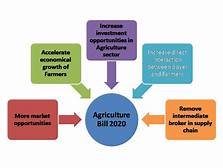
India’s agricultural sector has been liberalized and sort of privatised by the new Farmers bill 2020 by eliminating the dangerous middlemen, facilitating better realizations for farmers, attracting investment and enhancing technology in the sector. The three Farm bills are expected to bring revolutionary changes to the agrarian context and help double farmers’ incomes. There is a need to restore the shaken confidence of the agrarian sector and by implementing the three farm bills, they will break the monopoly of APMC markets/mandis and they will allow private companies to get into the agricultural produce supply chain by offering competitive prices and it will give a choice to the farmers to sell their produce for higher prices. It will also help introduce new technologies in the agriculture sector through private investment. 

This move is being hailed as the liberalization of agriculture trade and is being compared with 1991 economic reforms. New farm bills limit government intervention as the government cannot ban exports when the prices of a commodity increase and this will ensure more money to the farmers. The new farm bill will help the farmers who are debt-ridden and starved of funding by providing them with a competitive market. The three Agri bills if taken together can-do wonders for open agriculture trade and have the potential to double farmers income and will definitely feed the Indian economy. 


Conclusion:  

The purchase by organised retailers curtails the length of the supply chain, giving better prices to farmers and asking for lower prices from consumers. It is witnessed that middlemen charge higher prices than organised retail players. Also, contract farming by corporates implies that the corporate will provide technology to the farmers to improve their yield. This benefits both, the farmer through increased yield and the corporate, who can get higher production from suppliers. So the new Farmers bill will be a boon for the economy.   However, these 3 acts will prove beneficial only if the government addresses the loopholes of these acts. 

The loopholes of these acts are quite concerning and the government should discuss the same with farmers to be more efficient and effective. The government should form a proper mechanism for contract farming so no farmer is exploited by big greedy corporates. To solve disputes between farmers and traders the government should establish a different regulatory body rather than Sub-Divisional Magistrate. The MSP  system is flawed and even though the government recently said that they are not repealing MSP but still they need to address the fact that only 6% of Farmers are getting benefits. 

                                                                                       The government should Implement this scheme more effectively by spreading awareness with the help of Gram panchayat so that the smallest of farmers will know about this and will get the benefit. Farmers in our country are not united. Just like AMUL or National Egg Coordination Committee farmers should form a nationwide group or local groups to deal with big traders. Effective implementation is necessary. Right now, India is going through a food surplus still people are going to sleep hungry. This is because of the mismanagement of the government.


 

Indian Superstitions with their facts | Myths in India

Indian Superstitions with their facts

Myths in India

1.  Do not cut nails after sunset:

This has been a famous superstition in almost every home in India. But yes, it is just a myth we can definitely cut nails on any day, whether it is sunset or not. This myth was generated by our ancestors and it is believed that if we cut our nails before sunset then it will be hygienic and the particles you cut won’t get stuck to your feet. Also in the daylight, we can easily cut the nails, but if we do the same at night we may get some cut, to avoid that we must cut before sunset.

2.  Take a bath after attending the funeral:

After the death of the person, the bacteria can easily flow in the air and can stick to the person attending the funeral, to avoid such conditions it is advised to take bath as soon as you come after attending the funeral to get bacteria to wash off.

3.  The mourning family of a dead person should not cook food until shraddha :

This ritual is almost followed by every Indian house after the death of their loved one. The reason for following this is just to give rest to the family. Obviously, family members are very sad during the interval some crying, some arranging and calling people to meet. So this practice of not cooking food for around 14 days (Hindu religion) until shraddha is to provide rest to the family helping them to cope with the death of their loved one.

4.   Swallow Tulsi leaves, never chew:

Tulsi is considered to have powerful medicinal properties and is worshipped by Hindu devotees. It is also believed that Tulsi is Lakshmi’s avatar. It is suggested to swallow Tulsi leaves and not to chew them, the main reason for this is Tulsi contains some amount of mercury which is harmful to our teeth. mercury is considered harmful for teeth which can degrade the enamel and make your teeth yellow. When you chew the tulsi leaves then mercury content can get dissolved in your teeth and can harm them.

5.    Eat curd and sugar before heading out:

Curd contains calcium and proteins and is also easy on the stomach and the digestive system, whereas sugar provides instant glucose, making them good options for consumption before stepping out. Curd has a cooling effect on the stomach and is highly recommended to have it in regions like India. Curd also has some unique health properties which distinguish it from any other milk product, it contains calcium and protein which is easy to digest and provides cooling, and therefore it is considered to have curd before you step out as good luck.

6.    Crush the head of a snake after killing it:

“Snakes, in general, are well known for retaining reflexes after death,” said Steven Beaupré, a biology professor at the University of Arkansas. The Head of the snake should be crushed, burned, or buried after killing it. A snake can bite a person with a detached head. Snake is a cold-blooded organism, and all the cold-blooded organisms have this property as snakes do. So it is advised to crush its head before it harms any person.

7.    Lemon and green used chilies to avert Buri-Nazar :

This is almost seen in every shop in the market and also in many Indian homes. Nimbu-Mirchi totka is a well-known superstition. The main reason for this is lemon and chilies are rich in nutrients like vitamins and absorb the bacteria not allowing them to enter inside your home or the place you tie them out. Chilies also have several medicinal strengths. Lemon and green chilies have pesticide properties killing germs keeping insects and pests away and used by farmers.

The dignity of labour

All forms of work, manual or intellectual are called labour. Dignity of labour chiefly means respectability of manual labour.

Manual labour is very useful to us. The daily affairs of life cannot run without it. The food is the result of the sincere and tireless efforts of the manual work of the cultivators. The houses people live in, the automobile and other industries are the products of the manual labour of millions of workers. So, the dignity of their toil has to be appreciated.

Unfortunately, the educated youths are generally averse to manual labour under a false sense of dignity.They forget that respectability lies, not in whether work is done with the hand or with the intellect, but in how well it is done. A sweeper who does his work well is more honourable than a highplaced official who neglects his duties. The dignity of manual and mental workers is often erroneously judged. All manual works require a certain amount of mental work. The potters who make earthenware from a lump of clay have a considerable sensibility and imagination.

Manual labour is beneficial in other respects too. It keeps us physically fit and fosters a spirit of industry, self-help and manliness, and thereby helps moral growth.So, society must give due honour to manual labourers.

Newton’s 4th law and a new perspective

Note: This article does not take a scientific spin on Newton’s 4th law rather, a metaphorical one.

How often do you come across reels in your Instagram with aesthetically pleasing setups, where people showcase their productivity by fancy stationary, an iPad and their flawless note taking skills? Quite often right! It makes you question yourself. Am I of any good? Why am I wasting time scrolling on social media? I am worthless. While social media influencers with a fancy lifestyle ask you to motivate yourself with positive affirmations, it can give you a temporary boost of confidence but later you will see yourself slumped on the couch too tired to do work, too tired to rest. But believe, you are not alone.

Newton’s 4th Law

I’d like to call it Newton’s 4th law. The first three laws rule the world. The 4th law also is ruling the world, but no one explicitly acknowledges it. The fourth law states that ‘The value of a person is directly proportional to his/her productivity’. Yes, that is it. This single statement is the sole destroyer of the mental health of people, and ironically the destroyer of their productivity too.

Giving the statement a first glance, you will be virtually staring at me and saying what’s wrong with that. But by the end of this article, I assure you I’d have sparked something in you. The societal rules say that you have to be productive every single moment of your life. You would have heard your parents asking you to read books during your summer break so you can improve your vocabulary. Go to music class, you can be the next Shreya Ghoshal. Go to dance class, chess class and what not. The world basically says to shove skills into your throat so that you can be ‘valued’ as a man in the society.

So what is productivity?

What no one says you is that, productivity is not something measured by the time you spend before a laptop doing ‘work’ or the number of pages read in a book. It is not juggling multiple tasks by half-focusing on each task. It is a feeling of satisfaction that fills your heart. A feeling that cannot be measure by time or effort. You should feel happy that you did something new today. That work can either be a progress or a rollback, doesn’t matter. At the end of the day, all that matters is that your person you are today knows something more than the person you were yesterday. Happiness inspires productivity.

So am I saying that you should lessen the time of work or read fewer pages? Not essentially. You can still say that you are productive without feeling guilty of not crossing your intended checkpoint. You can take breaks instead of working 3 hours straight. You can do a few jumping jacks. You can sit idle for a while and do nothing. By idle, I don’t mean you can catch up on Netflix or scroll your phone.

Just sit idle and don’t do anything at all. Try not to think of anything. When you try not thinking, I can bet that your mind will reel great philosophies which you never would’ve thought about otherwise. It will think about that embarrassing incident that happened 2 years ago. No kidding. Try it and you will be amazed if you follow your train of thoughts. These small techniques not only improve productivity, but also improve your overall physical and mental health.


work hours and productivity
Time and Productivity

What isn’t productivity?

This list can include things which you previously thought belonged to the other list.

  • Working for longer hours=More productivity
  • Multitasking
  • Hoarding up more number of tasks together
  • Not planning on what to do before actually starting to do work
  • Trying to do everything by yourself
  • Neglecting social life

Be careful and identify these red flags. Once you identify it, try to change your mindset. As the old saying goes, mind is THE master.

Concluding remarks

I lined up for you what productivity is and how its definition has been corrupted by the society. Lead life one moment at a time, for life is nothing but the amalgamation of moments silver lined with emotions. I leave you with the quote of a great man.

Improved productivity means less human sweat, not more.

  -Henry Ford


Condition of Jobs Pre-Post Pandemic in INDIA

Talking about jobs is always an important discussion in the developing and vast country like India. The need of the job can only  be understood when we see an unemployed person fighting to live during this period of pandemic without a job and also striking toward to get a job and not getting a single chance to get away through him to get a job. our government has also started various measures to develop the market as well as to help the needy like Make In India initiative, supporting startup programmes but it cannot do much to meet the need of the hour. This aspect of economy cannot be ignored if any of the country wants to develop  because if a country needs to develop the very first step is to strengthen the roots of the society that comes only when all people get jobs and only after that  there is some initial cash flow comes to the economy, which in turns help to boost the economy. The recent data according to CMIE shows that unemployment rate in DECEMBER 2020 rose to 9.1% which later in JANUARY reported to decrease to 6.5% positively which shows that there are signs of recovery, also according to Dr. Krishnamurti Subramanian our Chief Economic Advisor India’s economy shows the signs of V Shape recovery.

As we see employment and economy are the two sides of the same coin and economy of a country always suffer when the employment goes down in anyway. as this pandemic is turning out to be the greatest disaster of all times not only for India but for the world also . According to several reports  millions of people have lost their jobs in formal sector and informal (unorganized)sector does not have a count that is caused by novel corona-virus. However the pandemic could not be stated as the only reason for the ongoing job crisis. there are many aspects that can be responsible for the same. they are as follows:

  1. Overpopulation– the  ongoing and unstoppable exposure of population in India with no proper family planing leads to overpopulation and that ultimately results into the employment crisis which in turn relates to failure of government planning . for this the government had also introduced schemes to motivate citizens for the control of population with that the government has also started many educational programmes to educate parents to have not more than 2 children so that they can afford their family expenses and also would help in the upliftment of children .
  2. Dependence on agriculture – as major part of India lives in rural areas so the majority depends upon the agriculture for their livelihoods but agriculture being seasonal does not provide permanent employment to the vast population.for this the government should do some efforts for the development of the rural areas which would also help in control of migration of people from rural to urban areas.
  3. Immobility of labor- as India is a country of sentiments by which most people from small towns fails to mobilize  because of family affection and attachment and for this again there is a need for development in small towns by which the population would not suffer.


Conclusion  as we know economy and unemployment are the two sides of the same coin they go hand in hand as the unemplyement rate decreases economy will boost up and if unemployment rate would go up there will be a downfall in the economy. hence there comes the need for the proper planning and development for the growth of the economy and country as well.

NATURE: THE TRUE HEALER

MOMENTS OF SOLLITUDE WITH MOTHER NATURE IS SUNSHINE TO A SOUL.


The purest sense where both serenity and wildness coexist in harmony, the most vital source of wonder and inspiration – NATURE, the most incredible gift we need to be grateful about . There is nothing as peaceful as being deep in forest and being immersed in the natural world completely.

Nature is the true antidote to today’s busy and stressful world as the more time we spend in nature the more tuned we we become towards our life. Nature is the most powerful force when it comes to healing the mind, body and spirit. It influences us to connect to one another. Spending mindful moments in nature helps us to reconnect with ourselves, our loved ones and moreover with the entire natural world around us.

Our natural surroundings really do support our innate healing capacity. It’s our responsibility to connect with the peaceful rhythms of the nature by walking barefoot ( to get connected with the positive vibes with the ground), sleeping outdoors, getting the morning vibes from sun by getting rich vitamin D and listening to the beautiful chirpings of the birds in the morning as they mark out to their deafening noise as they settle down to roost in the evening.

Exposure to the outdoors can help us feel calmer, boosts our immunity and enables us to sleep more soundly than ever before. Spending our quality time with nature can not only enhances our mental sharpness but increases our problem solving capacity and inspire creativity.

One study was conducted by the scientists in Japan to monitor the effects of a practice known as “Shinrin-yoku” which means forest-bathing and also refers to natural mindfulness walks. This study involved field experiments in 24 forests across Japan and there were more than 280 participants participating in this Shinrin-yoku experiment. In each experiment, the scientist sent one half of the participants into the deep woods and the other half into a city. The next day, the participants who spent time in the deep woods were sent into a city and vice versa.

At the end of the experiment, the scientists found that those who spent their time in forests had literally lower concentration of cortisol, lower pulse rate and even lower blood pressure. This experiment beautifully proved that the nature was very much effective in creating perfect health when they were in forest as compared to urban environment.

Not just one study, now there are infinite studies available revealing with utmost accuracy that the people who appreciates, extends gratitude towards nature and most importantly spends time in it are the most happier, healthier and innovative as the nature reduces the stress, pressure and solely helps one to find the true meaning of life and connect with themselves. Thus, all of the research points conclude that the closer we are to nature, the happier we feel.

 Anne frank well said that “The best remedy for those who feel lonely or unhappy is to go outside”. This makes us firmly believe that nature brings solace to all troubles as it improves our cognitive abilities and ignites our power of imagination. With absolutely no surprise that the immortal achievements of our ancestors or history’s greatest pieces of art, literature and music produced by them was possible because of their quality time spent with the mother nature.

But the most bitter truth is we all take nature for granted. One must not forget that what is taken for granted will eventually be taken away. We took nature for granted which is the most indispensable thing highly deserving our gratitude. It’s never too late let’s now understand our priorities and give huge respect to the Mother Nature!

OPTIMISM- THE NEED OF THE HOUR

When you can’t control what’s happening, challenge yourself to control the way you respond.


We all face challenges, tough times at some point of life but this time we all are undergoing with a common difficulty-“THE PANDEMIC”. It’s very true that we cannot change the direction of wind but definitely we can adjust our sails to reach our destination. Though this pandemic has triggered tremendous anxiety and sadness all over the map, we must not forget that troubles are our hidden teachers who come into our life to make us meaningful.

If we see our troubles and miseries with an eye of optimism we can realize that these are great opportunities to strengthen us from within, chances for our better version of life as optimistic attitude can never fail even after a massive failure. It always encourages the very person to think unquestionably that it is the path to achieve something more higher than never before

Shadows( tough times) are the evidences that we are standing in light. The determined effort to cultivate optimism will surely improve the quality of life, ensure happiness and success because with the optimistic attitude we can generate innovative ideas and create various possibilities to move forward faster. That’s why I strongly believe that optimistic way looking at the situation is as equally important as the most demanding oxygen cylinders.

The more we feed positive thoughts in our mind and around we can magnetize peace and happiness back so let’s train our mind in such a manner that we can see opportunity no matter how the hard the situation might seem for now. Winston churchill, the Prime Minister of Britain shouted with the sense of positivity at the time of 2nd world war with the saying “A pessimist sees the difficulty in every opportunity whereas an optimist sees opportunity in every difficulty.”

Continue reading “OPTIMISM- THE NEED OF THE HOUR”

NO CHALLENGE IS TOO BIG- ONLINE CLASSES

NO CHALLENGE IS TOO BIG- ONLINE CLASSES :The education is the ability to listen to almost anything without losing one’s confidence. The pandemic situation has opened new doors to learn, new opportunities to explore and has triggered new normal way of learning with increased use of online learning tools. This mode of education can be stepped towards revolutionizing the education system as never before.
Despite many advancements in technology the blend of technology and education has some challenges to throw light upon and find the best ever possible solution.

“Education is the most powerful weapon on which you can use to change the world.”

  • NO IN PERSON INTERACTION:

                Students can learn a lot from being in the company of their peers. In online event there are minimal physical interaction due to which the students find that they are not able to work up to their potential.
Body language and the eye-contact which are the two important cues for the faculty to understand a student is now difficult in online learnings. The best way to resolve is to proactively interact which in turn helps to understand the expectations of course clearly.

  • DISTRACTION:
    The convenience of online learning can encourage poor study habits. The presence of other people, easy access to other websites for entertainment and the ubiquitous mobile phone can keep the learners highly distracted.
    The best possible solution is to find a productive workspace and switching off other gadgets is highly recommended
  • TIME MANAGEMENT:
    The internet-based course demands that learners develop a good personal time management skill. If they don’t find to manage the time properly, they have strong chances to find themselves buried beneath a seeming insurmountable mountain of coursework.
    The best way to resolve this is by building and maintaining an effective daily and weekly schedule. Which creates a sense of familiarity and accountability which strongly helps in planning and time management.

  • CURSE FOR DIFFERENTLY ABLED LEARNERS:
    The students with disabilities had a concern regarding the availability of study material in appropriate formats. Teachers are apprehensive about teaching effectively without the use of touch to students with learning disorders, autism and low vision. The lack of effective education may further aggregate the high dropout rate of these children from school.
  • CHEATING PREVENTION DURING ONLINE ASSESSMENT IS COMPLICATED:
    Unfortunately, one of the biggest disadvantages of online learning continues to be cheating through various methods. Compared to traditional classes, online student can cheat on assessment in their own environment and while using their personal computer.
    Additionally, without proper identity verification system in a place, students taking online assessments might be able to let third party take the assessment.
    The best way to resolve this is by anti-cheating measures must be put in place by the institutes which does the automated ID verification and use the machine learning to detect fraudulent test-takers.
  • IMPACT ON PHYSICAL AND MENTAL HEALTH:
    One of the biggest concerns is about the health hazards having their prolonged duration spent in front of screen causing physical and mental health issues such as headaches, eye-strain, stress, anxiety, feeling of isolation, boredom, disturbed sleep patterns and food habits. Also, students develop a bad posture and other physical problems due to staying hunched in front of screen.
    The best way to resolve is to take adequate number of breaks from screen to refresh their mind and body, practice yoga regularly and taking a healthy diet.
  • UNCERTAINITY ABOUT THE FUTURE:
    The sudden switch to e-learning has caused anxiety and raised questions among the learners about their academic future. Also, relying solely in online education may hinder holistic development of children and many may underperform in personal life.

Every challenge is silver lining in a dark cloud as it teaches us to face every new experience with utmost confidence and shapes us to come out with the best solution.