Stress is part of being human, and it can help motivate you to get things done. Even high stress from serious illness, job loss, a death in the family, or a painful life event can be a natural part of life. You may feel down or anxious, and that’s normal too for a while. Talk to your doctor if you feel down or anxious for more than several weeks or if it starts to interfere with your home or work life. Therapy, medication, and other stategies help. In the meantime, there are things you can learn to manage stress before it gets to be too much. Consider these suggestions:
Exercise
To start with, physical activity can help improve your sleep. And better sleep means better stress management. Doctors don’t yet know exactly why, but people who exercise more tend to get better deep “slow wave” sleep that helps renew the brain and body. Just take care not to exercise too close to bedtime, which disrupts sleep for some people. Exercise also seems to help mood. Part of the reason may be that it stimulates your body to release a number of hormones like endorphins and endocannabinoids that help block pain, improve sleep, and sedate you. Some of them (endocannabinoids) may be responsible for the euphoric feeling, or “runner’s high,” that some people report after long runs.
People who exercise also tend to feel less anxious and more positive about themselves. When your body feels good, your mind often follows. Get a dose of stress relief with these exercises:
Education is important for all of us and it is our right to take education but today’s education system makes our study problematic and even student find it difficult to study their subjects.
Our teachers, parents only told us to study but they never told us How?
But there is always a real practical approch to do anything that you want to do and for study effectively it can also apply.
1. Adopt a study schedule
Every student studies many subjects in the school. For effective learning, we should know how to achieve more in less time and with lesser effort. It can be done by adopting a study schedule. When we make a schedule. We mentally prepare how to achieve it. It removes the uncertainty as to what we need to or not to do.
● Points to remember while making a study schedule
° Study schedule should be flexible to add and subtract some uncertain work to it which arises in day to day life.
° you should make it in such a way that it leaves. Some time in between for relaxation.
° personal preferences must be kept in mind while making a study plan
° you should always resolve to follow the schedule strictly then only you will have the maximum benefit from the study plan.
° Study schedule should include provision for homework, revision and some time for making notes.
° You should also have separate study plan for school days and holidays.
2. Make Notes
Note making is the most important skill leading to greater success in exams, but it is not enough to just make notes.
° Notes must be clear and understandable, they should be written in such a way that a glance should enable you to recall the entire subject
° Good notes are simple, well organized and easy to understand
3. Mind Mapping
Mind mapping involves visual images and other graphics details to make a deeper impression.
Because you know the fact that mind learn easily from images, songs, symbols, sounds and shapes.
Through mind mapping you can learn whole chapter or entire subject on one page.
4. How to Make Mind Map
Make mind maps on your own. Write the main topic in the middle. Add a branch extending out from the centre for each important point and add the details. Use abbreviations to learn it easily.
5. Look, Memorize, Write and Check Technique
Study a topic for some time and then close the book and write down what you remember. Now check your work with the book. Repeat this practise until you have most of the work correct and then move on to the next topic. Practice this technique on each topic twice atleast.
6. Revision- Important part of the effective study plan
It is the most important part but many students leave it as it is not important or procrastinate it for long time
° Prepare a revision plan for all the subjects.
° Keep a checklist for the all the chapters that you studied
° Do not exceed your revision time and break up the available time into study sessions and breaks.
Unemployment has become one of the biggest problems around the world. When an individual is an implied, he or she will know very less about the mankind. It is so difficult to face situation and handle situations when the individual is unemployed. Unemployment leads to many silly mistakes. And an unemployed person cannot take over the family and lead the family as well. There is a huge competition in highly populated countries like India. In order to be employed, the only method is to study hard and improve the skills and score better. Basically, the students are not showing good amount of interest towards the studies. Let us now see how to motivate them.
Covid crisis has made many people unemployed. It has taken away the basic need of living. Many people are left with the unfilled stomachs. Some people are dead about by not finding a way to live.
Types of unemployment :
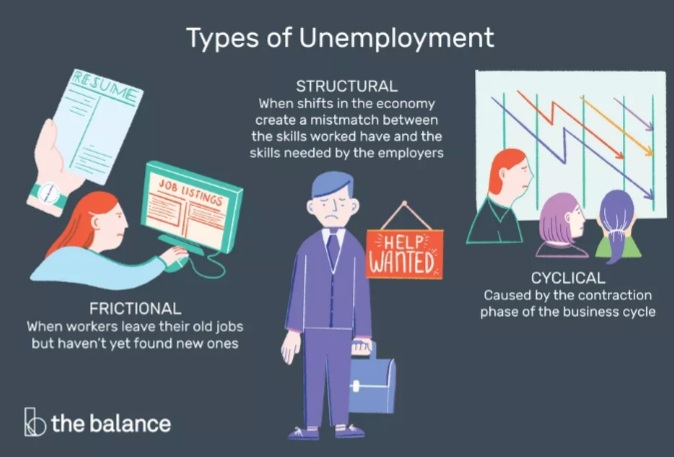
There are four main types of unemployment in an economy frictional, structural, cyclical, and seasonal and each has a different cause.
1. Frictional unemployment :
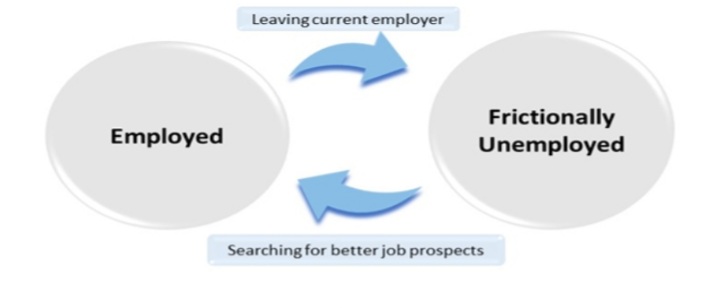
Frictional unemployment is caused by temporary transitions in workers lives, such as when a worker moves to a new city and has to find a new job. Frictional unemployment also includes people just entering the labor force, such as freshly graduated college students. It is the most common cause of unemployment, and it is always in effect in an economy.
2. Structural unemployment :
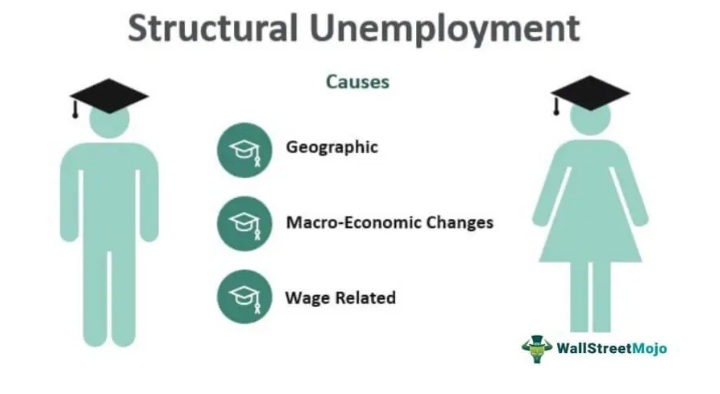
Structural unemployment is caused by a mismatch in the demographics of workers and the types of jobs available, either when there are jobs available that workers don’t have the skills for, or when there are workers availabes but no jobs to fill. Structural unemployment is most obvious in industries undergoing technological advancements.
3. Cyclical unemployment :
Cyclical unemployment is caused by declining demand. When there is not enough demand in an economy for goods and services, businesses cannot offer jobs . According to keynesian economics , cyclical unemployment is a natural result of the business cycle in times of recession: if all consumers become fearful at once, consumers will attempt to increase their saving at the same time, which means there will be a decrease in spending, and businesses will not be able to employ all employable workers.
4. Seasonal unemployment :
Seasonal unemployment is caused by different industries or parts of the labor market being available during different seasons. Fot instance, unemployment goes up in the winter months, because many agricultural jobs end oncr crops are have harvested in the fall, and those wotkers are left to find new jobs.
Consequences of unemployment in an Economy :
Low unemployment is key to economic stability High and long- term unemployment can cause significant stress on a nation in three key areas.
* Individuals :
Unemployed people have no ability to fulfill their financial obligations and can become mentally stressed, ill, and even homeless.
* Economic efficiency :
During times of high unemployment many job seekers will accept new jobs below their skill level, a situation called “underemployment ” which translates to a loss of human capital for an economys labor market. Unemployed workers will also significantly decreases their consumer spending, which is one of the driving forces of economic growth. Without consumer spending, the economy will slow dramatically.
* socio- political stability :
If unemployment remains high, citizen dissatisfaction can rise to the point of widespread civil unrest.
Possible solutions for Unemployment :
Solving unemployment is a hotly debated topic, and no economists agree on one simple way to do it. However, in the U.S ,if unemployment rises noticeably, the government usually steps in with specific policies designed to lower the total number of unemployed people.
1. Monetary policy :
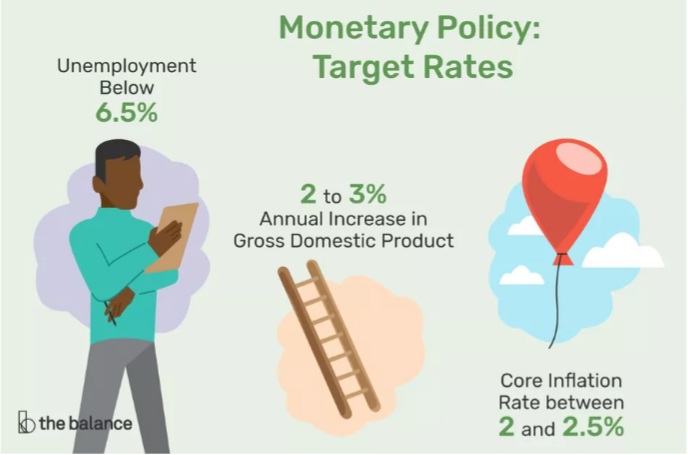
Monetary policy is financial influence implemented by a central bank . Monetary policies usually come in the form of lower interest rates, which increase the total money supply within an economy by allowing banks and businesses more access to loans and therefore, more accessible spending power.
2. Fiscal policy :
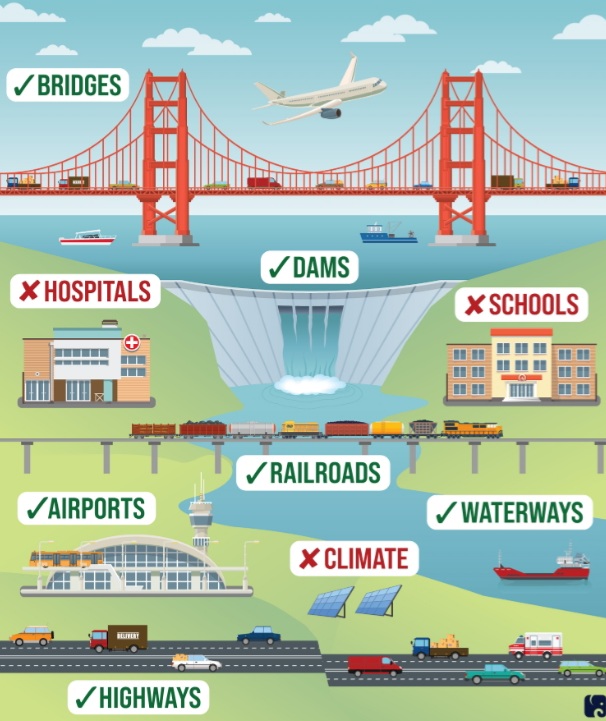
If expansionary monetary policy doesn’t adequately lower the unemployment rate government agencies will turn to fiscal policy. Fiscal policy is fiscal stimulus implemented by the national government and fiscal policies include spending on infrastructure, proposingtax cuts , increasing the minimum wage, or implementing unemployment benefits. These methods are designed to inject more demand into private economy and strengthen economic activity.
Let us now see some of the ways to motivate the students to study and get employeed.
• Make things easier :
Showing the things easier and explaining them with clarity helps the students to show better interest on the subject and makes them to pay more attention on what the teacher is trying to convey. When the topics are shown easier for the students, they start learning them and they feel achieved and they pay more attention to study. When a student learns a particular topic or a question, he/she feels comfortable and happy for getting it. Once if they start reading, they develop the interest in them and they continue to read more and more.
• Tell the importance :
The students must be motivated with good number of words to understand the need of studying and what happens if they don’t study. A student is like a bird without the wings when they don’t study. So, it is very important to motivate students to study and to make them understand the need of the situation. Motivation brings the right change in the students who are not interested in learning. It develops the interest in them to study.
It seems good if the government provides good number of jobs.
Education is very important in every individual’s life as it is very important for the living. The person who is educated will be well treated by the society and will you have good potential wherever he or she goes. Education as the extra energy to the individual’s life and a moles the individuals character into a good one. It is very important to be educated as the competition in the world is comparatively very high.
Online classes are the greatest and the biggest task to all the students. It is so difficult for all the students to understand the topics in a detailed manner. Even though the students try their level best to understand the topics during the online class, it is only the 50% of learning but the topics are not understood properly but the students and face lots of difficulties.
It is also equal difficult to conduct exams to all mine because it’s exams are connected through online then there is a chance formal practices. Basically, students commit malpractices during exams in a view to get good marks but not about the knowledge. So,many of the students commit malpractices.
Ways to improve the education system
* skill – based learning :
As of now , the education system is such that everyone is forced to study science and math. If this system can be revamped to identify the strengths of a student, then they can be given appropriate training in the chosen field. This will ensure that the child shines in that particular field.
* Rural Education :
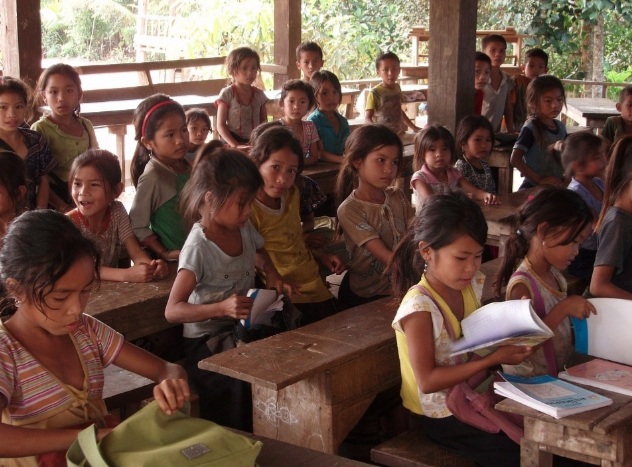
As the sad thing about the Indian education system is the fact that its focus is only on urban clusters. There are hardly any decent centres of learning in the rural areas. This is especially true in terms of higher education. If a country has to actually develop, urban and rural development have to go hand in hand.
* Gender Neutral Education :
The education system has always favoured men over the fairer sex. The major change that must be brought about is to involve women in the same. Particularly subjects that are now considered to be the strength of men alone ( like carpentry, engineering, etc). Should be made more accessible to women. Pioneer women in these fileds should be given due encouragement and appreciation.
* Teacher Training :
India has a very good quality of dedicated teachers. However, the sad fact here is the fact that after they join this service, they receive little or no training. In such a situation, giving them periodic training will not just ensure that they are updated with the changing times, but will also improve the entire education scene of the country by leaps and bounds.
* Infrastructure :
As in every other sector, the indian education sector is one that suffers from the acute death of infrastructure. Most of the government schools do not even have proper chairs, tables, restrooms, let alone a playground, libraries and laboratories. Thus ,the first step in revamping the education scene in the country should begin with improving the infrastructure so that the students are given an evironment where they can learn to the best of their abilities.
* subsidising professional courses :
It is a sad reality that many meritorious students are not able to afford professional corses because of the sheer expense involved in the same. This is all the way truer in case of students from the general category who do not have access to many scholarships. In such a situation subsidising the cost professional education will ensure that the same is within the reach of deserving students from the lower and lower middle class strata of the Indian society.
* Basic computing In Rural Areas :
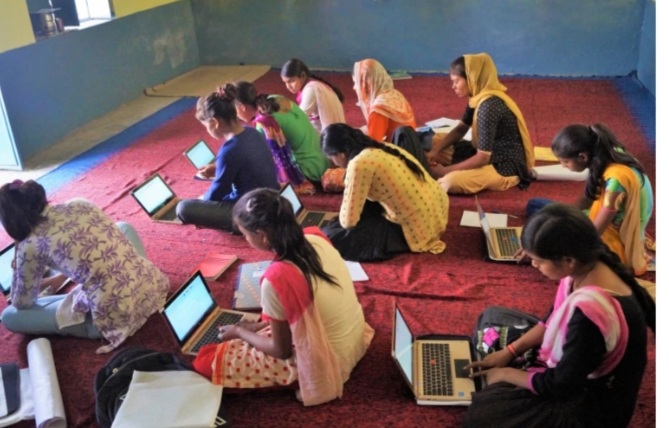
On one hand , India is a land of IT giants; on the other, rural India is completely digitally ill- equipped, in a sitiation like this, the first change that the education system must bring forward is to start free computing classes for skill development in rural areas. Only then will rural Indian move in the same pace as that of the urban Digital India and the country embark on the journey of development.
* Make sports compulsory :
One of the main reasons for the alarming rise in suicide amongst students in the country is the fact that they cannot handle stress. That in turn is because they are subjected to too much mental pressure. By making sports compusory it can be ensured that all the students indulge in some sort of some physical activity. This will lead to their mind performance better and enable them to grasp their theory lessons well.
* Educate parents :
Most of the times it is seen that the children’s woes centre atound that of their parents. In the Indian scenerio, parents are the ones who force their wards into a career they do not like. As a result students do not excel and upon failing to meet their parents expectations, they suffer from a number of mental health issues. To prevent such a thing from happening, the first step that must be taken is to educate the parents about the different carrer options that are available to the students and the possible scope of future in them.
* Remove The Reservation system :
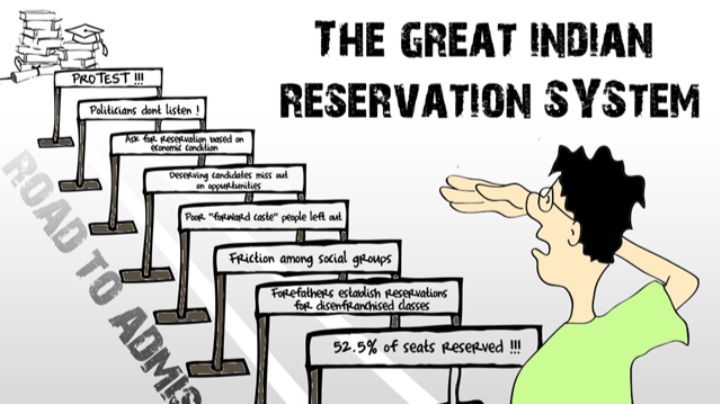
The reservation system in India has been so obsessed with providing the best of opportunities to the reserved that it misses out on many opportunities for the ones who actually deserve the same. This results in not just personal loss for certain people but also brain drain for the entire country and fosters a massive loss to the nation’s economy.
Today’s education system may be good to score marks, but fails to retain the knowledge once students have completed their examinations. This leads to young minds being stifled at an age when they should be asking questions, learning and gaining knowledge, and developing a thirst for more knowledge.
“The unthinkable is that we’re distorting this atmospheric balance. We’re shifting the chemical balance so that we have more poisons in the atmosphere – ozones and acid rain on ground level – while we’re also changing the thermal climate of the earth through the greenhouse effect and – get this – simultaneously causing destruction of our primary filter of ultraviolet light. It’s incredible. Talk about the national-debt crisis – we’re piling up debts in the atmosphere, and the piper will want to be paid.”
~ Michael Oppenheimer
Introduction
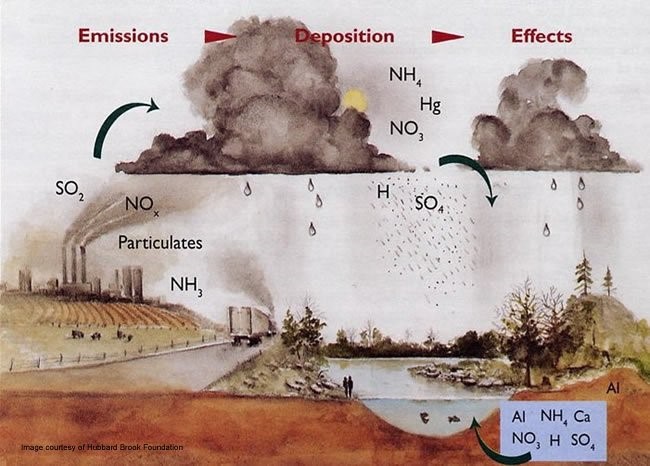
Acid rain, or acid deposition, is a broad term that includes any form of precipitation with acidic components, such as sulfuric or nitric acid that fall to the ground from the atmosphere in wet or dry forms. This can include rain, snow, fog, hail or even dust that is acidic.
Acid rain is caused by a chemical reaction that begins when compounds like sulfur dioxide and nitrogen oxides are released into the air. These substances can rise very high into the atmosphere, where they mix and react with water, oxygen, and other chemicals to form more acidic pollutants, known as acid rain.
It can have harmful effects on plants, aquatic animals, and infrastructure.
Effects of Acid Rain
The ecological effects of acid rain are most clearly seen in aquatic environments, such as streams, lakes, and marshes where it can be harmful to fish and other wildlife. As it flows through the soil, acidic rain water can leach aluminum from soil clay particles and then flow into streams and lakes.
Acid rain has been shown to have adverse impacts on forests, freshwaters, and soils, killing insect and aquatic life-forms, causing paint to peel, corrosion of steel structures such as bridges, and weathering of stone buildings and statues as well as having impacts on human health.
Acid rain also causes the corrosion of water pipes. Which further results in leaching of heavy metals such as iron, lead and copper into drinking water.
Prevention
1. The only precaution that we can take against acid rain is having a check at the emission of oxides of nitrogen and sulphur. 2. We have so far seen the details of acid rain and its harmful effect on animals, plants and the monuments. 3. Being responsible citizens, one should be aware of the harmful effects they cause and of the industries which give out nitrogen and sulphur compound wastes unethically. 4.A great way to reduce acid rain is to produce energy without using fossil fuels. Instead, people can use renewable energy sources, such as solar and wind power. Renewable energy sources help reduce acid rain because they produce much less pollution.
Acid Rain in India
Analysis of rainwater samples from Nagpur, Mohanbari (in Assam), Allahabad, Visakhapatnam and Kodaikanal in the decade 2001-2012 showed a pH level varying from 4.77 to 5.32, indicating that these places have actually been receiving ‘acid rain’. Rainwater with pH below 5.65 is considered acidic.
As energy requirements in India will grow rapidly in tune with the economy, coal dependence is expected to increase threefold over the current level of consumption, making the clouds of acid rain heavier over many highly sensitive areas in the country – the northeast, parts of Bihar, Orissa, West Bengal ,etc ,.
The rains in the Indian Ocean and the Arabian Sea and the Bay of Bengal have become acidic. Studies show the importance to regularly monitor more places for acid rains. But the mechanism to study acid rains is at present inadequate in India. imd stations are not located in the most polluted areas in the country.
The giant panda (panda bear/ panda) can be found in South Central China, primarily they live in China’s Yangtze river basin. Pandas were actually belongs to group of carnivorous animals but still it eats more of bamboo leaves and shoots. They occasionally eat grasses, wild tubers and even meat of birds or rodents.
Why giant pandas became endangered species of animals?
They were endangered mainly because of habitat loss. During the year of 1984 people of China started to clear bamboo forests which is needed more in number for the survival of pandas because they live in forests, they cannot adapt to live outside the forests and they also eat the same. People used to hunt them to make money from their skins. in the year 1990 pandas were declared as endangered.
Why pandas were removed from list of endangered species now?
After nearly 30 years of struggle to preserve species of giant pandas. Now there is an evidence documenting the increase in population of the pandas. Now 25% China’s land designated for ecological protection according to China’s State Council Information Office.
>>Stay connected to eduindex.org for more updates 🙂
Replacing traditional sources of energy completely with renewable energy is going to be a challenging task. However, by adding renewable energy to the grid and gradually increasing its contribution, we can realistically expect a future that is powered completely by green energy.
– Tulsi Tanti
A way to live a new life . Without any destruction , without worrying about the future . Live a life where we can grow together , develop a life with renewable resources.
Introduction
A renewable resource, also known as a flow resource, is a natural resource which will replenish to replace the portion depleted by usage and consumption, either through natural reproduction or other recurring processes in a finite amount of time in a human time scale.
When such recovery rate of resources is unlikely to ever exceed a human time scale, these are called perpetual resources. Renewable resources are a part of Earth’s natural environment and the largest components of its ecosphere. A positive life-cycle assessment is a key indicator of a resource’s sustainability.
Renewable resources are an energy source that cannot be depleted and are able to supply a continuous source of clean energy.
Renewable resources also produce clean energy, meaning less pollution and greenhouse gas emissions, which contribute to climate change.
Examples of renewable resources.
Biomass .
Biogas.
Tidal Energy.
Wind Energy.
Geothermal Energy.
Radiant Energy.
Hydro Electricity.
Compressed Natural Gas.
Types of renewable resources.
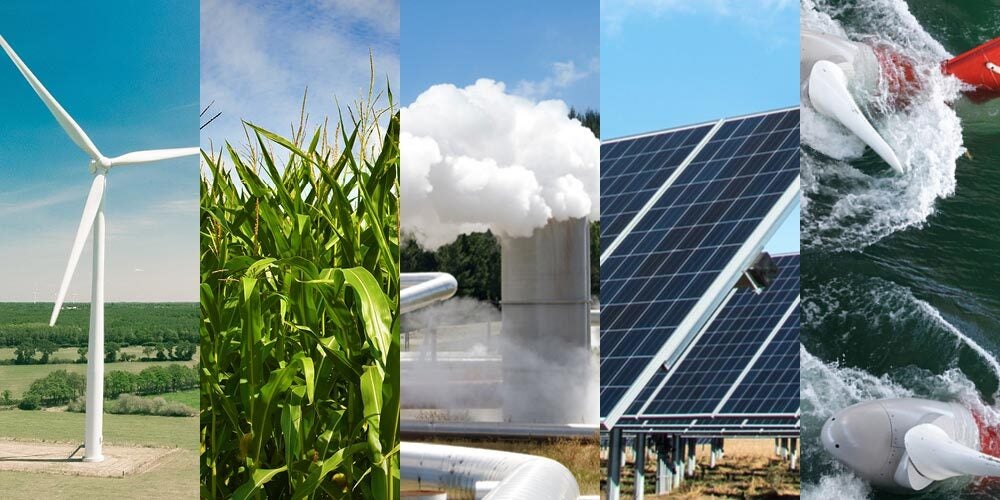
1) Solar energy. Sunlight is one of our planet’s most abundant and freely available energy resources. 2) Wind energy. Wind is a plentiful source of clean energy. 3) Hydro energy. 4) Tidal energy. 5) Geothermal energy. 6) Biomass Energy.
Impact of renewable resources.
Environmental impact
Renewable energy projects have also contributed in improving environmental impacts such as reduction of carbon dioxide gas, awakening community about the climate change. The study observed very small impacts on the people living in a particular area, tourism, cost of energy supply, and educational impacts. Significant impacts were observed in improvement of life standard, social bonds creation, and community development. They also observed that the renewable energy projects are complex to install and are local environmental and condition sensitive. Their forecasting, execution, and planning require more consideration and knowledge as compared to other projects.
Social impact
These resources also provide social benefits like improvement of health, according to choice of consumer, advancement in technologies, and opportunities for the work, but some basic considerations should be taken for the benefit of humans, for example, climate conditions, level of education and standard of living, and region whether urban or rural from agricultural point of view. Social aspects are the basic considerations for the development of any country. The following social benefits can be achieved by renewable energy systems: local employment, better health, job opportunities, and consumer choice.
Advantages of renewable resources.
Renewable energy won’t run out.
Maintenance requirements are lower.
Renewables save money.
Renewable energy has numerous health and environmental benefits.
Renewables lower reliance on foreign energy sources.
Higher upfront cost.
Intermittency.
Storage capabilities.
Conclusion
Renewable energy is becoming an important resource in all over the world . I do agree that people might exploit the resources for there own benefit . But the government is working on that aspect and trying to provide resources that can help our future households .
There are a lot of different ways of building a prosperous society, and some of them use much less energy than others. And it is possible and more practical to talk about rebuilding systems to use much less energy than it is to think about trying to meet greater demands of energy through clean energy alone.
Developers spend countless hours solving business problems with code. Then comes a never ending part where ops team’s turn to spend countless hours figuring out how to get the code that developers write up and running on whatever computers are available and making sure those computers operate smoothly. Serverless computing represents an enhancement of cloud programe models, abstraction, and platforms, and is a command to the attainment and wide acceptance of cloud technologies.
What is serverless computing?
Serverless computing is a cloud computing implementation model in which the cloud provider deals with machine resources on demand, taking care of the servers on behalf of their customers. It does not hold resources in volatile memory; computing is rather done in short bursts with the results persisted to storage. When an app is not in use, there are no computing resources allocated to the app. It is an execution model for the cloud in which Some of the Common languages supported by serverless runtimes are Java, Python and PHP. Amazon’s AWS Lambda was the first serverless platform and it defined several key dimensions including cost, programming model, deployment, resource limits,security, and monitoring. Supported languages include Node.js, Java, Python, and C programming. Initial versions had limited composability but this has been addressed recently.
Current trend
1.Google Cloud Functions : It provides basic FaaS functionality to run serverless functions written in Node. The functionality is currently limited but expected to grow in future versions.
2.Microsoft Azure Functions: It provides HTTP webhooks and integration with Azure services to run user provided functions. The platform supports C , Node.js, Python, PHP, bash, or any executable. The runtime code is open-source and available on GitHub under an MIT License. To ease debugging, the Azure Func-tions CLI provides a local development experience for creating, developing, testing,running, and debugging Azure Functions.
3.IBM OpenWhisk provides event-based serverless programming with the ability to chain serverless functions to create composite functions. It supportsNode.js, Java, Swift, Python, as well as arbitrary binaries embedded in a Docker Container. OpenWhisk is available on GitHub under an Apache open source license.Besides There are several serverless projects ranging from open source projects to vendors that find serverless a natural fit for their business. OpenLambda is an open source serverless computing platform. The source code is available in GitHub Lunder an Apache License. It’s paper outlines a number of challenges around performance such as supporting faster function startup time for heterogeneous language runtimes and across a load balanced pool of servers, deployment of large amounts of code, supporting stateful interactions (such as HTTP sessions), etc
4.AWS Lambda: It is a serverless compute service that lets you run code without provisioning or managing servers, creating workload-aware cluster scaling logic, maintaining event integrations, or managing runtimes. With Lambda, you can run code for virtually any type of application or backend service – all with zero administration. Just upload your code as a ZIP file or container image, and Lambda automatically and precisely allocates compute execution power and runs your code based on the incoming request or event, for any scale of traffic. You can set up your code to automatically trigger from over 200 AWS services and SaaS applications or call it directly from any web or mobile app. You can write Lambda functions in your favorite language (Node.js, Python, Go, Java, and more) and use both serverless and container tools, such as AWS SAM or Docker CLI, to build, test, and deploy your functions.
Advantages
1.No infrastructure to maintain :Serverless computer services, which are small snippets of code meant to execute a single function are executed on pre-existing servers that run functions for countless other customers as well. Since you’re literally using someone else’s computer to execute your serverless functions, there’s no infrastructure to maintain it.
2.No costs : when functions aren’t running As Hacker Noon points out, the costs associated with serverless computing are minimal compared to other cloud services. Access authorization, presence detection, security, image processing, and other costs associated with operating a server, whether physical or virtual, are eliminated under a serverless model. In short, serverless functions can be dirt cheap, and if they aren’t being spun up for use, you aren’t paying anything.
3.Infinitely scalable : Automatic scaling capability of any serverless platform worth investing in is designed to scale based on need. That’s another advantage to serverless computing as there’s never a need to partition a new cloud server or purchase additional computing power for an existing instance. All of that is handled by the serverless computing platform, leaving you with no complication outside of a slightly larger bill for additional computing time.
4.Reduced latency : Cloud flare points out that using serverless functions can greatly reduce the latency experienced by end users. Serverless functions don’t operate from an origin server, so there’s no single location that an end user’s traffic has to be directed to.
5.Reduced software complexity : Serverless computing functions don’t need to take any of that into account–the code just has to be supported by the cloud platform being used. On top of being easier to build, serverless functions require a lot less coding knowledge to build, which opens up development to those at lower skill levels. As cloud native systems inherently scale down as well as up, these systems are known as elastic rather than scalable. Small teams of developers are able to run code themselves without the dependence upon teams of infrastructure and support engineers; more developers are becoming DevOps skilled and distinctions between being a software developer or hardware engineers are blurring.
Disadvantages
1.Security issues : server that runs serverless functions runs them for myriad customers, which opens up a lot of security concerns.
2.Vendor lock-in : Building serverless functions on one platform can mean that migrating to another is difficult. Code might need to be re-written, APIs that exist on one platform may not exist. you’re going to invest in a serverless platform, be sure the vendor you’re considering has everything you need because becoming unhappy with your serverless computing provider a few months or years into your service can be a major problem.
3.Debugging is more difficult : Every time a serverless instance spins up it creates a new version of itself, and that means it’s difficult to collect data necessary to debug and fix a serverless function. Debugging serverless functions is possible, but it’s not a simple task, and it can eat up lots of time and resources.
Conclusion
Evolution of the trend towards higher levels of abstractions in cloud programming models, and currently exemplified by the Function as a Service (FaaS) model where developers write small stateless code snippets and allow the platform to man-age the complexities of scalably executing the function in a fault tolerant manner.This seemingly restrictive model nevertheless lends itself well to a number of common distributed application patterns, including compute intensive event processing pipelines. Most of the large cloud computing vendors have released their own serverless platforms.
How could it be possible that when the time gets worse we often ignore the vulnerable?
Nikhil Meshram
We are living in the world , where no one can intrude . A life , where you can’t touch the one you want . A life, where one has to stay away from his own . A life , where no one can go in one’s home . Yes , it’s a life we are living ‘ A life of a LOG’ .
Coronavirus , I believe it’s not a new word in your dictionary . This eleven letter word creating a massive destruction all over the world . I know you are well aware but the real question is , are you following the protocols properly?
Firstly let’s get some knowledge about coronavirus.
The origin .
The recent outbreak began in Wuhan, a city in the Hubei province of China. Reports of the first COVID-19 cases started in December 2019.
Coronaviruses are common in certain species of animals, such as cattle and camels. Although the transmission of coronaviruses from animals to humans is rareTrusted Source, this new strain likely came from bats, though one study suggests pangolins may be the origin.
However, it remains unclear exactly how the virus first spread to humans.
Some reports trace the earliest cases back to a seafood and animal market in Wuhan. It may have been from here that SARS-CoV-2 started to spread to humans.
Coronaviruses are a group of viruses that can cause disease in both animals and humans. The severe acute respiratory syndrome (SARS) virus strain known as SARS-CoV is an example of a coronavirus. SARS spread rapidly in 2002–2003.
The new strain of coronavirus is called severe acute respiratory syndrome coronavirus 2 (SARS-CoV-2). The virus causes coronavirus disease 19 (COVID-19).
Around 80%Trusted Source of people with COVID-19 recover without specialist treatment. These people may experience mild, flu-like symptoms. However, 1 in 6 peopleTrusted Source may experience severe symptoms, such as trouble breathing.
The new coronavirus has spread rapidly in many parts of the world. On March 11, 2020, the World Health Organization (WHO)Trusted Source declared COVID-19 a pandemic. A pandemic occurs when a disease that people are not immune to spreads across large regions.
It’s okay take a deep breath . Yes, it’s a lot to take in but we all know how china played with the whole world .
The protocols.
Wear masks ,
Wash hands ,
Use sanitizers ,
Social distancing , etc,.
Is it important to follow protocols ?
You say NO , I say ‘if you want to die you can easily ignore the protocols ’ . Well I don’t want to die , I have my whole 20s , 30s and so on…… .
According to the survey, people have been moving around freely, meeting different social groups and attending gatherings, going to malls and markets. This indicates that a pandemic fatigue has set in after after a year of restrictions on movement, social distancing and strict mask wearing norms.
Well , if you are saying this is what following protocols is than I am happy to stay home rather than chilling around like a monkey . Like really , a monkey also has a common sense that when to do chilling and when to fight for himself . What we are doing is putting masks in our pocket to showcase the world that I have one . Haha it’s kinda funny .
We long to return to normal, but **normal led to this**. To avert the future pandemics we know are coming, we MUST grapple with all the ways normal failed us. We have to build something better. I hope this piece, in showing what went wrong, helps.
Diamond mining in India dates back to ancient times. In the past, India was the only source of nearly all the world’s known diamonds, until the discovery of diamonds in South Africa in 1896. India has not been a major diamond-producing country since the 1900s, but diamond mining continues. But don’t we all know what is the price we have to pay for in order to make a mine?
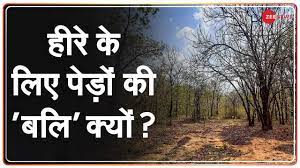
Not recently have the forests of Buxwaha been in news for the wrong reasons. The diamond mine project, which is now with Aditya Birla Group’s Essel Mining & Industries Limited (EMIL), is once again facing dark clouds due to protests over ecological concerns, as it could result in the felling of over 2 lakh trees. Yes, this is the rate of a diamond mine currently!
The 55,000-crore rupees mining project spans over 300 hectares in Madhya Pradesh’s Chhatarpur district, in the drought-prone Bundelkhand region. The block is estimated to have 34 million carats of rough diamonds. The existing diamond mine, National Mineral Development Corporation’s (NMDC) is about 175 kilometres from Bunder.
The proposed Bunder diamond block in the Chhatarpur district of Madhya Pradesh has been in the news for the wrong reasons over the years. The forests of Buxwaha, located near the site, are home to tigers, leopards, Indian foxes, sloth bears and other wildlife. The area is also rich in minor forest produce such as Tendu leaves and Mahua. Over 200,000 trees are expected to be cut in the Buxwaha forest for the diamond project. Environmentalists fear that the mining project would result in loss of biodiversity as well as air and water pollution.
The Forest clearance report shows that the project would cost over 200,000 trees in the forest region and also use a lot of water. We are against the environmental destruction in our area, which is already a water distress area,” said Sankalp Jain, a local youth who is associated with one of the groups running social media campaigns such as ‘save Buxwaha forest’ and ‘India stands with Buxwaha forest’ last month.
Credits: Mongababy
It is to be noted that the project, once operational, has the potential to become one of the largest diamond mines in the Asian region. The company targets the execution of the mining lease by the end of the financial year 2022. But what potential be praiseworthy where Mother Nature gets compromised? In addition to trees and wildlife, the amount of water needed to build the mine will dry out the already water-scarce region of Buxwaha. A dam is to be constructed to divert a seasonal nallah.
Expectedly the project is facing strong opposition, including social media campaigns. Already, a Public Interest Litigation has been filed in the Supreme Court of India, seeking a stay on the project that had been secured by the Essel Mining & Industries Limited in 2019. In 2006, the Madhya Pradesh government had granted a prospecting licence to Rio Tinto Exploration India Private Limited, an Australian mining giant, to explore diamond mining in the Buxwaha region in the Chhatarpur district. Opposition was done even then.
Effects of Mine
2,00,000 trees are no joke. The ecosystem is no joke. Imagine the countless number of animal species residing in the woods, the amount of oxygen and water that is retained by these green guys.
The residents fear a massive loss of trees, including teak, ken, behda, banyan, jamun, tendu, arjuna and other medicinal trees as well as the devastation of the natural ecosystem if the project proceeds further.
“Despite the claims to provide jobs in mining, I feel the project will eat out the livelihood options in the area.” said a resident of Kasera village- closest village to mining site.
The villagers are dependent on minor forest produce and water for farming. The project involves the diversion of a nullah which is a lifeline for the area. It ensures groundwater level and water for wildlife.This project will lead to groundwater depletion as well.
Environmental activist Hari Krishna Dwivedi said the “whole Bundelkhand region is facing a water crisis and this forest is essential for the local ecology”.
The homes of people are going to be uprooted. What progress is this that uproots tribal people who have lived in the region for hundreds of years and generations, tending to the forests and taking only as much is their wont?
Since ancient times to the modern world, the Higher Education System has always been remarkable in our country, India. From ancient Bharat to modern India, higher education has always occupied a place of prominence in Indian history. In ancient times, Nalanda, Taxila and Vikramsila universities were renowned seats of higher learning, attracting students not only from all over the country but from far off countries like Korea, China, Burma, Sri Lanka, Tibet and Nepal. Today, India manages one of the largest higher education systems in the world.
UGC
The University Grants Commission of India (UGC India) is a statutory body set up by the Government of India in accordance to the UGC Act 1956 under the Ministry of Education, and is charged with coordination, determination and maintenance of standards of higher education. It provides recognition to universities in India, and disbursements of funds to such recognized universities and colleges. The headquarters are in New Delhi, and it has six regional centers in Pune, Bhopal, Kolkata, Hyderabad, Guwahati and Bangalore. A proposal to replace it with another new regulatory body called HECI is under consideration by the Government of India. The UGC provides doctoral scholarships to all those who clear JRF in the National Eligibility Test. On an average, each year more than a $100 million is spent on doctoral and post-doctoral fellowships by the commission.
University grant commission logo
Basic information
Established
28 December 1953 First
executive
shanti Swaroop bhatnagar
Headquarter
new Delhi
Chairman
Dp Singh
Department
department of higher education, ministry of education
Sector
higher education
History
The present system of higher education dates back to Mountstuart Elphinstone`s minutes of 1823, which stressed on the need for establishing schools for teaching English and the European sciences. Later, Lord Macaulay, in his minutes of 1835, advocated “efforts to make natives of the country thoroughly good English scholars”. Sir Charles Wood`s Dispatch of 1854, famously known as the ` Magna Carta of English Education in India`, recommended creating a properly articulated scheme of education from the primary school to the university. It sought to encourage indigenous education and planned the formulation of a coherent policy of education. Subsequently, the universities of Calcutta, Bombay (now Mumbai) and Madras were set up in 1857, followed by the university of Allahabad in 1887. The Inter-University Board (later known as the Association of Indian Universities) was established in 1925 to promote university activities, by sharing information and cooperation in the field of education, culture, sports and allied areas.
The first attempt to formulate a national system of education in India came In 1944, with the Report of the Central Advisory Board of Education on Post War Educational Development in India, also known as the Sergeant Report. It recommended the formation of a University Grants Committee, which was formed in 1945 to oversee the work of the three Central Universities of Aligarh, Banaras and Delhi. In 1947, the Committee was entrusted with the responsibility of dealing with all the then existing Universities.
Soon after Independence, the University Education Commission was set up in 1948 under the Chairmanship of Dr. S Radhakrishnan “to report on Indian university education and suggest improvements and extensions that might be desirable to suit the present and future needs and aspirations of the country”. It recommended that the University Grant Committee be reconstituted on the general model of the University Grants Commission of the United Kingdom with a full-time Chairman and other members to be appointed from amongst educationists of repute. In 1952, the Union Government decided that all cases pertaining to the allocation of grants-in-aid from public funds to the Central Universities and other Universities and Institutions of higher learning might be referred to the University Grants Commission. Consequently, the University Grants Commission (UGC) was formally inaugurated by late Shri Maulana Abul Kalam Azad, the then Minister of Education, Natural Resources and Scientific Research on 28 December 1953.
The UGC, however, was formally established only in November 1956 as a statutory body of the Government of India through an Act of Parliament for the coordination, determination and maintenance of standards of university education in India. In order to ensure effective region-wise coverage throughout the country, the UGC has decentralized its operations by setting up six regional centers at Pune, Hyderabad, Kolkata, Bhopal, Guwahati and Bangalore. The head office of the UGC is located at Bahadur Shah Zafar Marg in New Delhi, with two additional bureaus operating from 35, Feroze Shah Road and the South Campus of University of Delhi as well.
In 1994 and 1995 the UGC decentralized its operations by setting up six regional centres at Pune, Hyderabad, Kolkata, Bhopal, Guwahati and Bangalore. The head office of the UGC is located at Bahadur Shah Zafar Marg in New Delhi, with two additional bureaus operating from 35, Feroze Shah Road and the South Campus of University of Delhi as well.
In December 2015 the Indian government set a National Institutional of Ranking Framework under UGC which will rank all educational institutes by April 2016.
Role
The main aim & role of UGC in higher education is to provide funds to universities and coordinate, determine & maintain the ethics in institutions of higher education. The commission upholds the interpretation among the universities, government, and the community. UGC has also set some standards for the universities for being UGC Approved Universities. With the growth of higher education in India, many top, medium, and small universities are being established day by day. Among these universities, there are many universities that are fake and not fit as per the UGC standards. Therefore, the University Grants Commission has released the list of Fake Universities in India to help the students to recognize these rejected universities
Functions
It provides funds and it also arranges for the coordination and maintenance of the universities in India. The UGC controls the following in India:
1.Maintaining the standard of research, teaching and examination in the university maintaining standards of teaching, examination and research in universities & Framing regulations on minimum standards of education.
2.It is a link between the union government and the institutes of higher education system.
3. It also advises the government about the steps to be taken in order to improve the education system.
4.Allocates grants to the universities and colleges out of its own funds for their development or other general purpose.Advises the central and state government on disbursing grants to the universities out of the Consolidated Fund of India. Advises any authority on the establishment of new university or on the proposal seeking expansion of any university.
5.Collects information on university education in India and in other countries.
6.Seeks information from the universities from time to time. The information may range from the financial position of the university, their various branches of learning to the rules and regulations followed in a particular university.
Imparts education to the students in various streams through its Country wide classroom teachings and a four-year old 24 hours educational channel ‘Vyas’.
8.Conducts National Eligibility Test (NET) through its National Educational Testing Bureau in a bid to determine eligibility for lectureship. It also awards Junior Research Fellowship (JRF), which has been set as the minimum standards for Indian nationals to enter teaching profession and research. Humanities (including languages), Forensic Science, Computer Science, Social Sciences, Environmental Sciences, and Applications and Electronic Science are the subjects in which a student can appear for a JRF.
9.The University Grants Commission has recently launched an ‘e-scripting’ course in television for all those students who want to make a career in broadcast media. The course is being run by its Consortium of Educational Communication, an Inter University Centre of the UGC on electronic media.
10.Monitoring developments in the field of collegiate and university education; disbursing grants to the universities and colleges.
Sanskrit was considered as “Dev Bhasha”, “Devavani” or the language of the Gods by ancient Indians. The word sanskrita, meaning “refined” or “purified”, is the antonym of prakrita, meaning “natural,” or “vulgar. The corpus of Sanskrit literature encompasses a rich tradition of poetry and drama as well as scientific, technical, philosophical and dharma texts.
Sanskrit is the most ancient language and perfect among the great languages in the world.It is the greatest treasure given to the world by ancient India.
Sanskrit is the primary sacred language of Hinduism, and has been used as a philosophical language in the religions of Hinduism, Buddhism, and Jainism. Sanskrit is a standardized dialect of Old Indo-Aryan, originating as Vedic Sanskrit as early as 1700-1200 BCE.
Vedic Sanskrit is the language of the Vedas, the most ancient Hindu scripts, compiled c. 1500-500 BCE. The Vedas contain hymns, incantations called Samhitas, and theological and philosophical guidance for priests of the Vedic religion. Believed to be direct revelations to seers among the early Aryan people of India, the four chief collections are the Rig Veda, Sam Veda, Yajur Vedia, and Atharva Veda. (Depending on the source consulted, these are spelled, for example, either Rig Veda or Rigveda.)
Vedic Sanskrit was orally preserved as a part of the Vedic chanting tradition, predating alphabetic writing in India by several centuries. Modern linguists consider the metrical hymns of the Rigveda Samhita, the most ancient layer of text in the Vedas, to have been composed by many authors over several centuries of oral tradition.
Sanskrit Literature began with the spoken or sung literature of the Vedas from c. 1500 BCE, and continued with the oral tradition of the Sanskrit Epics of Iron Age India, the period after the Bronze Age began, around 1200 BCE. At approximately 1000 BCE, Vedic Sanskrit began the transition from a first language to a second language of religion and learning.
Around 500 BCE, the ancient scholar Panini standardized the grammar of Vedic Sanskrit, including 3,959 rules of syntax, semantics, and morphology (the study of words and how they are formed and relate to each other). Panini’s Astadhyayi is the most important of the surviving texts of Vyakarana, the linguistic analysis of Sanskrit, consisting of eight chapters laying out his rules and their sources. Through this standardization, Panini helped create what is now known as Classical Sanskrit.
As we approach the change of times and as Indians rediscover their roots in their collective consciousness, we begin to reflect why and how the Europe-centric mind-set has pervaded and distanced us from our own languages, culture, traditions and knowledge. More and more countries are popularising the study of Sanskrit, not just for the spiritual, cultural and literary interest in the language, but also for the wealth of scientific knowledge available in Sanskrit texts.
Sanskrit is vital to Indian culture because of its extensive use in religious literature, primarily in Hinduism, and because most modern Indian languages have been directly derived from, or strongly influenced by, Sanskrit.
Knowledge of Sanskrit was a marker of social class and educational attainment in ancient India, and it was taught mainly to members of the higher castes (social groups based on birth and employment status). In the medieval era, Sanskrit continued to be spoken and written, particularly by Brahmins (the name for Hindu priests of the highest caste) for scholarly communication.
Today, Sanskrit is still used on the Indian Subcontinent. More than 3,000 Sanskrit works have been composed since India became independent in 1947, while more than 90 weekly, biweekly, and quarterly publications are published in Sanskrit. Sudharma, a daily newspaper written in Sanskrit, has been published in India since 1970. Sanskrit is used extensively in the Carnatic and Hindustani branches of classical music, and it continues to be used during worship in Hindu temples as well as in Buddhist and Jain religious practices. Sanskrit is a major feature of the academic linguistic field of Indo-European studies, which focuses on both extinct and current Indo-European languages, and can be studied in major universities around the world.
The corpus of Sanskrit literature encompasses a rich tradition of poetry and drama as well as scientific, technical, philosophical and dharma texts. Sanskrit continues to be widely used as a ceremonial language in Hindu religious rituals and Buddhist practice in the forms of hymns and mantras. The one country that still regards Sanskrit as a classical language containing merely religious literature is India. Sanskrit is a treasure and very relevant in the modern knowledge-society and is perhaps the future for science and technology.
Many universities in Europe and America are raising the level of Sanskrit proficiency in their departments, while India is still treating it as a third language meant to enhance scores in school transcripts, without real application. If there is one language that can be called the language of the future, it is undoubtedly Sanskrit.
“Humankind has not woven the web of life. We are but one thread within it. Whatever we do to the web, we do to ourselves. All things are bound together. All things connect.”
~ Chief Seattle
What is environmental pollution ?
Is it degrading our lifestyle ?
How can we improve our environment ?
Let’s get through the topic .
Introduction
One of the greatest problems that the world is facing today is that of environmental pollution, which is causing grave and irreparable damage to the natural world and human society with about 40% of deaths worldwide being caused by water, air and soil pollution and coupled with human overpopulation has contributed to the malnutrition of 3.7 billion people worldwide, making them more susceptible to disease.
Environmental pollution is defined as “the contamination of the physical and biological components of the earth/atmosphere system to such an extent that normal environmental processes are adversely affected.”
From: Environmental Management, 2017
We all are well known about the word Environmental pollution . It is not some kind of new phenomenon , yet it is a greatest problem facing by our society . Still , people are avoiding the topic to its utmost.
Environmental pollution is one of the most serious global challenges. Wild-type organisms have a slower degradation rate of hazardous materials.
Both developed and developing nations share this burden together, though awareness and stricter laws in developed countries have contributed to a larger extent in protecting their environment.
Reasons behind environmental pollution
The Burning of Fossil Fuels. Industrial Emission.
Indoor Air Pollution.
Wildfires.
Microbial Decaying Process.
Transportation.
Open Burning of Garbage Waste.
Construction and Demolition.
Urbanization and industrialization. Since the era of industrial revolution, man has continued to introduce hazardous materials into the environment at an alarming rate.Mining and exploration.
Agricultural activities.
Particulate matter.
Plastics.
Energy production.
Deforestation.
Mining.
Over population.
Increase in global average temperature.
Effects of environmental pollution
Environmental pollution is an incurable disease . It can only be prevented.
Barry commoner
1. Effects on Humans. The effects of environmental pollution on humans are mainly physical, but can also turn into neuro-affections in the long term. The best-known troubles to us are respiratory, in the form of allergies, asthma, irritation of the eyes and nasal passages, or other forms of respiratory infections. Other rarer diseases include hepatitis, typhoid affections, diarrhea, and hormonal disruptions.
2. Effects on Animals . Environmental pollution mainly affects animals by causing harm to their living environment, making it toxic for them to live in.
3. Effects on plants . As for animals, plants, and especially trees, can be destroyed by acid rains (and this will also have a negative impact on animals as well, as their natural environment will be modified), ozone in the lower atmosphere block the plant respiration, and harmful pollutants can be absorbed from the water or soil.
Solutions for environmental pollution.
Evironment planning.
Shifting to eco-friendly transportation.
Air pollution must involve moving away from fossil fuels, replace them with sustainable fuels .
Solar power .
Wind power.
Go green.
Storage facilities for solid waste.
Environmental friendly products.
Policies implimentation for environmental pollution.
We also need to work on electromagnetic radiation (ER) reduction.
Awareness through mass media.
More green parks and areas.
Environmental education, etc,.
“We say we love flowers, yet we pluck them. We say we love trees, yet we cut them down. And people still wonder why some are afraid when told they are loved.”
“We are, all of us, growing volcanoes that approach the hour of their eruption, but how near or distant that is, nobody knows- not even God.”
~ Friedrich Nietzsche
We always talk about , what it would be like to see volcano eruption in front of your eyes ?
How amazing it would be like to find out , how the volcano erupt ?
There are many things that we don’t know exist in our earth 🌍. Do you want to know about it . If yes , than read the editorial .
Introduction
A volcano is a rupture in the crust of a planetary-mass object, such as Earth, that allows hot lava, volcanic ash, and gases to escape from a magma chamber below the surface.
On Earth, volcanoes are most often found where tectonic plates are diverging or converging, and most are found underwater.
The word volcano is derived from the name of Vulcano, a volcanic island in the Aeolian Islands of Italy whose name in turn comes from Vulcan, the god of fire in Roman mythology.
Many ancient accounts ascribe volcanic eruptions to supernatural causes, such as the actions of gods or demigods. To the ancient Greeks, volcanoes’ capricious power could only be explained as acts of the gods, while 16th/17th-century German astronomer Johannes Kepler believed they were ducts for the Earth’s tears.[87] One early idea counter to this was proposed by Jesuit Athanasius Kircher (1602–1680), who witnessed eruptions of Mount Etna and Stromboli, then visited the crater of Vesuvius and published his view of an Earth with a central fire connected to numerous others caused by the burning of sulfur, bitumen and coal.
Types of eruptions
Hydrothermal eruption. An eruption driven by the heat in a hydrothermal systems.
Phreatic eruption. An eruption driven by the heat from magma interacting with water.
Phreatomagmatic eruption.
Lava.
Strombolian and Hawaiian eruptions.
Vulcanian eruptions.
Subplinian and Plinian eruptions.
How do volcanoes erupt?
Deep within the Earth it is so hot that some rocks slowly melt and become a thick flowing substance called magma. Since it is lighter than the solid rock around it, magma rises and collects in magma chambers. Eventually, some of the magma pushes through vents and fissures to the Earth’s surface. Magma that has erupted is called lava.
The explosivity of an eruption depends on the composition of the magma. If magma is thin and runny, gases can escape easily from it. Explosive volcanic eruptions can be dangerous and deadly.
Humans and volcanoes
Volcanic eruptions pose a significant threat to human civilization. However, volcanic activity has also provided humans with important resources.
Although volcanic eruptions pose considerable hazards to humans, past volcanic activity has created important economic resources.
Volcanic ash and weathered basalt produce some of the most fertile soil in the world, rich in nutrients such as iron, magnesium, potassium, calcium, and phosphorus.
Volcanic activity is responsible for emplacing valuable mineral resources, such as metal ores.
The paradox of volcanoes was that they were symbols of destruction but also life. Once the lava slows and cools, it solidifies and then breaks down over time to become soil – rich, fertile soil. She wasn’t a black hole, she decided. She was a volcano. And like a volcano she couldn’t run away from herself. She’d have to stay there and tend to that wasteland. She could plant a forest inside herself.





















































 Eduindex
You must be logged in to post a comment.