Psychological Disorders Part 8

Introduction

In Psychological Disorders Part 7, Depressive and Substance-Related disorders were discussed. They are both very serious disorders that need immediate help. Both can be dealt with by consulting a psychologist and taking the proper medication needed. This article will discuss Neurocognitive and Obsessive-Compulsive Disorders.

Neurocognitive Disorders

These disorders are accompanied by deficits in cognitive functioning. These are different from the disorders of impaired cognition present at birth.

Delirium is a serious disorder concerning disturbance in mental abilities that results in confused thinking and reduced awareness of the surrounding environment. Delirium is usually very rapid; it starts within hours or a few days. It usually arises because of contributing factors such as a chronic illness, changes in metabolic balance, medication, infection, surgery, or intoxication. It is important to note that delirium and dementia look very similar but are different. Symptoms for reduced awareness of the environment are the inability to stay focused or continuously switching topics, getting easily distracted by useless things, getting stuck on one idea, and being withdrawn. Symptoms for poor thinking skills are disorientation, poor memory, difficulty in speaking or recalling words, trouble understanding speech, rambling, and difficulty in reading or writing. Some of the behavioural changes are hallucinations, calling out or moaning, lethargy, disturbed sleep habits, agitation, being withdrawn, and reversal of the night-day cycle. Some of the emotional disturbances experienced are depression, euphoria, apathy, anxiety, paranoia, anger, unpredictable moods, and personality changes.

Neurocognitive Disorders used to be known as Organic brain syndrome. It is a group of conditions that leads to impaired mental function. These disorders usually occur in older people but that does not mean they cannot affect young adults. It includes problems with memory, changes in behaviour, trouble performing daily activities, and difficulty understanding language. These symptoms may be caused because of a neurodegenerative condition like Alzheimer’s disease or dementia. Neurodegenerative diseases result in the brain and nerves deteriorating over time which then causes loss of neurological function. Neurocognitive disorders can be a result of brain trauma or substance abuse. Symptoms for this are memory loss, confusion, anxiety, headaches, inability to focus, short-term memory loss, trouble performing normal tasks, changes in vision, and difficulty in walking and balancing. Some of the neurodegenerative diseases that cause this disorder are Alzheimer’s disease, Huntington’s disease, Parkinson’s disease, prion disease, dementia, and multiple sclerosis.

Obsessive-Compulsive Disorders

This is a category of psychiatric condition that includes obsessive-compulsive disorder (OCD), body-dysmorphic disorder, hoarding disorder, trichotillomania (hair-pulling disorder), excoriation disorder (skin picking), substance-induced OCD, and OCD because of a medical condition.
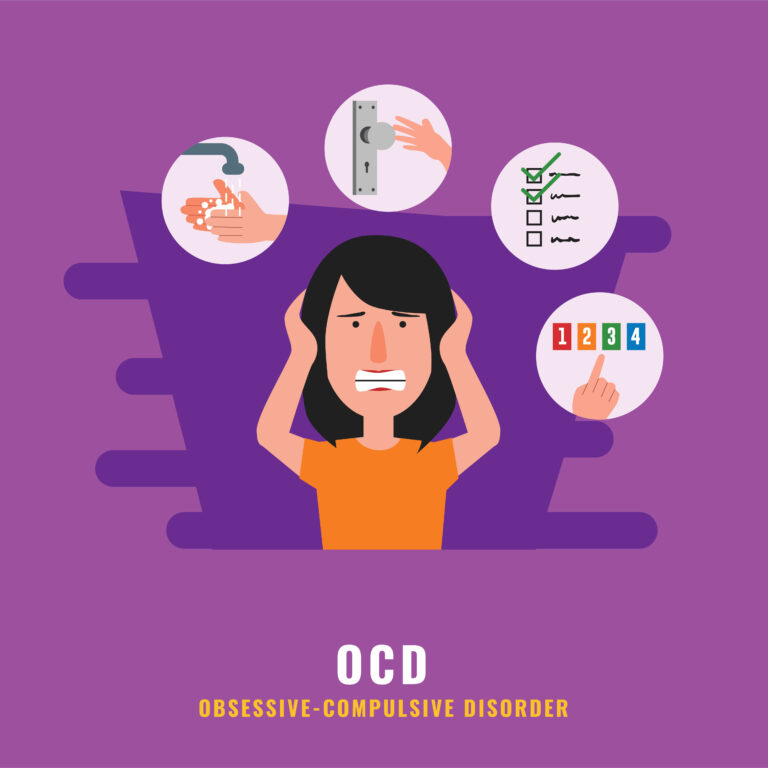
Obsessive-Compulsive Disorder is a pattern of unwanted fear (obsessions) which leads to doing repetitive behaviours (compulsions). This starts interfering in the daily activities. When a person tries to ignore the obsessions, the anxiety keeps increasing hence making the urge to do the compulsions stronger, and this is how the cycle of OCD is created. Obsessions usually have a theme such as fear of contamination, having difficulty tolerating uncertainty, needing things to be symmetrical, having horrific thoughts about losing control, and unwanted thoughts on religion or sexual subjects. Symptoms of obsession are fear of touching people because of contamination, doubts whether you have locked the door or turned off the stove, images of driving into a crowd of people, unpleasant sexual images, excessive stress when objects are not placed orderly, thoughts about acting inappropriately in public and avoiding situations that might trigger obsessions. Symptoms of compulsion are washing hands till the skin becomes raw, checking doors repeatedly, checking the stove repeatedly, counting in a pattern, silently repeating a word or phrase, and arranging things in a particular order.

Conclusion

Neurocognitive disorders remain chronic but they can be controlled and monitored by medication and therapy. There is no exact way to prevent OCD but it can be treated by consulting a psychologist and learning how to deal with the fears that lead to the compulsions.

References

Note: this is just Part 8 of the Psychological Disorders series.

MUST-READ TWO BOOKS BY PAULO COELHO – 2

Paulo Coelho wrote many best-selling books most of which are popular all around the world. And translated in various languages. One of his masterpieces is Alchemist. All of his works are related to self-help and motivational genres.

Book: Veronica Decides To Die

Veronica is a young woman who commits suicide due to being full of emptiness in her life. While she waiting for death after taking a lot of sleeping pills she fainted and found herself in an asylum alive. But Doctor said that she has only a few days to live due to a heart condition caused by the overdose. Her presence there affects all of the mental hospital’s patients, especially Zedka, who has clinical depression; Mari, who has panic attacks; and Eduard, who has schizophrenia, and with whom Veronika falls in love. At least she wants to live or not is the key base of this novel.

Why you should read this book: 

This one is not a boring plot, book content moves slow still does not let you drop the idea to read it. And this contains good vocabulary which is worth recommending to every reader. If you ever tried or at least thought once to end your life read this one it will make you believe in Miracle. 

Book Quotes:

People never learn anything by being told, they have to find out for themselves.

You are someone who is different, but who wants to be the same as everyone else. 

You have two choices, to control your mind or to let your mind control you.

Note: This book is also adapted as a film by Emily Young in 2009. 

Book: The Spy

Mata Hari, the beautiful woman, the dancer, the courtesan, and the spy. She was the center of attraction wherever she goes… As a dancer she delighted her audiences, as a courtesan, she bewitched the richest and powerful men of the era. But is she really a spy? 

Why you should read this one:

This book is based on real events. Mata Hari is a real person who is accused of espionage and executed.

On the back cover, it says, “Fiction.” But, I would rather love to say it’s a historical work. 

When a man sleeps with many women, do we care to say any terms? So, I can’t criticize Mata Hari for being a courtesan. 

In this work, I can visualize how men treated women as an object during those time. They gave preference for outer appearance. They wanted their wife to be loyal. But, those rules aren’t for them. And those things made my heart shrunk.

Book Quotes:

I decided to be who I always dreamed of. And the price of a dream is always high.

When we don’t know where life is taking us, we are never lost. 

At this moment, I look back at my life and realize that memory is a river, one that always runs backward.

Recommendations:

I don’t recommend both of these books to children especially if you are younger than sixteen. One book contains intimate scenes and another one contains sexual harassment scenes. Thus I would like to recommend these to elder readers who are more than sixteen.

TWO MUST-READ BOOKS OF PAULO COELHO https://eduindex.org/2021/07/18/two-must-read-books-of-paulo-coelho/

BOOK REVIEW: THE DA VINCI CODE https://eduindex.org/2021/07/19/book-review-the-da-vinci-code/

Poverty

Poverty! Poverty is lack of food, Poverty is lack of shelter, Poverty is being sick and can not afford medicines, Poverty is knowing how to read but can’t afford going to School, Poverty is being unemployed. And Poverty is lack of representation and freedom.Poverty has so many faces, and can describe in different ways. Most often, poverty is a situation people want to escape.

We have to take the step to reduce poverty so that many more may have enough food to eat, adequate shelter to cover their head, access to education and health.Overpopulation and underdevelopment in the country is the main cause for poverty. The birth rate in India is very high and the former has taken the measure of the ‘one child policy’ to change the situation, but the latter has not made any effort yet.

Underdevelopment is another reason, the country do not have enough economic growth to support their growing populations.Poverty in India can eradicate with some effective programmes, just need a joint effort from everyone not only from the government. Government of India should make effective policies aiming to develop rural areas through the key components like primary education, population control policies, family welfare, job creation and many more.

We can define poverty as the condition where the basic needs of a family, like food, shelter, clothing, and education are not fulfilled. It can lead to other problems like poor literacy, unemployment, malnutrition, etc. A poor person is not able to get education due to lack of money and therefore remains unemployed. An unemployed person is not able to buy enough & nutritious food for his family and their health decline. A weak person lacks the energy required for the job. A jobless person remains poor only. Thus we can say that poverty is the root cause of other problems.

How Poverty is Measured?

For measuring poverty United nations have devised two measures of poverty – Absolute & relative poverty.  Absolute poverty is used to measure poverty in developing countries like India. Relative poverty is used to measure poverty in developed countries like the USA. In absolute poverty, a line based on the minimum level of income has been created & is called a poverty line.  If per day income of a family is below this level, then it is poor or below the poverty line. If per day income of a family is above this level, then it is non-poor or above the poverty line. In India, the new poverty line is  Rs 32 in rural areas and Rs 47 in urban areas.

Causes of Poverty

According to the Noble prize winner South African leader, Nelson Mandela – “Poverty is not natural, it is manmade”. The above statement is true as the causes of poverty are generally man-made. There are various causes of poverty but the most important is population. Rising population is putting the burden on the resources & budget of countries. Governments are finding difficult to provide food, shelter & employment to the rising population.

The other causes are- lack of education, war, natural disaster, lack of employment, lack of infrastructure, political instability, etc. For instance- lack of employment opportunities makes a person jobless & he is not able to earn enough to fulfill the basic necessities of his family & becomes poor. Lack of education compels a person for less paying jobs & it makes him poorer. Lack of infrastructure means there are no industries, banks, etc. in a country resulting in lack of employment opportunities. Natural disasters like flood, earthquake also contribute to poverty.

In some countries, especially African countries like Somalia, a long period of civil war has made poverty widespread. This is because all the resources & money is being spent in war instead of public welfare. Countries like India, Pakistan, Bangladesh, etc. are prone to natural disasters like cyclone, etc. These disasters occur every year causing poverty to rise.

Ill Effects of Poverty

Poverty affects the life of a poor family. A poor person is not able to take proper food & nutrition &his capacity to work reduces. Reduced capacity to work further reduces his income, making him poorer. Children from poor family never get proper schooling & proper nutrition. They have to work to support their family & this destroys their childhood. Some of them may also involve in crimes like theft, murder, robbery, etc. A poor person remains uneducated & is forced to live under unhygienic conditions in slums. There are no proper sanitation & drinking water facility in slums & he falls ill often &  his health deteriorates. A poor person generally dies an early death. So, all social evils are related to poverty.

Government Schemes to Remove Poverty

The government of India also took several measures to eradicate poverty from India. Some of them are – creating employment opportunities, controlling population, etc. In India, about 60% of the population is still dependent on agriculture for its livelihood. Government has taken certain measures to promote agriculture in India. The government constructed certain dams & canals in our country to provide easy availability of water for irrigation. Government has also taken steps for the cheap availability of seeds & farming equipment to promote agriculture. Government is also promoting farming of cash crops like cotton, instead of food crops. In cities, the government is promoting industrialization to create more jobs. Government has also opened  ‘Ration shops’. Other measures include providing free & compulsory education for children up to 14 years of age, scholarship to deserving students from a poor background, providing subsidized houses to poor people, etc.

Poverty is a social evil, we can also contribute to control it. For example- we can simply donate old clothes to poor people, we can also sponsor the education of a poor child or we can utilize our free time by teaching poor students. Remember before wasting food, somebody is still sleeping hungry.

Photo by namo deet on Pexels.com

HOW DO YOU PRESENT YOURSELF…

Presentation is very important and crucial part in everyone’s life, because at some point everyone should go through this presentation. Basically, we do think that presenting ourselves is an easy thing, Yes indeed it is , but if you follow some tips then you can present yourself in an extraordinary way and style. Here in this article we’ll be sharing some important tips to be noted and remembered for a wonderful presentation. Let’s look at them one by one.

5P’s of Presentation: The five p’s of presentation are planning, preparation, consistency, practice and performance.

TIPS FOR A GOOD AND HEALTHY PRESENTATION:

1.The first thing to be kept in your mind is you should prepare for the presentation, if it is informed to you beforehand.

2.It’s better to practice or make a trail performance before you give your original presentation.

3.Do not byheart everything that you wanted to convey in your presentation, but just remember the main points that you want to highlight or speak about, and so you can proceed your talk based on the main points.

4.Try to learn the correct pronunciation of the words that you find hard , vocabulary is important for an effective talk.

5.If you are presenting through some PPT presentation or something like that, you need to speak out the points relating to the slides.

6.Be confident in talking, if you get nervous before the gathering, it won’t look good, so try to practice before a mirror or before your close friends if you have the stage fear.

DO’S DURING PRESENTATION:

1.Firstly introduce yourself .You should talk confidently whatever you feel like talking, instead of uttering the words in a confused way.

2.You need to maintain proper pitch in your speech,  it leads to effective presentation.

3.Next, your body language. It includes, your hand gestures, facial expressions, body posture, eye contact, touch and use of space. If all the above were maintained in an orderly manner it gives the interest to the audience.

4.Your flow should be balanced, because you should neither speak like an express train nor be like a tortoise, so balance should be maintained.

5.Connect with the audience, keep your eye contact and keep a smile on your face, use your voice effectively.

6.Keep your speech simple, and tell some stories in between to create interest among the audience.

7.Keep yourself relaxed, breathe and convey with full confidence.

DO NOT’S DURING PRESENTATION:

1.You should never doubt in your talk, feel free and speak what’s in your mind.

2.Do not cover yourself like folding your hands or keeping hands tight etc., it delivers that you’re not confident enough and it shows your nervous feel.

3.Do not look at the script and keep on reading if you have a script with you, because you should keep eye contact with the gathering.

4.If you are showing some slides, do not reading the whole sentences from the slides as it is.

5. Do not try to make it fast and cut short your works, like if it’s and hour presentation do not end it within 30 minutes.

6.Don’t end your talk by simply summarizing what you have talked about.

7. If place is given, try to move and talk, instead of standing at the same place like an idol.

8.While using your gestures, do not move them very frequently but move accordingly.


*ALWAYS TRY TO GIVE YOUR BEST IN YOUR PRESENTATION AND SO NO NEED TO CONSIDER THE REST OF THE THINGS…

*KEEP A SMILE ON YOUR FACE,BREATHE AND CONVEY HEARTHFULLY…

BELIEVE YOU CAN SUCCEED AND YOU WILL SUCCESS

 BELIEVE YOU CAN SUCCEED AND YOU WILL
SUCCESS :-

 positive things. Success means personal prosperity: a fine home, vacations, travel, new things, manual security, giving your children maximum advantages. Success means winning admiration, leadership, being looked up to by people in your business and sodalite. Success
means freedom: freedom from worries, fears, frustrations, and
failure. Success means self-respect, continually fading more real
happiness and satisfaction from life, being able to do more for
those who depend on you.
Success means winning.
Success~achievement~is the goal of life!

HOW TO DEVELOP THE POWER OF BELIEF:-

 Here are the three guides to acquiring and strengthening the
power of belief:
1. Think success, don’t think failure. At work, in your home,
substitute success thinking for failure thinking. When you
face a difficult situation, think, ”I’ll win,” not ‘Til probably

YOU CAN BUY WEALTH BUT NOT HEALTH..

As we all are aware that, “Health is Wealth”. It is important to take care of our health, because if you lost it then, no one is going to give you your perfect health even if you pay lakhs of rupees. God gives good health to every human, but it is in our hands whether to keep it good or make it worse. Health is not only being physically fit but being mentally healthy. To be physically fit, we need to eat healthy and exercise, and to be mentally health, avoid negative thoughts.

SOME WAYS TO BE PHYSICALLY HEALTY AND FIT:

1.Eat healthy, whatever you eat, eat with love and satisfaction, don’t hate your food.

2.Take foods like fruits, vegetables and, homemade meat dishes instead of Fast foods.

3.Eat fully, make your tummy happy, if you eat half and if you stay half empty, it leads to health issues.

4.Prefer homemade foods, because the homemade is filled with love and tastes good.

5.Eat whatever you like, but have a limit, because anything more is poison though.

6.Excercise daily, drink more water, maintain your physic. 

7.Avoid bad habits like Smoking, drinking, taking drugs etc.

SOME WAYS TO BE MENTALLY HEALTHY:

1.Firstly, to be mentally healthy, you need to avoid negative thoughts.

2.You should accept all the situations of life, may be happy or sorrow times.

3.Receive everything with love, even if it hurts you, try to accept it, then your mind feels free.

4.Spend time with your family and beloved ones, instead of always running after earning money.

5.Think positive, Be positive, Do positive, Receive positive and Stay positive.

6.Do not overthink about anything, don’t stress your mind 

I want to tell some important things before I end this article. 

  • It’s better to buy healthy foods like fruits, veggies etc. instead of buying medicines.
  • It’s better to drink fresh water instead of drinking soft drinks and hard drinks as well.
  • It’s better to have homemade food instead of having harmful food(fast foods).
  • It’s better to think about something useful and worthy instead of overthinking about something unnecessary.
  • It’s better to share your sorrow, instead of feeling depressed.
Finally, stay fit and healthy both physically and mentally..

Insecurity

Everyone feels a little unsure at times. As humans, we constantly think, and some of our thoughts can be filled with doubt. This can lead to thoughts of insecurity. Too much insecurity can lead to other problems — in relationships and in your everyday life. However, there are ways you can work through your insecure thoughts and live life more confidently.

What Is Insecurity?

Insecurity is a feeling of inadequacy (not being good enough) and uncertainty. It produces anxiety about your goals, relationships, and ability to handle certain situations. Everybody deals with insecurity from time to time. It can appear in all areas of life and come from a variety of causes. It might stem from a traumatic event, patterns of previous experience, social conditioning (learning rules by observing others), or local environments such as school, work, or home. It can also stem from general instability. People who experience unpredictable upsets in daily life are more likely to feel insecure about ordinary resources and routines.On the other hand, insecurity can have no definite, external cause. Instead, it can appear as a quirk of personality or brain chemistry. Understanding the nature of insecurities can help you manage your own and offer others the support they need.  

Types of Insecurity:

There are almost limitless areas of potential insecurity. Moreover, insecurity often bleeds over from one area of life into another. However, there are some types of insecurity that appear frequently.

Relationship Insecurity: One of the most common kinds of insecurity concerns relationships or “attachments.” Attachment theory originated out of a desire to connect the attachment patterns of early childhood to later relationship patterns and expectations. When a child’s “attachment figures”, often parents or guardians, aren’t reliably available and supportive, the child often feels insecure, forms a negative self-image and relationship models, and experiences greater emotional distress and maladjustment later in life. Relationship or attachment insecurities don’t need to begin in early childhood. They can arise wherever previous experience or personal insecurity undermines someone’s security in their closest relationships.

Job Insecurity: Job insecurity occurs when you are anxious about your continued employment or about the continuation of certain benefits attached to your employment. It can be triggered by anxiety over your own job performance or anxiety over factors beyond your control, such as the economy, industry trends, workplace conflict, or the danger of company restructuring or failure. High rates of unemployment and temporary work increase job insecurity on a national scale and contribute to widespread mental health problems.

Body Image Insecurity : A common source of insecurity is body image. Many people feel insecure about the way they look and question whether they measure up to an imposed ideal. There is no necessary connection between actual body health or appearance and body insecurity. People of all body types can experience this type of insecurity.

Social Insecurity/Anxiety : Another common type of insecurity surrounds the way we are perceived by our peers and the ease with which we interact with them. This insecurity can be a recurring, low-level problem or can blossom into full-blown social anxiety disorder or social phobia.

Signs of Insecurity:

Signs of insecurity are as variable as the condition itself, but there are some common tendencies you can look out for.

Low or Superficial Self-Esteem : One sign of insecurity is low self-esteem or negative self-image, particularly when that image seems to be inconsistent with external observation. Low self-esteem means you think badly about yourself or your abilities. It can lead to other problems, especially concerning mental health. Talk to a doctor if your self-esteem is very low.Because the measurement of self-esteem generally relies on self-report, insecurity can lead to superficial self-esteem. People with insecurity often want to appear secure, and their explicit comments may be at odds with their automatic responses to certain stimuli. Deliberate self-misrepresentation or false behavior/information on social media can also be a sign of social anxiety. The act of faking then reinforces the social insecurity.

Perfectionism : The inability to be satisfied with progress and need to control and refine projects until they’re perfect can be a sign of insecurity. It stems from the sensation that you or your performance is never enough. It can appear as a manifestation of insecurity in any area of life but is frequently found in cases of job insecurity and body insecurity. Eating disorders, for example, often appear along with both harmful perfectionism and attachment insecurities.

Self-Isolation : Social insecurity can lead people to avoid social interactions, isolating themselves. Sometimes these people prefer to interact virtually in internet situations they feel they can control.

Anxious or Avoidant Attachment Styles : Attachment insecurities often result in problematic attachment styles, or dysfunctional approaches to relationships. The two most common are anxious or avoidant attachments. Anxious attachment styles are characterized by emotional dependence (relying on someone else for your emotional well-being), a fear of being alone, and fantasies of perfect relationships that can never be fulfilled. Avoidant attachment styles also stem from insecurity but go in the other direction. People with this style tend to keep relationships superficial and disengage from more intimate connections.

Poor Job Performance : Job insecurity (not having a stable job) can work to motivate some people, but it more often results in poorer performances. It can lead to absenteeism (avoiding work), turnover intention (wanting to change jobs soon after starting), disengagement from colleagues and in group projects, and poor work attitudes.

Depression or Anxiety : All types of insecurity can lead to decreased mental wellness. Depressive or anxious behavior or thinking is often an effect of insecurity, particularly when that insecurity produces (or is accompanied by) erroneous beliefs and patterns of thought.

Dealing with Insecurity :

Occasional insecurity is a natural part of life. For deeper and more longer-lasting feelings of insecurity, however, professional therapists can help you sort through your emotions and develop strategies for everyday life. In dealing with insecurity, there are a couple of helpful tips to keep in mind.

Social Networks Matter : Broad and meaningful social networks — frinedships, relationships with coworkers, and more — help to lessen both insecurity and its negative effects. There’s an inverse correlation between healthy social networks and insecure attachment styles. Having a wide circle of friends and many close connections allows you to develop the tools and confidence to engage in deeper adult relationships.Developing good friendships both in and out of the workplace also has a proven record of success as a coping strategy that helps prevent job insecurity, depression, and general anxiety. People who disengage from colleagues in response to job insecurity more frequently suffer in their mental health and job performance.

Trust Takes Practice : While having an overly trusting behavior creates its own problems, ask yourself if you have any reason to distrust expressions of affection or liking from others. People with insecurities sometimes express doubt and perceive rejection in everything from partner relationships to new acquaintances. These expressions can be self-fulfilling. Practice taking displays of interest at face value, something that can be easier in more casual relationships. You can build up the confidence to accept deeper affection and intimacy.

Google Digital Unlocked -Explained

According to Wikipedia, Digital Unlocked is an initiative by Google in collaboration with the Indian School of Business and Ministry of Electronics and Information Technology to promote digital awareness and to help small-scale businesses and startups to go digital in India.

In this blog, We’ll try to build a good insight of Google Digital Unlocked and also about its Certification, which you might be planning to appear for.

What is Google Digital Unlocked?

Google has established a platform to assist Startups, business owners, students, and anybody who is willing to understand the process of conducting business online and the online marketing and growth strategies.
It is in cooperation with the Indian School of Business as well as the Ministry of Electronics and Information Technology. It is designed to aid small and medium businesses by teaching them the necessary digital knowledge which can be utilized to set up an online presence for companies.

What Courses are provided in Google Digital Unlocked?

It offers a spectrum of courses to choose from. There are 136  Google digital unlocked courses available, as of now. These courses can be grouped together in three categories which are as follows :-

  • Digital Marketing
  • Data and Technology
  • Career Development

Is Google Digital Unlocked Couse and its Certification Free?

Yes, the courses are offered free of cost and so are the certifications, if included.

The only condition applied is that you must finish all the lessons of a particular course in order to unlock the examination which is an evaluation for certificate eligibility. 

To get certified in a particular course, a candidate should obtain a score of 80 percent or more. There are 3 attempts provided, so make sure you make up in these attempts.

Why Google Digital Unlocked?

Image Source – Google

The key reason to go for Google Digital Unlocked is the brand value that Google has.

The certification provided will be of utmost value and will boost the individual’s CV.
Moreover, the majority of the courses are free, and are approved by industry experts, top entrepreneurs and some of the world’s leading employers.
So you can be sure that you’re learning an up-to-date, real-world skill that will help you reach your goal.

Key Features of Google Digital unlocked

  • Variety of Courses
  • Learn at your own pace
  • Flexible and personalized training
  • Learn at the comfort of your home
  • Anytime access
  • Get certified

Start Learning

Fundamentals of Digital Marketing, Basics of Code, Digital Wellbeing, Effective Networking, Business Communication and many more.

QUESTIONS YOU NEED TO AS YOURSELF BEFORE STARTING A BUSINESS

1. Why are you starting the business?

First of all defining the why behind what you are doing is most important, If you aren’t clear about why you are doing what you are doing then its better to quitting that thing.


2. What value are you going to add in other peoples life?

Ask yourself whether you are going to add value to other peoples life, whether you are going to bring comfort in others life. If the answer is yes, then definitely your business will sustain in the market.

3. How well are you mentally prepared to start the business?

For starting a business you need to be mentally strong enough. Running a business includes a lot of problem solving tasks, pressure ,bear losses, patience. Therefore you need to be mentally strong enough to handle all such situations.

4. Is there any easier way ?

Most entrepreneurs think if the problem is hard then there should be a complicated solution to the complicated problem but if your are creating any product then always think how you can make it more easier for its end consumers.

5. Is it really worth it ?

Ask yourself that it is actually worth it doing this particular thing because you are going to spend a lot of time on that thing, I know you can’t predict this too early but being realistic is more important that being optimistic.

LEARNING LESSONS FROM THE BOOK : THE PSYCHOLOGY OF MONEY

1. Use money to gain control over time, because the ability to do what you want, when you want, with whom you want , for as long as you want to, pays the highest dividend that exists in finance.

2. Wealth is what you don’t see, its hidden, it is the oncome that you have not spent and that is the fastest way to be wealthy, not spending the money you have and doing its opposite will never make you wealthy.

3. Wealth is just the accumulated leftovers after you spend what you take in. And since you can build wealth without a high income, but have no chance of building wealth without a high savings rate, its clear which one matters more.

4. Do not aim to be coldly rational( by looking at the spreadsheet) when making financial decisions. Aim to just be pretty reasonable. Reasonable is more realistic and you have a better chance of sticking with it for the long run.

5. Like everything else worthwhile, successful investing demands a price. But its currency is volatility, fear, doubt, uncertainity, and regret and you have to view them as fees( a price worth paying to get something nice in exchange).

What is Bipolar Disorder?

Bipolar disorder, also known as manic depression, is a mental illness that causes extreme mood swings between emotional highs (mania or hypomania) and lows (depression). The word bipolar itself means two extremes. Hence, it is a mental health condition characterized by extreme shifts in moods and mental states. Depression causes feelings of sadness or hopelessness, and you lose interest or pleasure in most life activities. When your mood shifts to mania or hypomania, you may feel euphoric, full of energy or unusually irritable. These mood swings can affect sleep, energy, activity, judgment, behavior and the ability to think clearly. People with bipolar disorder may have trouble managing everyday life tasks at school or work, or maintaining healthy relationships. There is no known cure, but there are many treatment options available that can help to manage the symptoms. 

Causes

The exact cause of bipolar disorder is unknown, but several factors may be involved. For example, researchers believe that certain people with bipolar disorder have biological differences that cause chemical imbalances in the brain. There is also the factor of genetics, as bipolar disorder is more common in people who have a first-degree relative, such as a sibling or parent, with the condition.

Types

  • Bipolar I disorder: This involves manic episodes lasting 7 days or more, or severe mania that requires hospitalization. The person may also experience a major depressive episode that lasts 2 weeks or more. Thus, this type is characterized by extreme and severe highs and lows.
  • Bipolar II disorder: This features both mania and depression, but the mania is less severe than in bipolar I, and doctors call it hypomania. A person with bipolar II may experience a major depressive episode preceding or following a manic episode. Hence, here there are briefer, less extreme periods of elation with longer periods of depression.
  • Cyclothymic disorder: Also known as cyclothymia, this type includes symptoms of hypomania and depression that last for 2 years or more in adults or 1 year in children. These symptoms do not fit the criteria for wholly manic or depressive episodes.
  • Other types: People with these disorders experience symptoms that do not fall into the above categories. The symptoms may stem from drug or alcohol use or medical conditions, for example.

Symptoms

The three main symptoms of this illness are those mentioned earlier; mania, hypomania, and depression. These symptoms also vary depending on the type of bipolar disorder. The most serious type is Bipolar I, where a person experiences both mania and depression very deeply.

Mania is an emotional high that makes people feel excited, impulsive and euphoric. But these exceed ordinary feelings of joy, causing racing thoughts, rapid speech, sleeplessness, hypersexual feelings, and risky actions. Hypomania is generally associated with bipolar II disorder. It is similar to mania, but not as severe.

Depression causes things like low mood, dwindling interest in hobbies, changes in appetite, feeling worthless, sleeping too less/too little, and suicidal thoughts. Basically, life loses all colour for a person experiencing depression, and it is very hard for them to enjoy anything or feel any positive emotions.

Treatment

Though it cannot be cured, bipolar disorder can be controlled with treatment. Medication is the cornerstone of bipolar disorder treatment, and psychotherapy can help many patients learn about their illness and how to cope with it, preventing future mood episodes. Treatment aims to stabilize the person’s mood and reduce the severity of symptoms. The goal is to help the person function effectively in daily life.

Medications known as ‘mood stabilizers’, such as lithium, are the most commonly prescribed type of medications for bipolar disorder. These medications are believed to correct imbalances in brain signaling. Because bipolar disorder is a chronic illness in which mood episodes typically recur, ongoing preventive treatment is recommended. Bipolar disorder treatment is individualized, as individuals react differently and symptoms vary widely. It is important to get a correct diagnosis and find a suitable treatment as per the individual.

People suffering from bipolar disorder have their life split in two realities; elation and depression. For someone constantly bouncing between emotional states, it can be hard to find the balance which will help lead a healthy life. Hence, we should also support the people in our lives suffering from bipolar disorder and help them cope with such extreme and debilitating emotions.

MAJOR LEANINGS FROM THE BOOK : THE 5 AM CLUB

1. The first hour of the day is the golden hour and thus in the first hour from 5 am to 6 am applying  the 20/20/20 formula can truly change your performance of the whole day.

2. It states that the first 20 minutes are for exercising, the next 20 minutes are for growing i.e. reading or listening podcast or audiobooks.

3. By performing these activities you awaken the 4 interior empires( mindset, heart set, soul set, and health set) because if you want to experience empires in your outer life you need to develop your inner ones first.

4. Waking up at 5 am can enhance peoples productivity and happiness and as a result people can achieve an epic height of success in their professional as well as personal life.

I recommend everyone reading this blog to please read this book once.

HAPPY READING ; )

Thank you!

Delhi University: Societies-Importance for students

The Delhi University is well- known for its academics as well as extra- curriculum. It offers a variety of courses in its affiliated and recognised colleges. Students dream of getting admission to DU colleges. Equally are important the societies of DU as much is its academics. They upskill the students and provide a platform to grow and develop. Societies are a good way to improve yourself and prepare for the future. You can take part in any of the societies as per your (career) choice or hobby. It can be a single or multiple based on your capability to manage things but there are some procedures to be selected for a society in DU. Yes, you have to clear either interviews or auditions to be a member. Some are open societies too, i.e. anyone can enter them but you surely have to participate actively and do hard work to make them a success and make your college proud.

What do the DU societies offer to its students ?

  • There are a number of societies in DU which serve the needs of your career along with making you enjoy the membership.
  • It often makes up a small family or a big group of friends where age is no bar; all three year’s students enjoy and party together besides managing the society.
  • It not only builds a community but also introduce you to the corporate world. You get ready for the formal world by participating in the college activities and also get a chance to launch your own ventures.
  • The staff is very supportive in colleges and always ready to assist the newbies. You will never feel alone or bored once you take part in a college society.
  • You will always feel engaged yet enjoy the moments. There won’t be much burden of work but hard work is a necessity in them.

What are the types of societies in DU ?

  • Social service

You will find some student-led societies that work for the welfare of the people especially who are in need. They provide them assistance either by organising food drives or book donation, etc. to help them out. It feels great to have the youth concerning for the nation and putting forward a step to improve the conditions. The students work their best under the guidance of the college staff and sets up a good example for the upcoming ones.

  • Career related

They help the university students get an exposure to the outside world and sharpen their skills. They provide with opportunities to learn and explore. It could be either by assigning responsibilities in the society itself or outside, i.e. through placements in the corporate world. You will learn while doing and would never regret it. Such societies/cells prepare a student for the formal world full of responsibilities and new opportunities to grow.

  • Hobby / Passion

It’s not necessary to always worry for future, instead you should not worry at all since it spoils the joy of the moment. Think about the present and take up a role you would enjoy forever. There are dance societies, fashion societies, creative writing societies and many more which you can choose as per your hobby or passion to pursue. Usually, their selection process is not hard to crack. You will enjoy a lot in the activities of such society if it matches your preference.

Photo by Helena Lopes on Pexels.com

This is too less to say perhaps. The offerings and advantages can’t be listed better than the real experience a person gets. Besides societies, there are cells and units as well, which too, are student-led. The biggest opportunity and advantage is that the societies are run by the students themselves. They manage the operations their own way but in accordance with university rules. The exposure a student gets especially during college fests is hard to express in short lines. You meet the giant community of the university during fest season.

The societies surely have their own classifications and departments bearing responsibilities and hard work based on good knowledge. It seems easy but actually is difficult, to run such organisations at college level. You need to manage time for that and also grow along to keep up with others’.

How Indian Education System is getting infected due to Appraisal of Online Classes

Photo by Julia M Cameron on Pexels.com

All our lives have been paused and shattered due to the arrival of the Covid 19 Virus which has devasted humans Globally and created tough times for every Human being who is striving to survive from this fatal disease.

It is no surprise how this deadly virus has become horrible nightwear for everyone and it provided a gift of Loss in every section of society. Globally it had provided huge losses in all types of professional fields. In these challenging times, one of the major sectors had been at a sea since a massive breakdown in the education sector due to the online classes and pandemic life.

Indian Students and unfavorable effects of Covid 19 on Education System :

 It is majorly remarked that 1.2 billion children in 186 countries have been affected by school closures due to the epidemic of the Covid Virus. There is no doubt that E-Learning platforms have gained wide recognition in such time and the importance of technology in the world of humans has portrayed that human needs Technology to survive in such tough times.

As per in the field of Education sector it is noticed that India has around 320 Million learners who had shifted to E-Learning since the nation closure. Living in the era where E-Learning has become a prominent part of every student’s life, has also shown how difficult it has become for both students and teachers in India.

Since India is still a developing country, there are several drawbacks that Indians are facing in this Contemporary Epidemic. The situation of the education system is worse than the deadly disease which is slaughtering human communities.

India being the world’s 2nd largest school system, after China, has certain factors which are weakening the academic life of students, among these factors, there are several factors:  

  1. Lack of  Sufficient Network Ability: As looking into the current situation, Internet consumption has been a major necessary element in a pandemic life. Everyone coming from all sorts of backgrounds and fields needs network connectivity for their respective purpose to fulfil.

The youngsters significantly need network broadband for their daily online classes and as a student network has become a mandatory part to get educated in the present condition. But sadly the scenario of Rural Indian households is much worsening as we get to observe that fewer than 15%, have Internet access ( as opposed to 42% of Urban Indian households).

  • Gender Barrier is still a Hindrance: This might be an unreal fact to process for many people, but rural Indian household is still not developed in gender equality and educating there children especially when it comes to the girl child. 8.5% of Females use the Internet in Rural India and suffer from the obstacle of getting education because either due to unavailability of network or due to prioritizing male child teachings. Hence, there has been more number of dropouts of children from the online education system.
  • Online System – A major obstacle for the older generations :

In our education system, not only students are suffering from the inconvenience set by the online classes, but it is also the teacher community that is in a state of perplexing when it comes to the usage of technology.

There are times when technology made our elder generations uncomfortable because it is something new for them to learn. In this instance, many teachers leave their jobs due to the uncomfortable environment set by the online classes.

So we can say that online classes are somewhere a curse for everyone in the education system.

Future Generation striving with the adversity:   

Though the times are tough for everyone, as a human we should have the enduring capacity to work on our weakness.

Prominently, the youngsters, who would be the future minds must keep this as a note that, as millennial generations, we have many opportunities to turn the curse into a blessing and provide inspiration for many people globally.

As students, we can create an environment a comfortable zone for the teachers and our elders by making them aware of technology, and that we will be some minute steps which can make our country a developed country and not developing.

Gig Economy

What Is the Gig Economy?

In a gig economy, temporary, flexible jobs are commonplace and companies tend to hire independent contractors and freelancers  instead of full-time employees. A gig economy undermines the traditional economy of full-time workers who often focus on their career development.

Understanding the Gig Economy

In a gig economy, large numbers of people work in part-time or temporary positions or as independent contractors. The result of a gig economy is cheaper, more efficient services, such as Uber or Airbnb, for those willing to use them. People who don’t use technological services such as the Internet may be left behind by the benefits of the gig economy. Cities tend to have the most highly developed services and are the most entrenched in the gig economy. A wide variety of positions fall into the category of a gig. The work can range from driving for Lyft or delivering food to writing code or freelance articles. Adjunct and part-time professors, for example, are contracted employees as opposed to tenure-track or tenured professors. Colleges and universities can cut costs and match professors to their academic needs by hiring more adjunct and part-time professors.

The Factors Behind a Gig Economy

America is well on its way to establishing a gig economy, and estimates show as much as a third of the working population is already in some gig capacity. Experts expect this working number to rise, as these types of positions facilitate independent contracting work, with many of them not requiring a freelancer to come into an office. Gig workers are much more likely to be part-time workers and to work from home. Employers also have a wider range of applicants to choose from because they don’t have to hire someone based on their proximity. Additionally, computers have developed to the point that they can either take the place of the jobs people previously had or allow people to work just as efficiently from home as they could in person.

Economic reasons also factor into the development of a gig economy. Employers who cannot afford to hire full-time employees to do all the work that needs to be done will often hire part-time or temporary employees to take care of busier times or specific projects. On the employee’s side of the equation, people often find they need to move or take multiple positions to afford the lifestyle they want. It’s also common to change careers many times throughout a lifetime, so the gig economy can be viewed as a reflection of this occurring on a large scale.

During the coronavirus pandemic of 2020, the gig economy has experienced significant increases as gig workers have delivered necessities to home-bound consumers, and those whose jobs have been eliminated have turned to part-time and contract work for income. Employers will need to plan for changes to the world of work, including the gig economy, when the pandemic has ended.

Criticisms of the Gig Economy

Despite its benefits, there are some downsides to the gig economy. While not all employers are inclined to hire contracted employees, the gig economy trend can make it harder for full-time employees to develop in their careers since temporary employees are often cheaper to hire and more flexible in their availability. Workers who prefer a traditional career path and the stability and security that come with it are being crowded out in some industries.

For some workers, the flexibility of working gigs can actually disrupt the work-life balance, sleep patterns, and activities of daily life. Flexibility in a gig economy often means that workers have to make themselves available any time gigs come up, regardless of their other needs, and must always be on the hunt for the next gig. Competition for gigs has increased during the pandemic, too. And unemployment insurance usually doesn’t cover gig workers who can’t find employment.

In effect, workers in a gig economy are more like entrepreneurs than traditional workers. While this may mean greater freedom of choice for the individual worker, it also means that the security of a steady job with regular pay, benefits—including a retirement account—and a daily routine that has characterized work for generations are rapidly becoming a thing of the past.

Lastly, because of the fluid nature of gig economy transactions and relationships, long-term relationships between workers, employers, clients, and vendors can erode. This can eliminate the benefits that flow from building long-term trust, customary practice, and familiarity with clients and employers. It could also discourage investment in relationship-specific assets that would otherwise be profitable to pursue since no party has an incentive to invest significantly in a relationship that only lasts until the next gig comes along.