Have you visited The Sahara Desert? or the Snow-capped mountains of Switzerland? If you haven’t, it’s perfectly alright. Why visit so far when you can see such places in India too. India has deserts, snow-covered mountains, waterfalls, historic places, and a lot of greenery. You name it and we have it! There are so many breathtakingly beautiful places in India that one doesn’t need to go out.
Here are some spots you should visit before you kick the bucket.
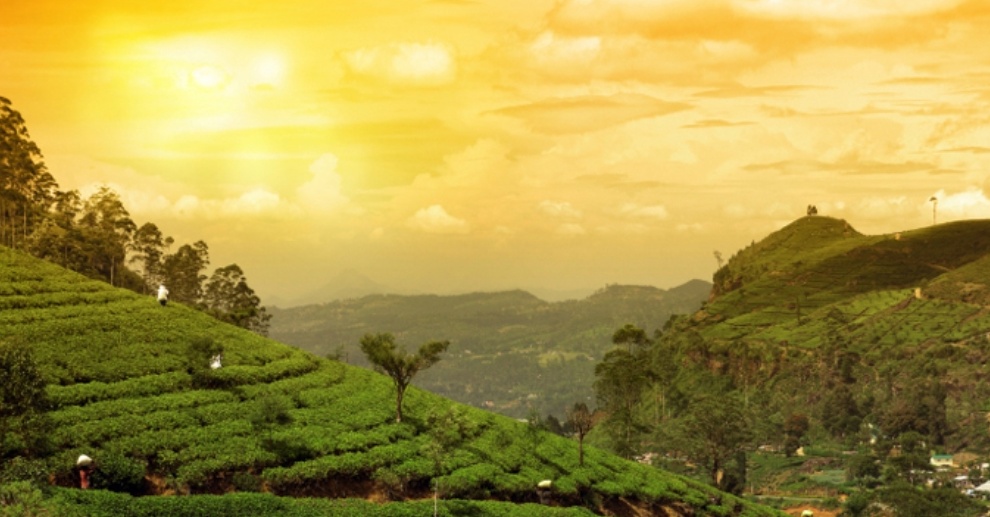
• Tea Garden Hills of Munnar
Munnar is situated in God’s own country, Kerala. It is a famous hill station in Kerala. It is well-known for its tea plantations and lush green hills. The best time to visit these tea garden hills is between November – February.
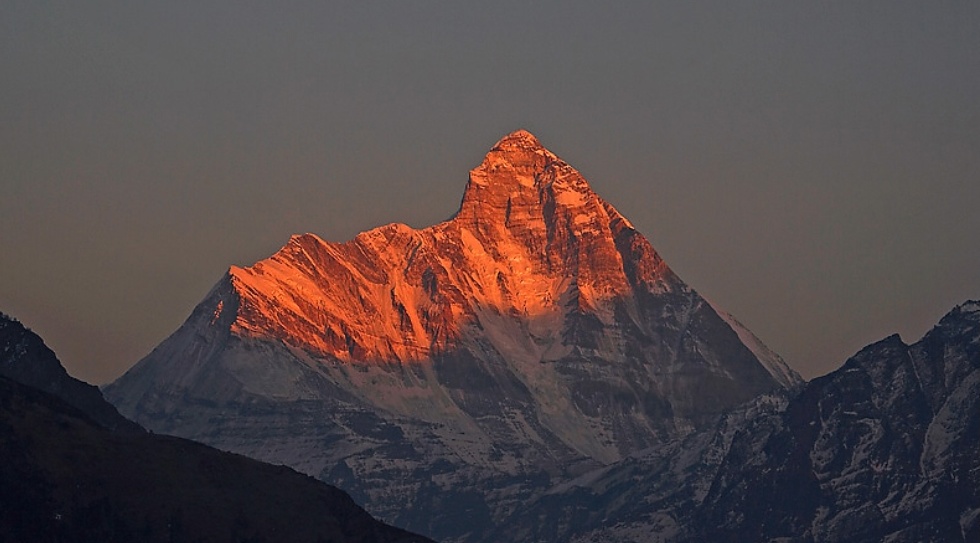
• Nanda Devi
Nanda Devi is the second-mosy noteworthy mountain in India. It is located in the Himalayan Mountains in the northern part of India. It is extremely famous for its remarkable view. From 15 June to 15 September is the best time to visit Nanda Devi.
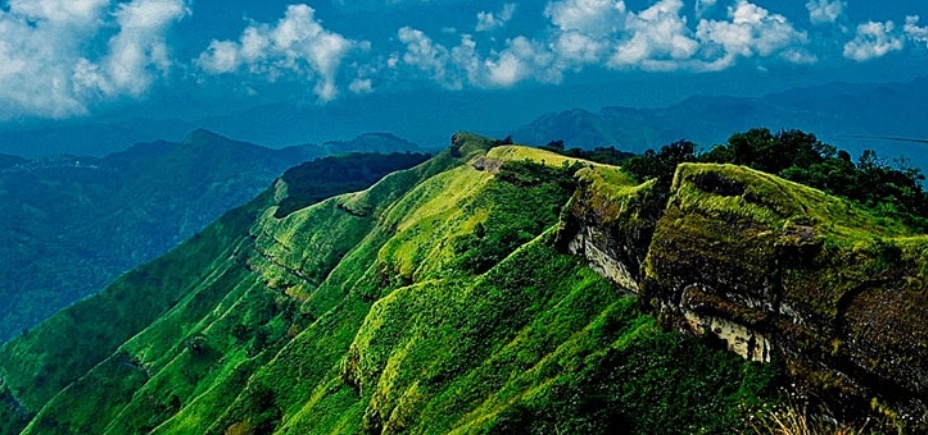
• Mizoram
Mizoram is a land of hills, lakes, rivers, and valleys. It is a state in northeastern India. It is known for its evergreen hills, rivers, and high sparkling waterfalls. The best time to visit Mizoram is during October, November, and December.
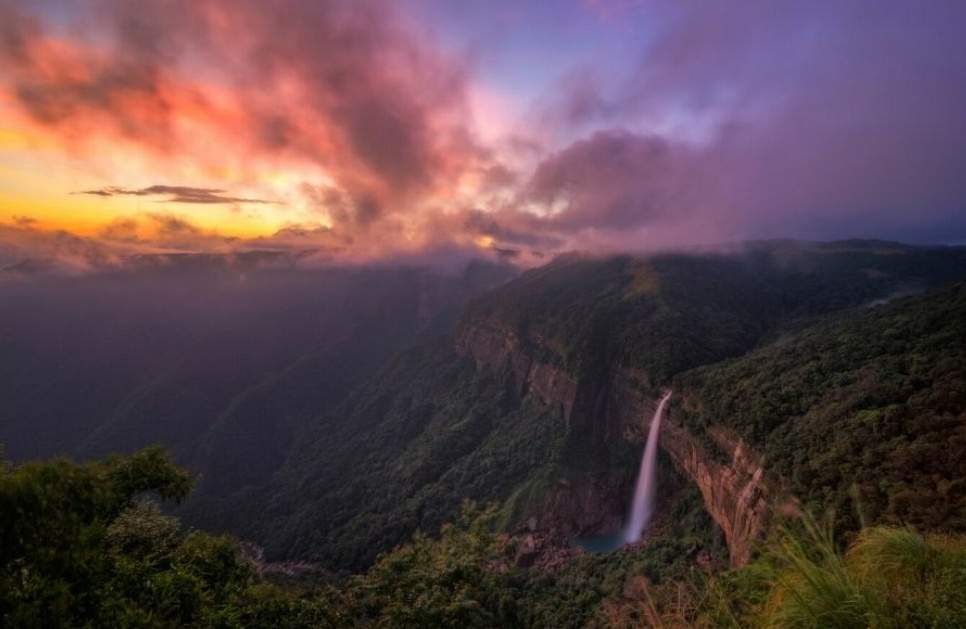
• Nohkalikai Falls, Cherrapunji
Nohkalikai is the highest waterfall in India. It is located in the state of Meghalaya which is in the northeastern part of the country. It is known as the wettest place on Earth The best time to visit is in September and October.
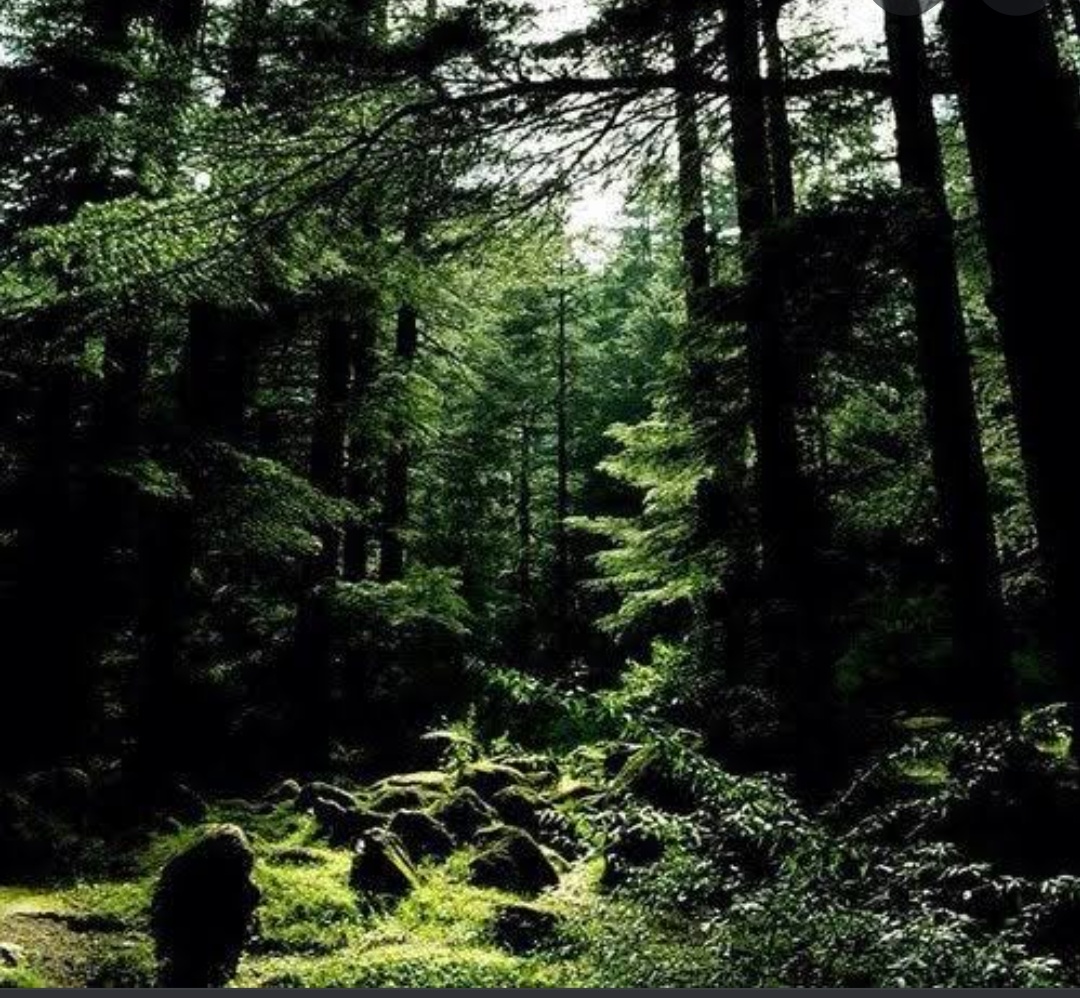
• Deodar Forest, Himachal Pradesh
Deodar forest is located in Himachal Pradesh and it is famous for its pine trees, Cedrus deodar tree species. The best time to visit is between February to June.
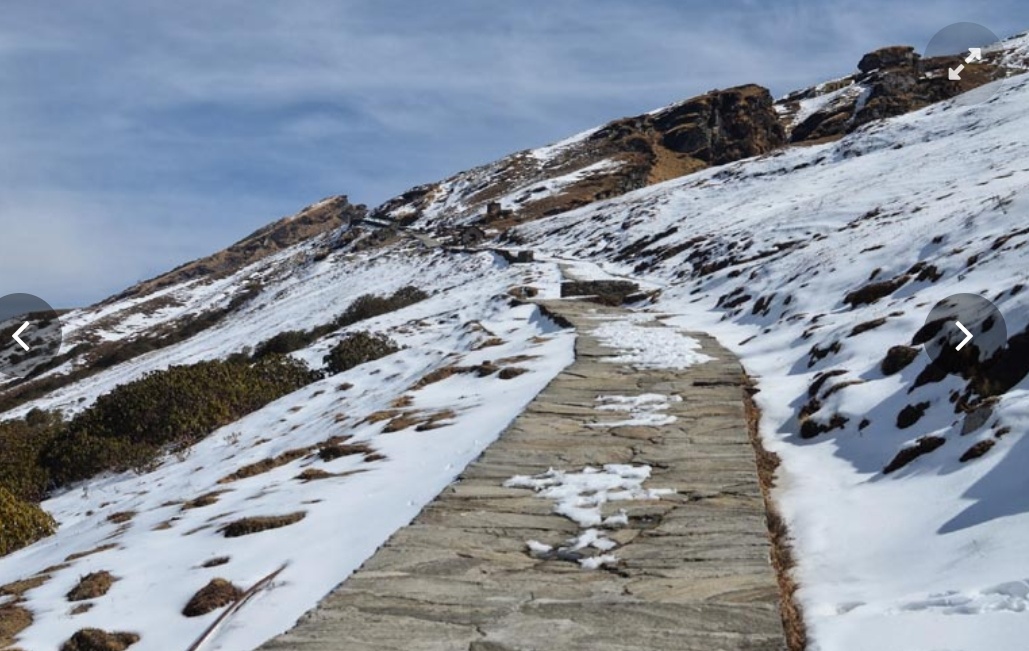
• Tungnath, Uttarakhand
You can find the oldest Hindu Shrine of Lord Shiva here surrounded by the tungnath mountains. It is the best place if you’re looking for a trek. One can visit throughout the year
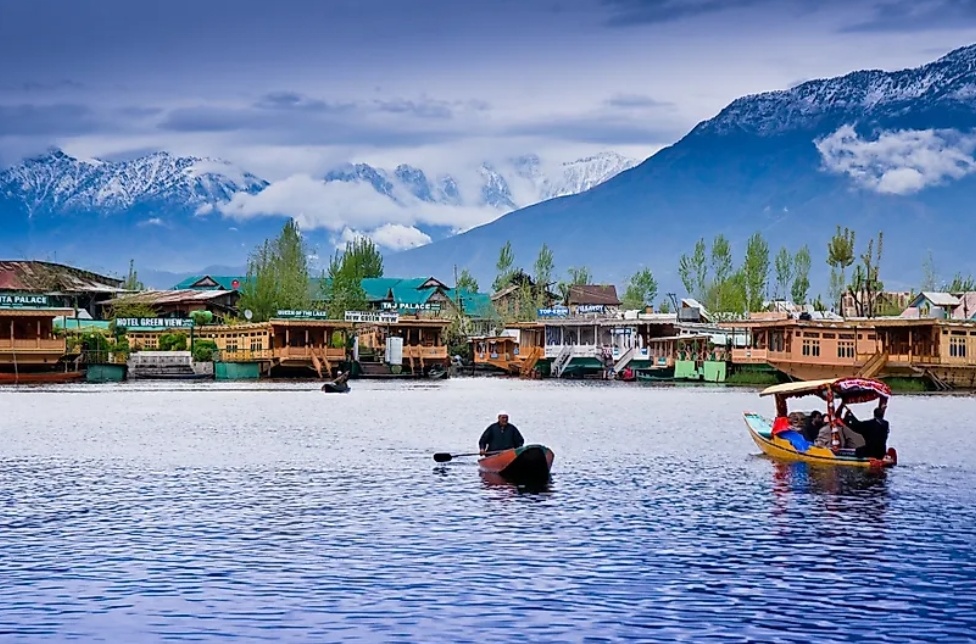
• Kashmir
Kashmir is also known as ‘ Paradise on Earth’. It is very famous for its snow-capped mountains, wildlife, monuments, and mesmerizing scenic beauty. March to August is the best time to visit Kashmir.
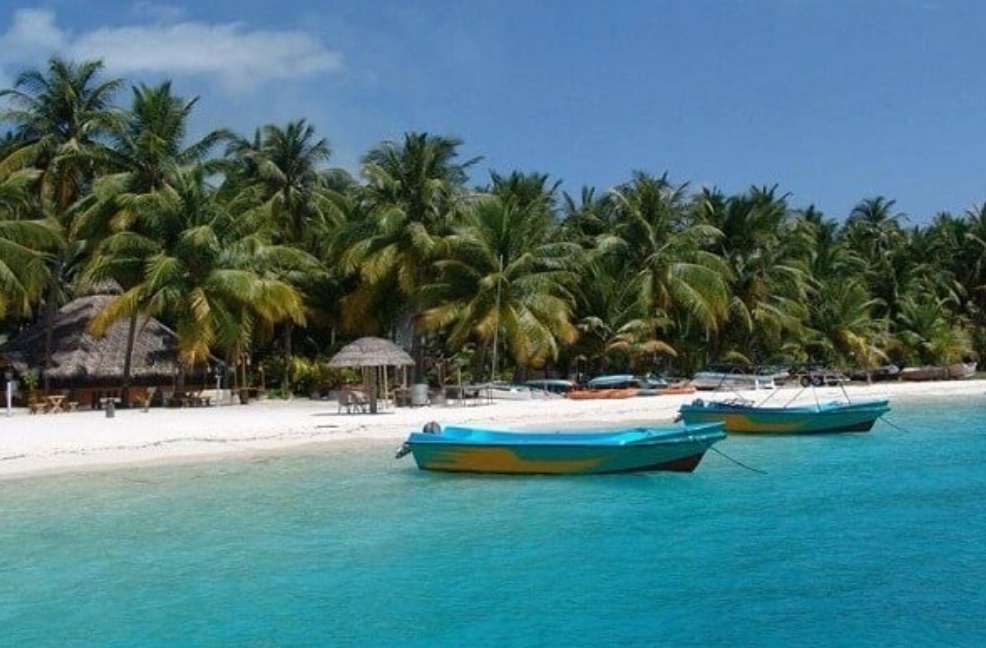
• Lakshadweep
Lakshadweep is a renowned Island located in the Arabian sea. It is known for its flora and fauna and crystal clear waters. The best time to visit this island is from October to mid-May.
A sudden change in the external environment surrounding a person might affect ones physical, mental and emotional health. As we all have been facing an unusual situation for past one year, the importance of sanity and peace has increased. It might not possibly change the outer environment but it can certainly change the way a person sees the situation and help them fight the hardships of life. There is no thumb-rule to living a perfect life. However, there are certain qualities we can attain that might help us make our lives nearly perfect. JOURNALING AND WRITINGONE’S EMOTIONS OUT, is something we have heard since ages. How children make a personal diary and write their emotions out where they feel the need to be heard. I know it sounds boring to a lot of people but Journaling and letting ones feeling out can reduce a lot of burden from one’s chest (Yes, children can be smarter than adults). In life, we have a lot of things that generally cannot be shared with others and we tend to keep those emotions inside us, hoping that they won’t bother us anymore. But little do people know how suppressed emotions can harm a person’s mind and even manifest itself in form of physical illness.
Looking at our own life from an outside perspective.
So, the first issue with Journaling might be accepting one’s emotions which we have denied for a long-time. I know, that accepting might not change the situation but might help in making peace with it. If not so, then a little writing might not affect a person as it might give you a clearer picture of the issue and maybe possible outcomes or ways to make things better for it.
Probably we have started considering writing our issues out but what about others getting an insight into our hidden lives by reading the journal. For such cases, thanks to technology we have free appsfor IOS and Android that keeps a person’s account confidential and provides app locks for security purpose. Since we have checked out two major issues from our list, I guess we might start to consider Journaling.
Additionally, it is win – win situation as there’s no loss. However, there might be some gain in terms of gaining more understanding, compassion and peace.
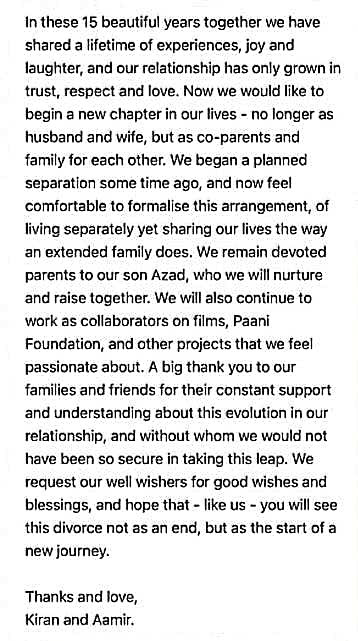
Bollywood Actor Aamir Khan and filmmaker Kiran Rao have announced their divorce after 15 years of marriage in a joint statement. The couple said that they will co-parent their son, Azad Rao Khan, as well as continue with their professional partnership on Paani Foundation and ‘other projects that they feel passionate about’. The couple also thanked their families for constant support in understanding their relationship.
reaction of people around the world
Irony is that she was not able to live in India now she wants to leave her husband 😂🤣🤣🤣😂😂😂
Aamir Khan married Kiran Rao, who had been an assistant director to Gowariker on the set of Lagaan .On 28 December 2005 they got married. They announced the birth of their son, Azad Rao Khan,on 5 December 2011, through a surrogate mother. Aamir has married twice and his first wife was Reena Dutta, who had a small part in Qayamat Se Qayamat Tak, on 18 April 1986. They have two children: a son named Junaid and a daughter, Ira. Dutta was involved briefly in Khan’s career when she worked as a producer for Lagaan. In December 2002, Khan filed for divorce and Dutta took custody of both children.
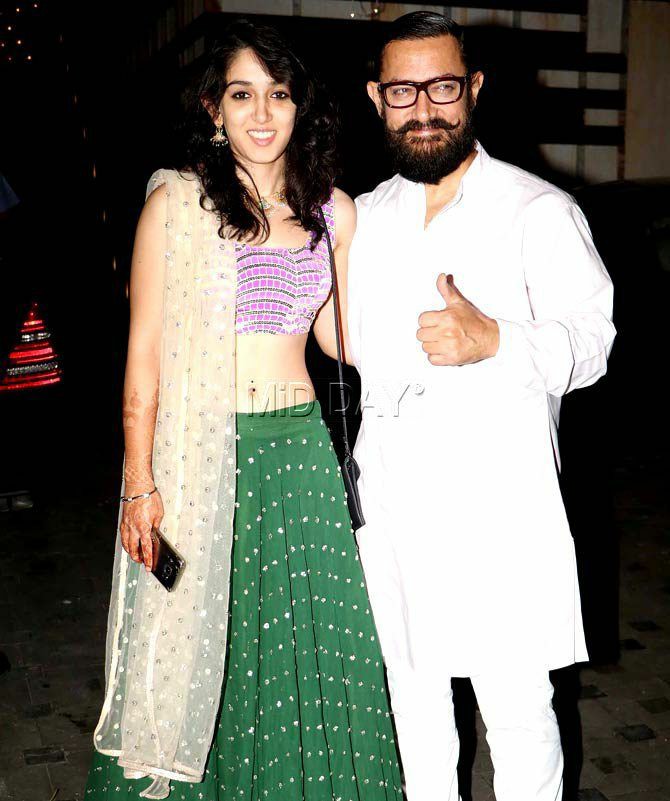
aamir khan with his daughter Ira Khan.
Famous movies & upcoming projects
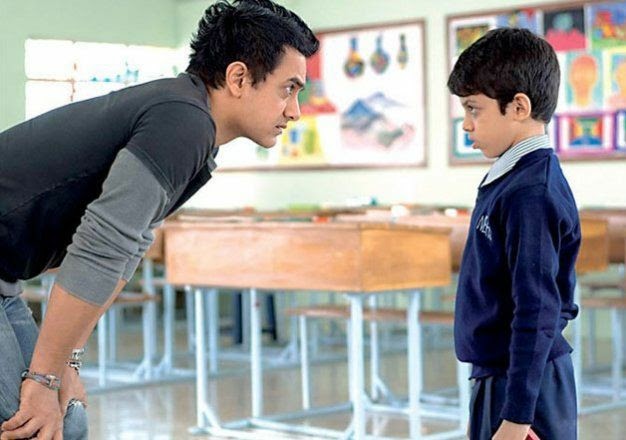
Aamir khan have his own production house ,which has produced brilliant piece of cinema. The first film of ‘Aamir khan production was laagan (2001), which was nominated for the Academy Award for Best Foreign Language Film, and earned him a National Film Award for Best Popular Film .After a four-year absence from the screen, Khan returned to appear in leading roles, notably in Fanaa and Rang De Basanti. He made his directorial debut with Taare Zameen Par (2007), which won him the Filmfare Awards for Best Film and Best Director. Khan’s greatest global success came with Ghajini ,3 Idiots, Dhoom 3 ,PK and Dangal, each having held the record for being the highest-grossing Indian film. He created and hosted the television talk show Satyamev Jayate, through which he highlights sensitive social issues in India, occasionally influencing the Indian parliament. His upcoming projects includes lal Singh chadda , which is An adaptation of the 1994 American film Forrest Gump .
“Black Hole” almost everyone has heard this term but, what exactly it is? How it is formed? Is a black hole is danger? what if we pass near to black hole?
The idea of a body so massive that even light cannot escape was given by astronomical pioneer John Michell in a letter published by him in november 1784. And since after this an excitement was filled between astronomers and physicists about a body which is invisible. And in December 1967 in a lecture of John Wheeler one of his student reportedly suggested phrase ‘Black Hole’, which Wheeler adopted for his brevity.
Black hole was first spotted in 1971. But after 235 when it was first mentioned by John Michell in 2019, the Event Horizon Telescope(EHT) saw and captured an image of black hole in center of Galaxy M87 53.49 million light years away from earth. The images before this are just art work based imagination and properties of black hole done by astronomers and physicists to define black hole.
Image of black hole captured by Event Horizon Telescope in 2019
How Black Hole is formed? Let us first understand how a star is made. From cloud from Nebula(made of hydrogen and 25% helium) due to density compresses together and forms a shape some what circular, and this object after many million years becomes star one of like sun. The core of star burns hydrogen to be active, when after million years the fuel of star burns out then due to its own gravity and density it starts to compress itself. And if that star is bigger than our sun than it may form a neutron star or the star makes a negative gravity and starts to pull every mass near it. If we compress a massive body bigger than our sun into a size of a city say Mumbai, then it will become black hole. The gravity of this black hole so much increases that even light cannot escape from its horizon making it invisible.
A black can also be size of our sun but its gravity is 1 crore times more than sun. Albert Einstein in his theory of special relativity said that near the black hole the time will run slow. When a star becomes black hole it makes changes in fabric of space-time. And the movement will happen in only linear direction for a person inside it.
What if s person goes inside Black Hole? If a person goes near black hole than time will run slow for him compared to a person on earth. And as a person goes inside the black hole than he will feel so much gravity i.e. gravity 1 crore time more than our sun, that he can die. When a matter goes inside a black hole than due to gravity the atoms are separated and slowly it is vanished. But let say somehow a person survives than for the person it is like having a boon of immortality. If we put a black hole same as the size of sun and replace it with sun then probably nothing change will be happen, it cannot affect us. But due to lack of sunlight our earth will freeze and will only be a giant snowball.
How to find a Black Hole? When a black hole tries to swallow a massive body than its own then it belch just like animals and it gives some portion of light. Black hole has gravity much higher that light like x-rays cannot escape, but when there is a material very close to horizon of black hole, matter is heated at millions of degrees as it is pulled towards black hole and glows in x-rays. Black hole can also be found by coronas. Black holes don’t give any light themselves, but they are often encircled by glowing materials and making it to shine with different types of light.
Corona coming out of a black hole
Types of Black Holes: There are four types four black holes. 1) Stellar-mass black holes As star reaches to the end of their lives, most will inflate, lose mass, and then will cool down to be a white dwarfs. But those with 10 to 20 times as massive as our sun, destined to either become a super-dense neutron star or stellar-mass black holes. Thousands of these stellar-mass black holes may lurk within our own galaxy. 2) Super massive black holes Super massive black hole are the ones predicted by Einstein’s general theory of relativity, can have masses equal to billion of suns; these cosmic giant creatures hide in the center of galaxies. The milky way hosts its own black hole called Sagittarius A* as is more than four million times massive than our own sun. 3) Intermediate Black holes Astronomers also suspect that there is class of so-called intermediate black holes exists in the universe, although evidence for them is so far debatable. 4) Miniature black holes The tiniest member of the black hole family, so far theoretical. These black holes may have swirled to life soon after the universe formed by big bang, some 13.7 billion years ago and quickly evaporated.
Answer to some questions about black holesIs it possible for a black hole eat entire galaxy? No. There is no chance that a black hole whatever is in size can eat a whole galaxy, because the gravitational reach of black holes(even super massive black holes) is not large enough to eat entire galaxy. What if sun turned it a black hole? The sun will never turn into a black hole as it is not massive to explode into a black hole. Instead sun will become a white dwarf. Have black holes have any influence on our planet? No. Even if we put a black hole in place of our sun then also it will not make a difference, earth will continue its rotation, but due to no sunlight it will we disastrous event on earth. Which is farthest black hole we found? The most distant black hole is located 13.1 million light years away from earth called “Quasar”. This black hole is made 690 million years after big bang.
We have found many black hole and learnt many things about them, yet many discoveries are to be made. And black holes will always amaze us.
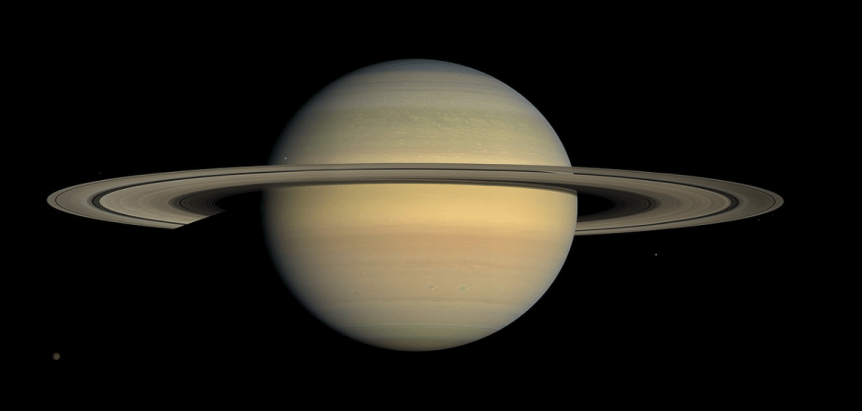
Saturn is the sixth planet from the Sun and the second-largest in the Solar System, after Jupiter. It is a gas giant with an average radius of about nine and a half times that of Earth. It only has one-eighth the average density of Earth; however, with its larger volume, Saturn is over 95 times more massive. Saturn is named after the Roman god of wealth and agriculture.
Some facts about Saturn
Diameter- 120,536 km
Orbital period- 29.4yr
Length of a Day- 10hrs 39min
Axis tilt- 26.7degrees
Distance from the Sun- 9.58AU
Moons- 82
Special features
The planet’s most famous feature is its prominent ring system, which is composed mostly of ice particles, with a smaller amount of rocky debris and dust. At least 82 moons are known to orbit Saturn, of which 53 are officially named; this does not include the hundreds of moonlets in its rings. Titan, Saturn’s largest moon and the second largest in the Solar System, is larger than the planet Mercury, although less massive, and is the only moon in the Solar System to have a substantial atmosphere
The outer atmosphere is generally bland and lacking in contrast, although long-lived features can appear. Wind speeds on Saturn can reach 1,800 km/h (1,100 mph; 500 m/s), higher than on Jupiter but not as high as on Neptune.
Natural satellites and Rings
Saturn has 82 known moons, 53 of which have formal names. In addition, there is evidence of dozens to hundreds of moonlets with diameters of 40–500 meters in Saturn’s rings, which are not considered to be true moons. Titan, the largest moon, comprises more than 90% of the mass in orbit around Saturn, including the rings. Saturn’s second-largest moon, Rhea, may have a tenuous ring system of its own,along with a tenuous atmosphere.
Saturn is probably best known for the system of planetary rings that makes it visually unique.The rings extend from 6,630 to 120,700 kilometers (4,120 to 75,000 mi) outward from Saturn’s equator and average approximately 20 meters (66 ft) in thickness.The particles that make up the rings range in size from specks of dust up to 10 m. While the other gas giants also have ring systems, Saturn’s is the largest and most visible.
There are two main hypotheses regarding the origin of the rings. One hypothesis is that the rings are remnants of a destroyed moon of Saturn. The second hypothesis is that the rings are left over from the original nebular material from which Saturn was formed.
Structure
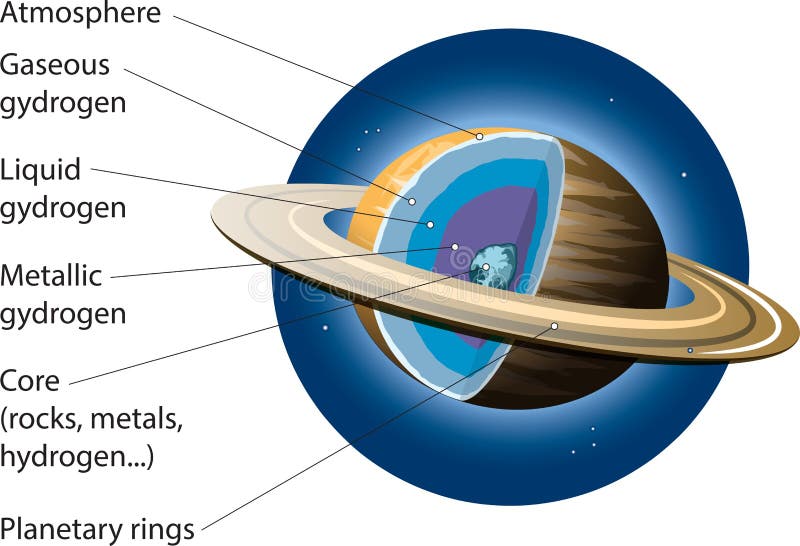
Despite consisting mostly of hydrogen and helium, most of Saturn’s mass is not in the gas phase, because hydrogen becomes a non-ideal liquid when the density is above 0.01 g/cm3, which is reached at a radius containing 99.9% of Saturn’s mass. The temperature, pressure, and density inside Saturn all rise steadily toward the core, which causes hydrogen to be a metal in the deeper layers. Standard planetary models suggest that the interior of Saturn is similar to that of Jupiter, having a small rocky core surrounded by hydrogen and helium, with trace amounts of various volatiles. This core is similar in composition to Earth, but is more dense. The examination of Saturn’s gravitational moment, in combination with physical models of the interior, has allowed constraints to be placed on the mass of Saturn’s core. In 2004, scientists estimated that the core must be 9–22 times the mass of Earth, which corresponds to a diameter of about 25,000 km. This is surrounded by a thicker liquid metallic hydrogen layer, followed by a liquid layer of helium-saturated molecular hydrogen that gradually transitions to a gas with increasing altitude. The outermost layer spans 1,000 km and consists of gas.
Exploration
Pioneer 11 made the first flyby of Saturn in September 1979, when it passed within 20,000 km of the planet’s cloud tops. Images were taken of the planet and a few of its moons, although their resolution was too low to discern surface detail. In November 1980, the Voyager 1 probe visited the Saturn system. It sent back the first high-resolution images of the planet, its rings and satellites. Surface features of various moons were seen for the first time. Voyager 1 performed a close flyby of Titan, increasing knowledge of the atmosphere of the moon. The Cassini–Huygens space probe entered orbit around Saturn on 1 July 2004. In June 2004, it conducted a close flyby of Phoebe, sending back high-resolution images and data. Cassini’s flyby of Saturn’s largest moon, Titan, captured radar images of large lakes and their coastlines with numerous islands and mountains. The orbiter completed two Titan flybys before releasing the Huygens probe on 25 December 2004. Huygens descended onto the surface of Titan on 14 January 2005.
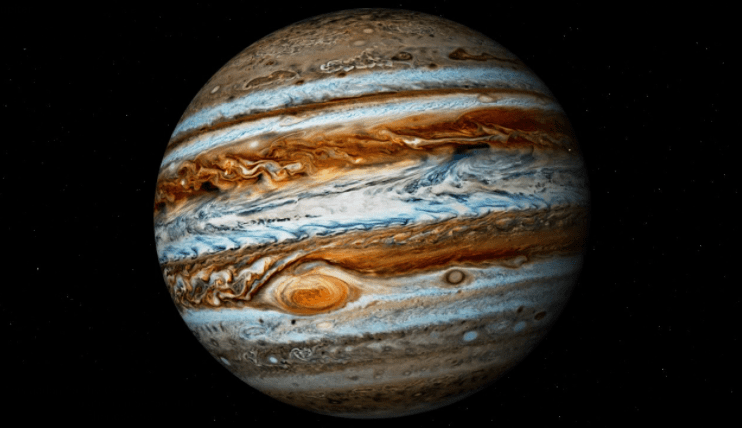
Jupiter is the fifth planet from the Sun and the largest in the Solar System. It is a gas giant with a mass more than two and a half times that of all the other planets in the Solar System combined. Jupiter is the third-brightest natural object in the Earth’s night sky after the Moon and Venus. It has been observed since prehistoric times and is named after the Roman god Jupiter, the king of the gods, because of its observed size.More than eleven Earths would fit across its diameter. It’s also the most massive. More than 1,300 Earths could fit inside Jupiter, with room to spare.
Some facts about Jupiter
Diameter- 142,984 km
Orbital period- 11.8yrs
Length of a Day- 10 hours
Axis tilt- 3degrees
Distance from the Sun- 779 million km(5.2AU)
Moons- 79known moons
Special features
Jupiter is primarily composed of hydrogen, but helium comprises one quarter of its mass and one tenth of its volume. It likely has a rocky core of heavier elements,but like the other giant planets, Jupiter lacks a well-defined solid surface. The on-going contraction of its interior generates heat greater than the amount received from the Sun. Because of its rapid rotation, the planet’s shape is that of an oblate spheroid; it has a slight but noticeable bulge around the equator. The outer atmosphere is visibly segregated into several bands at different latitudes, with turbulence and storms along their interacting boundaries. A prominent result of this is the Great Red Spot, a giant storm that is known to have existed since at least the 17th century, when it was first seen by telescope. Surrounding Jupiter is a powerful magnetosphere. Jupiter’s magnetic tail is nearly 800 million km long, covering the entire distance to Sa turn’s orbit. Jupiter has almost a hundred known moons and possibly many more, including the four large Galilean moons discovered by Galileo Galilei in 1610. Ganymede, the largest of these, has a diameter greater than that of the planet Mercury.
Natural Satellites and Rings
Jupiter has 79 known natural satellites. Of these, 60 are less than 10 km in diameter. The four largest moons are Io, Europa, Ganymede, and Callisto, collectively known as the “Galilean moons” Jupiter has a faint planetary ring system composed of three main segments: an inner torus of particles known as the halo, a relatively bright main ring, and an outer gossamer ring.These rings appear to be made of dust, rather than ice as with Saturn’s rings
Structure
The composition of Jupiter is similar to that of the Sun—mostly hydrogen and helium. Deep in the atmosphere, pressure and temperature increase, compressing the hydrogen gas into a liquid. This gives Jupiter the largest ocean in the solar system—an ocean made of hydrogen instead of water. Scientists think that, at depths perhaps halfway to the planet’s center, the pressure becomes so great that electrons are squeezed off the hydrogen atoms, making the liquid electrically conducting like metal. Jupiter’s fast rotation is thought to drive electrical currents in this region, generating the planet’s powerful magnetic field. It is still unclear if, deeper down, Jupiter has a central core of solid material or if it may be a thick, super-hot and dense soup. It could be up to 90,032 degrees Fahrenheit (50,000 degrees Celsius) down there, made mostly of iron and silicate minerals (similar to quartz).
Exploration
Pioneer 10 was the first spacecraft to visit Jupiter, making its closest approach to the planet in December 1973. Jupiter has since been explored on a number of occasions by robotic spacecraft, beginning with the Pioneer and Voyager flyby missions from 1973 to 1979, and later by the Galileo orbiter, which arrived at Jupiter in 1995. In 2007, Jupiter was visited by the New Horizons probe, which used Jupiter’s gravity to increase its speed and bend its trajectory en route to Pluto. The latest probe to visit the planet, Juno, entered orbit around Jupiter in July 2016. Future targets for exploration in the Jupiter system include the probable ice-covered liquid ocean of the moon Europa.
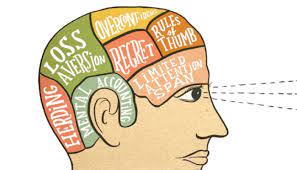
In an ideal world, people would always make optimal decisions that provide them with the greatest benefit and satisfaction. In economics, rational choice theory states that when humans are presented with various options under the conditions of scarcity , they would choose the option that maximizes their individual satisfaction. This theory assumes that people, given their preferences and constraints, are capable of making rational decisions by effectively weighing the costs and benefits of each option available to them. The final decision made will be the best choice for the individual. The rational person has self-control and is unmoved by emotions and external factors and, hence, knows what is best for himself. Alas behavioral economics explains that humans are not rational and are incapable of making good decisions.
Behavioral Economics is the study of psychology as it relates to the economic decision-making processes of individuals and institutions. Behavioral economics draws on psychology and economics to explore why people sometimes make irrational decisions, and why and how their behavior does not follow the predictions of economic models. Decisions such as how much to pay for a cup of coffee, whether to go to graduate school, whether to pursue a healthy lifestyle, how much to contribute towards retirement, etc. are the sorts of decisions that most people make at some point in their lives. Behavioral economics seeks to explain why an individual decided to go for choice A, instead of choice B.
Because humans are emotional and easily distracted beings, they make decisions that are not in their self-interest. For example, according to the rational choice theory, if Charles wants to lose weight and is equipped with information about the number of calories available in each edible product, he will opt only for the food products with minimal calories. Behavioral economics states that even if Charles wants to lose weight and sets his mind on eating healthy food going forward, his end behavior will be subject to cognitive bias, emotions, and social influences. If a commercial on TV advertises a brand of ice cream at an attractive price and quotes that all human beings need 2,000 calories a day to function effectively after all, the mouth-watering ice cream image, price, and seemingly valid statistics may lead Charles to fall into the sweet temptation and fall off of the weight loss bandwagon, showing his lack of self-control.
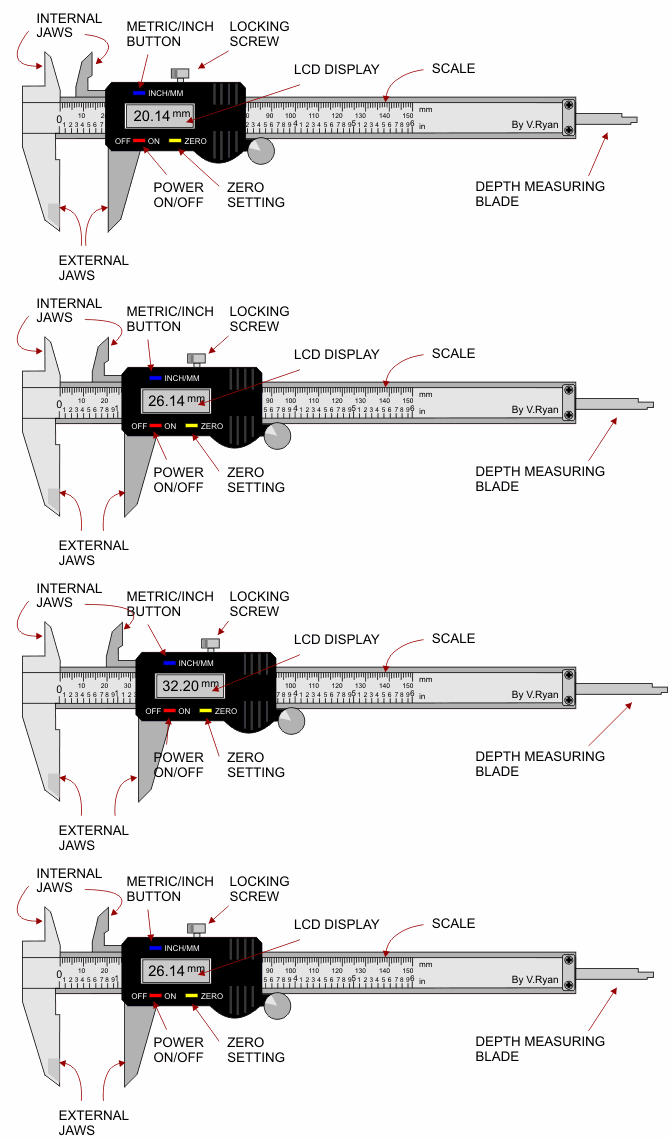
The Vernier Caliper consists of a thin long steel scale graduated in cm and mm called main scale. To the left end of the main scale an upper and a lower jaw are fixed perpendicular to the bar. These are named as fixed jaws. To the right fixed jaws, a slider with an upper and a lower moveable jaw is fixed. The slider can be moved or fixed to any position using a screw.
The vernier scale is marked on the slider and it moves along with the moveable jaws and the slider. The lower jaws are used to measure the external dimensions and the upper jaws are used to measure the internal dimensions of the objects. The thin bar attached to the right side of the vernier scale is used to measure the depth of hollow objects.
USAGE OF VERNIER CALLIPER
The first step in using vernier calliper is to find out its least count, range and zero error.
LEAST COUNT
Least count of the instrument (L.C) is equal to the value of one main scale division divided by Total number of vernier scale division. The main scale division will be in centimetre, further divided into millimetre. The value of the smallest main scale division is 1mm. In the vernier scale there will be 10 divisions. Therefore L.C is equal to 0.01cm.
ZERO ERROR
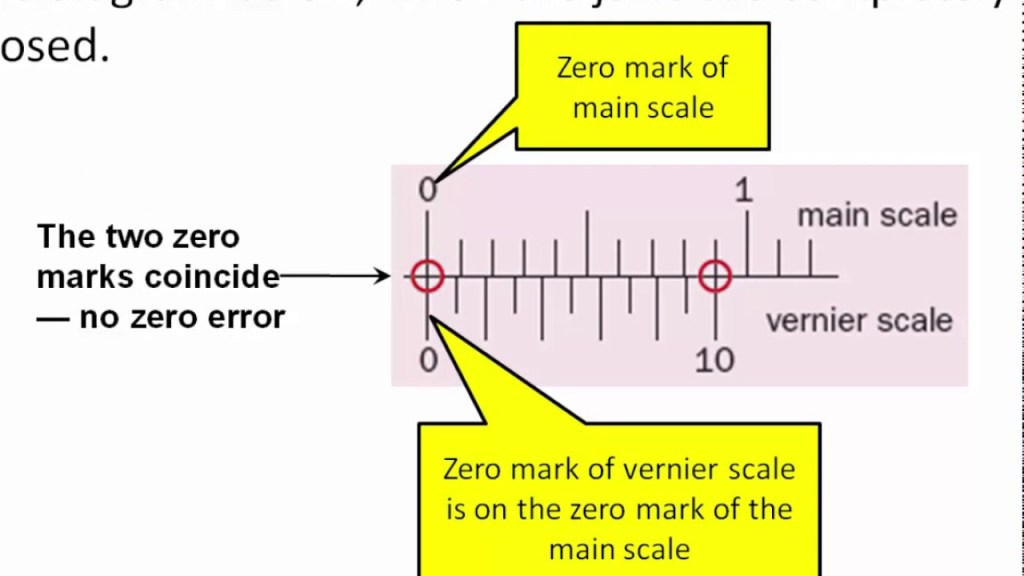
Unscrew the slider and move it to the left, such that both the jaws touch each other. Check the zero marking of the main scale coincides with that of the zero of the vernier scale. If they coincide then there is no error. If they do not coincide with each other, the instrument is said to possess zero error. Zero error may be positive or negative. If the zero of a vernier is shifted to the right of main scale, it is called positive error. On the other hand, if the zero of the vernier is shifted to the left of the zero of main scale, then the error is negative
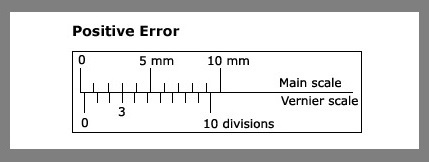
POSITIVE ZERO ERROR
That the zero of the vernier scale is shifted to the right of the zero of the main scale. In this case the reading will be more than the actual reading. Hence, this error should be corrected. In order to correct this error, find out which vernier division is coinciding with any of the main scale divisions. Here, fifth vernier division is coinciding with a main scale division. So, positive zero error = +5LC = +50.01 = 0.05cm and the zero correction is negative. Hence, zero correction is -0.05cm.
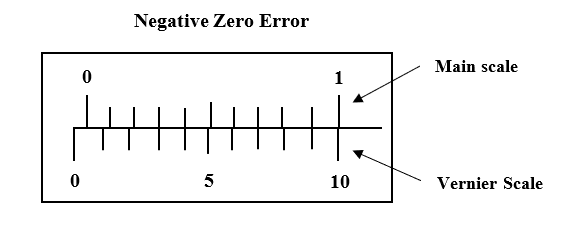
NEGATIVE ZERO ERROR
That the zero vernier scale shifted to the left of the zero of the main scale. So, the obtained reading will be less than the actual reading. To correct this error we should first find which vernier division is coinciding with any of the main scale divisions, as we found in the previous case. In this case, the sixth line coinciding. To find negative error, we can count backward (from 10). Here, the fourth line is coinciding. Therefore, negative zero error= -4 × LC = -4×0.01 = -0.04cm. Then zero correction is positive. Hence, zero correction is +0.04cm.
DIGITAL VERNIER CALIPERS
In this digital world, the digital version of vernier caliper are available. Digital vernier caliper has a digital display on the slider, which calculates and displays the measured value. The user need not manually calculate the least count, zero error etc.,
Cigarette smoking is one of the major killers in the world .When a person smokes he simply invites all kind of lung diseases and cancer towards its way . When people smoke they don’t realize how harmful smoking is for their lungs .Not only adults but also a lot of teenagers have started smoking . smoking cigarette is considered a boom and has become very popular amoung youngster.They get influenced by their peers and don’t realize how much effect it can cause on their system .Smokers are at an increased risk for cancer of the larynx , oral cavity , bladder , oesophagus , kidney and pancreas. Smoking causes five times increase in the risk of dying.
Several studies over the years say that’s the risk of lukaemia increases by 30% in active smokers . In todays time smokers who also get affected by corona virus are at higher risk as the virus also affects the lungs . Smoking decreases a persons immunity to fight disessea which is very harmful in todays times .Hence a person should realize the harm of smoking and think of being healthy and immune .
Let’s double down on solar energy, let’s be more energy-efficient, let’s weatherize our homes. We can build a better, healthier economy based on good-paying, clean energy jobs.”
Ian Somerhalder, Actor
Being one of the second largest country , climate change in India is having profound effect on India and all over the world . India is ranked fourth among the list of countries most affected by climate change in the period from 1996 to 2015 .
With 7% of global emissions , India emits about 3 gigatonnes (Gt) CO2eq of greenhouse gases each year; about two and a half tons per person, which is half the world average.
Due to the rise in temperature , the Tibetan plateau are causing problem to Himalayan glaciers . It directly effect in increasing the flow rate of the Ganges , Brahmaputra, Yamuna and other major rivers.
The Indira Gandhi Institute of Development Research has reported that, if the prediction of the Intergovernmental Panel on Climate Change is correct about Global warming than it may cause fall of GDP upto 9%.
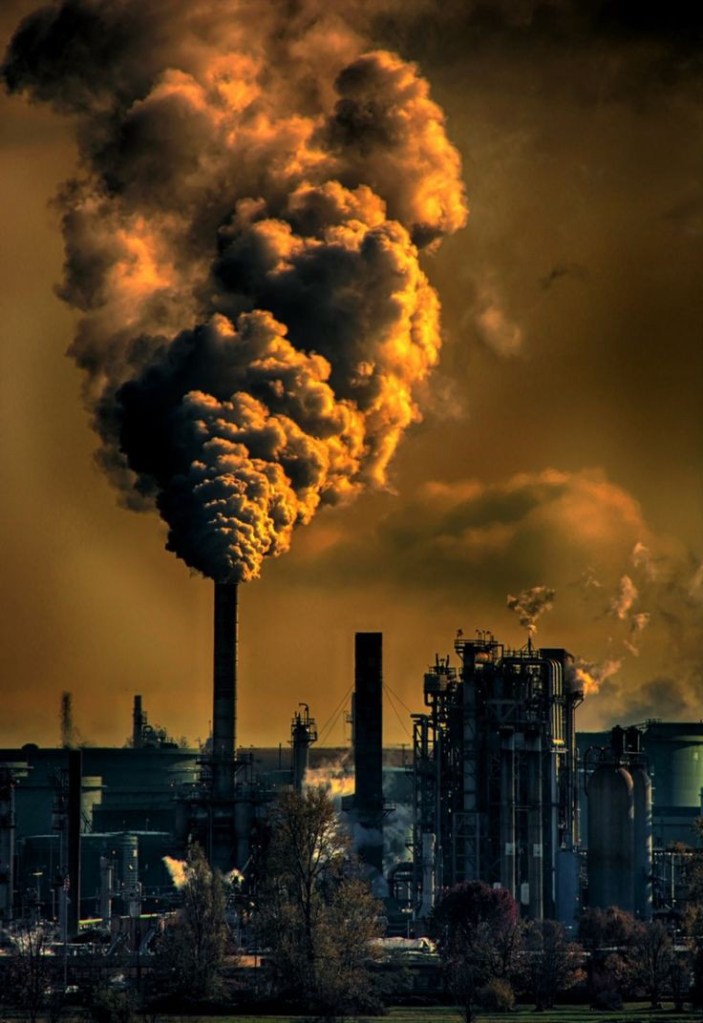
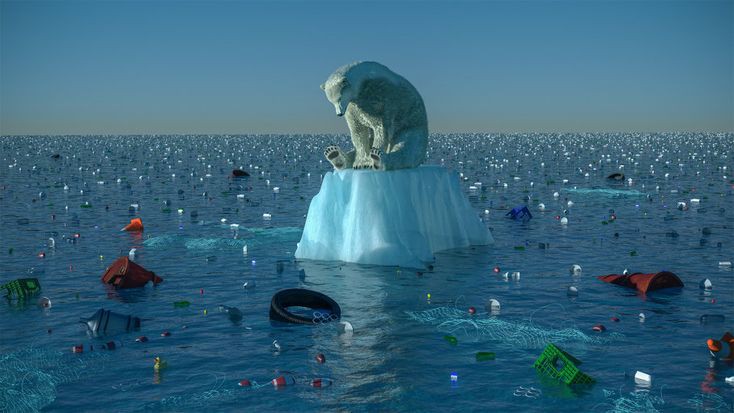
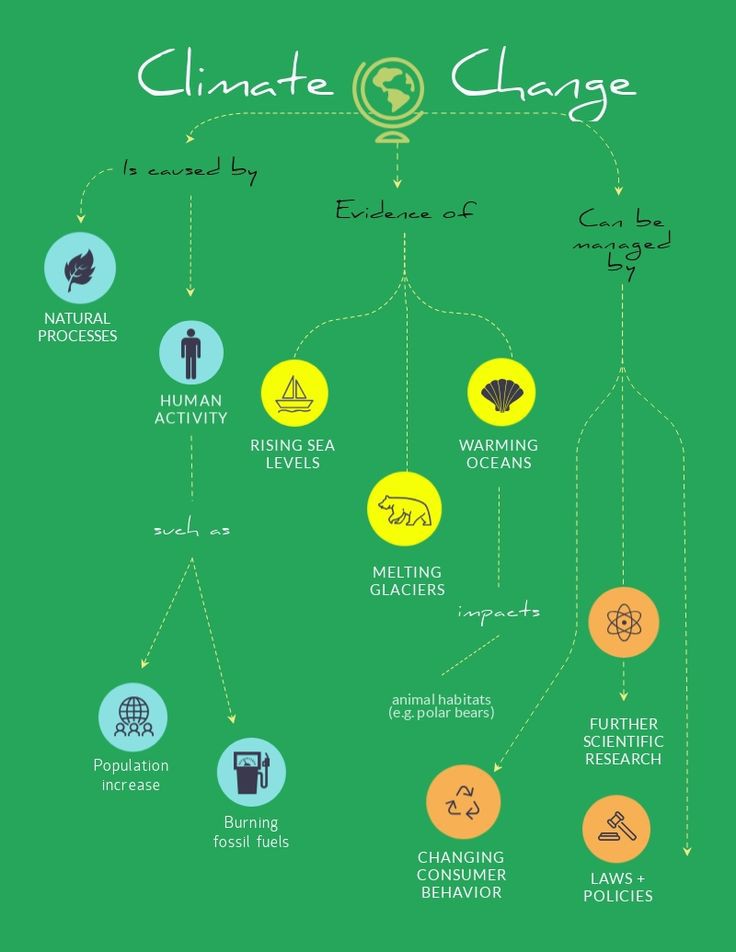
In all over the world , climate change is drastically affecting the change in temperature of the globe 🌎 . Climate change includes both global warming driven by human-induced emissions of greenhouse gases and the resulting large-scale shifts in weather patterns.
Causes :
Human envision and green house gasses are two important causes in the climate change. Greenhouse gases affect Earth’s energy balance and climate .Human activities have added greenhouse gases to the atmosphere. Human activities are changing the climate.
Other causes :
Power Plants.
Farming .
Deforestation.
Fertilizers.
Oil drilling.
Natural gas drilling.
Permafrost.
Garbage .
Volcanic eruption.
Pollution.
Campaigns
There are many campaigns that are going on . One of them is The ActNow campaign . It was launched at the UN Climate Change Conference (COP 24) in December 2018, with a call from Sir David Attenborough in conjunction with the award-winning “People’s Seat” initiative.
It signifies individual action on climate change and sustainability. By changing our habits and making choices that have less harmful effects on the environment, we can tackle the climate emergency and build a more sustainable world.
It is also working with other campaigns like The Good life goals , Anatomy of action , 170 actions to combat climate change , lazy person guide to saving the world , connect4climate , climate neutral now , trash hack , stop the waste , Think. Eat. Save. , Clean seas , breathe life , glowing glowing gone . Their may be others as well .
Prevention :
Becoming more energy efficient is a great way to prevent pollution. It causes the power plants to expend less energy that can lead to the production of greenhouse gases. … Replace your light bulbs with energy-efficient light bulbs that help you save electricity too.
Speak up!
Power your home with renewable energy.
Weatherize, weatherize, weatherize.
Invest in energy-efficient appliances.
Reduce water waste.
Actually eat the food you buy—and make less of it meat.
Buy better bulbs.
Pull the plug(s).
Conclusion
In the times , where the world is changing and taking measurements for saving the globe . Many Environmentalist , Actors , Politicians , Countries are taking precautions and actions on the climate change . It is our duty to prevent our world from falling . Take Initiative To Save The World .
Climate change is real. It is happening right now, it is the most urgent threat facing our entire species and we need to work collectively together and stop procrastinating.
India is the world’s second-largest consumer of liquor. The WHO study also illustrates that India’s consumption was 2.4 liters per person in 2005, which surged up to 5.7 liters per person in 2016. The Research and Markets on changing behavioral patterns of Indian Alcohol consumption, says that the estimated consumption of alcohol would reach up to 16.8 billion liters by 2022. The report also says that the alcohol industry in Indian markets is growing at a CAGR of 8.8 percent. The figures infer that there is always a thriving market that creates an opportunity for the alcohol industry in India to strengthen its sales and revenue.
Despite pervasive alcohol harmful effects, India does not have a national alcohol policy system. Instead, alcohol policy solutions rely on state governments. Even though alcohol benefits the economy of India more than the revenue it generates. The state governments think of alcohol as a revenue-generating product. This thinking led to alcohol policy-making such as excise alcohol taxation being centered around revenue instead of public health.
Reason for online service
Alcohol stores were closed nationwide from March 25, 2020, accepting social distancing protocols due to the deadly pandemic of COVID-19. While the reopening in May 2020 caused people to throng outside stores in massive numbers, and the government had to quickly re-analyze. Meanwhile, the New Delhi authorities introduced a “Special Corona Fee” of 70% on top of retail liquor costs. On the other hand, Mumbai shut down its liquor stores entirely within two days of its reopening. So, the administration exercised online home delivery of alcohol. On May 8, 2020, the Supreme Court of India examined that the states should find alternatives to liquor delivery. Here is where players like Zomato and Swiggy came into the process.
Methods
As alcohol is regulated by the state government so different states are using different methods for online delivery of alcohol. These include,
Online purchase and issuing e-tokens for pickup,
Online purchase and home delivery through the alcohol portal, or
Online purchase and home delivery through a third-party delivery platform.
Difficulty faced
However, the delivery of liquor and its products is not as simple as the food delivery market. It is a highly regulated market. Different states have established different legal ages for alcohol consumption. Also, the suppliers have to obey multiple regulations and rules assessed by the government to stay within legal holds to deliver liquor.
Measure to ensure safe delivery
To secure the safe delivery of alcohol in obedience to laws, Swiggy introduced compulsory age confirmation and user authentication features on their application. Customers have to verify their age by uploading a picture of a valid government ID. A selfie is then also required for authentication that is verified by the platform using an AI-powered system. All the orders carry a special OTP, which is expected at the time of delivery and needs to be procured by the customer. There is also control over the quantity of liquor ordered.
Zomato, as well, has acquainted consumption and identity confirmation procedures, several safety procedures and inspections, to ensure credible and safe ordering and delivery of alcohol. There are age checks at the time of ordering as well as the delivery. There are product category maxima to stimulate responsible consumption. The application only has licensed alcohol retailers who have opted for the service.
Drawbacks
Although this move by the delivery companies like Zomato and Swiggy has opened a new way for alcohol orders through smartphones, which promotes social distancing and consumer safety. But there is a high possibility that the delivery man can be attacked by goons for the bottles and, we know, what a person can do if he does not get goods to which he is addicted. Moreover, the young generation knows how to use the internet very well. So there is a possibility of a bad influence on the young generation of the country.
It’s a memory, an idea, an experience, a feeling, an expression. In simple words, photographs are the medium that allows us to see the world from another person’s point of view. Isn’t it magical, I believe photography is one of the greatest inventions of mankind. That’s why it has been said; a photograph is worth a thousand words.
Every year World Photography Day is celebrated on the 19th of August to inspire all the shutterbugs to share a single photo and share their world with the world. Let’s have a look at photography over the years.
It originates from the invention of the photographic process called Daguerreotype developed by Frenchmen Louis Daguerre and Joseph Nicephore Niepce in 1837. Later, on the 9th of January 1839, the Daguerrotype process has been announced by the French Academy of Sciences. And on the 19th of August, the French government purchased the patent and declared the invention as a gift “free to the world”.
But Daguerrotype was not the first photographic process. In 1826, Nicéphore Niépce invented a process called heliography, which he used to create the earliest known surviving photograph from nature; View from the Window at Le Gras.
On the 19th of August 2010, World Photography day hosted its first online gallery globally. In which approximately 300 shutterbugs shared their pictures and people from more than 100 countries visited the website. This marked the first official, globally reaching World Photography Day.
Some interesting photography facts:
★ In 1861, the first durable colored photograph was taken by Thomas Sutton. It was a combination of three black and white pictures taken through red, blue, and green filters.
★ The first selfie was taken in 1839 by an amateur chemist and photography enthusiast from Philadelphia named Robert Cornelius.
★ The first digital photograph was taken in 1957, almost 20 years before Kodak invented the first digital camera.
Don’t forget to share your world with the world on the coming World Photography Day.
“For me, the camera is a sketchbook, an instrument of intuition and spontaneity.” – Henri Cartier-Bresson
When you think about home remedies, you’re definitely thinking about turmeric, coconut oil. But today I’ve got something different for you which is rice water. In Korean culture, rice water has been used through generation for skin and hair. Rice is one of the most popular beauty ingredients used by them. The Japanese and Korean women are known for their flawless, glowing skin. Fortunately you don’t have to make a trip to Korea to learn this best-kept beauty secret.
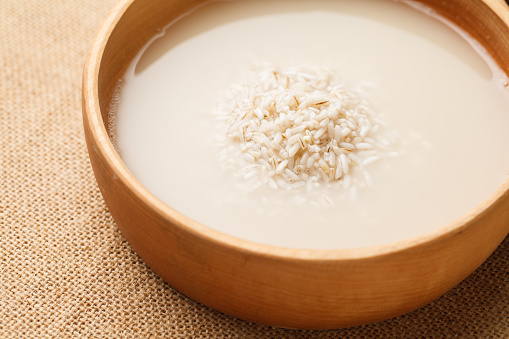
How to make a rice water? The type of rice which you use doesn’t matter. There are couple of methods to make rice water at home but this is the easiest one. You’ll need a half cup of uncooked rice after rinsing it atleast 3-4 times, one cup water and an air tight container. Then, place the rice into a glass bowl filled with water and soak for 30 minutes. Once the water become milky, store the water in an air tight container and it is ready to use. The reason rice water is so good for your skin is that it is rich in a lot of nutrients. Today rice water is gaining popularity for skin and hair care because of its large benefits.
Rice water is rich in antioxidants that keeps the skin. So if you’re looking to start an anti aging skincare journey. This will do wonders to your skin. There is limited evidence that rice water may reduce or slow skin aging but this will definitely help.Rice water helps in tightening the appearance of large pores and helps in reducing oilness and pimples. Soak a cotton pad in rice water and apply it over your face twice a day for it to work. Starch in rice water is beneficial in maintaining the natural barrier for the skin. Rice water have a cooling effect on mild sun damage. It lighten the skin or reduces dark patches and makes your skin glowing. You can also add rice water to your bath.
Rice water is comparatively safer to use than other kitchen DIY. There is no evidence that fresh rice water is harmful to the skin. Store the rice water in a spray bottle and you can directly use it on your skin. It can be used daily, has zero side-effects. Just make sure that it doesn’t smell sour.
Applying it to your skin and hair may bring positive benefits.
India is a largely populated country with many different kinds of people. There are variations in culture, traditions, language, food, etc. But more importantly, there are people with different origins and roots. Some such people are the ‘Adivasis’ who we more commonly refer to as the ‘Tribes’ or ‘Tribal People’ of India. The word Adivasi comes from the Sanskrit term meaning ‘original inhabitants’ (Adi= original/from the beginning, Vasi= inhabitant/resident). Therefore, when we use the term Adivasi or categorize a group as Adivasis, it is generally understood to mean that they are the inhabitants of that area from the very beginning. It is a blanket term used to refer to the indigenous people and groups of India, and helps forge a sense of identity for them. Sometimes you may hear the term ‘Scheduled Tribes’ being used in a legal or constitutional sense, but this differs from State to State and may exclude some groups which may be considered indigenous.
Background
Adivasis make up a substantial minority of the Indian population, comprising about 8% of the total population. They are of great numbers especially in the states like Maharashtra, Madhya Pradesh, Jharkhand, Odisha and Andhra Pradesh. They are said to have arrived in India during the great human migration from Africa, and are believed to have been living in India from as early as 2000 BCE. As the name suggest, their presence pre-dates even the Dravidians and Aryans in our country, and they were the original hunter-gatherer, foragers and agriculturists of these lands. But today, they hold little to no political power and most of them are below the poverty line. They have seen a relegation of their status in the country, with a loss of land, wealth and political presence and representation. The Adivasis have been conferred a classification of tribes or tribal communities under Article 366 (25) of the Indian constitution, the criteria for this being ‘geographical isolation, backwardness, and having a distinct culture, religion and ‘shyness of contact’.
Examples of Adivasis or tribes in India are communities like the Bhil, Chenchu, Korwa, Lodha, and Bonda. Perhaps the most well-known tribes are those of the Andaman and Nicobar Islands, like the Jarawa, Onge and Sentinels, who have remained mostly untouched by modern civilization and continue to live like primitive tribes.
Modern Day Situation
Most of us today when we hear the word ‘Adivasi’ do not think of the people who first populated Indian territories and who possess ancient cultures and traditions tied to these lands. Instead, we think of those people living in rural and underdeveloped areas, living in poverty and struggling to make ends meet. While larger and more prominent tribal groups may survive as result of numbers, the destruction of their environmental and economic base will not allow them to continue their traditional way of life and may result in their cultural extinction. The primary reason for the Adivasis socioeconomic problems is that they have gradually been displaced from all their land and are constantly being denied land ownership. Today they are in a constant battle just to retain their economic and social identity. Today’s India is all about modernization and progress, and even government schemes only aim at integrating these tribes into normal society rather than allowing them to continue living by their distinctive way of life. Attempt are constantly being made to bring these tribes into mainstream Indian culture and integrate them into the national identity, disregarding their own unique and age-old cultures. Although they have been given schemes for reservation, the impact of the quota system upon Adivasis has remained negligible up until now. Also, many smaller tribal groups are quite sensitive to ecological degradation caused by modernization, and so government policies on forest reservation have also affected Adivasis profoundly. The 2006 Forest Rights Act (FRA) was enacted to secure the rights of Adivasis to their customary lands and forests, but they are still subject to encroachments on forest area.
Conclusion
It can be concluded that the Adivasis or tribal people of India represent an important cultural group of our country, but their modern-day situation is not good and not respected. The tribes in India are now under the impact of ‘mobility and change’. They have been subject to things like the caste system, and religions like Christianity and Hinduism which have transformed them completely. They have basically joined the ranks of peasantry in modern times, and have become wage-laborer’s in industries, plantations and mining. Hence, they are at the lowest point of the socioeconomic indicator, and are also subject to prejudice and oppression in mainstream Indian society. Furthermore, their issues are generally under reported, neglected or trivialized. We must try to change this situation for their betterment, and we as citizens must educate ourselves on who these people are and what they represent.


















 Eduindex
You must be logged in to post a comment.