Don’t let the desire of a successful future destroy your present

Vaishali Singh ( Cheenu Singh Rathore)

This four lettered word “LIFE” is the synonym of living and nothing else, don’t waste it about thinking over the things which have either happened in the past or more likely have not even happened yet, this is a constantly changing world, everything is temporary in this world even you and me, we are perishable, then what are you doing why are you wasting your life over thinking of the things which are just confined within your mind doors, they are not reality they just exist within in your mind most of the problems you have in your life have originated from overthinking, be in now and enjoy this moment, live this moment because this moment is life, don’t take it too seriously, don’t put too much pressure on your mind, don’t let the desire of a successful future destroy your present, if you think that a sad present can give you a beautiful life then you’re wrong because life is now and if you can’t make yourself happy being in this moment then how can you expect it from yourself that attaining a certain goals will make you happy? If something doesn’t satisfy you today then how can you think that it will give you a beautiful and peaceful life, most of the people destroy their life either thinking about their past or caring about their uncertain future, we human being have only 5 senses, we can never analyse what’s going to happen in the future the only thing which is in our hand is to take actions but we can never predict the result of our actions and most of times the way we perceive our future is not exactly how it turns out to be, now the current scenario of world is a good example of the uncertainty of life, no one knew that this would happened in the beginning of 2020 all of us had a tons and tons of plans for our new year but our plans got failed they turned out to be something called “LOCK DOWN” we are at our home today, probably many of us had a lot of plans and wishes with our family, or friends but today it’s not safe to step out of our homes unnecessarily, this is life man, this is the reality and nothing can change the fact no matter how many plans you make, no matter how much time you waste in figuring out your life, at the end you will have even more questions than before. So live your life instead of worrying.

Meaning of Company and its Classification


A company is a voluntary association of individuals formed to carry on business to earn profits or for non profit purposes. These persons contribute towards the capital by buying its shares in which it is divided. A company is an association of individuals incorporated as a company possessing a common capital i.e. share capital contributed by the members comprising it for the purpose of employing it in some business to earn profit.

“As per Companies Act 1956, a company is formed and registered under the Companies Act or an existing company registered under any other Act”.

Types of Companies:

Companies can be classified under the following heads:

1. On the basis of formation.

2. On the basis of liability.

3. On the basis of ownership.


1. On the basis of formation: On the basis of formation companies can be categorised as:

(a) Statutory Company: A company formed by a Special Act of parliament or state legislature is called a Statutory Company. Reserve Bank of India, Industrial Financial Corporation of India, Life Insurance Corporation of India, Delhi State Finance Corporation are some of its examples.

(b) Registered Company: A company formed and registered under the Companies Act, 1956 or earlier Companies Acts is called a Registered Company. The working of such companies is regulated by the provisions of the Companies Act.


2. On the basis of liability: On the basis of liabilty, companies can be catagorised as:

(a) Company limited by shares: The liability of the member of such company is limited to the face value of its shares.

(b) Company limited by guarantee: The liabilty of each member of such company is limited to the extent of guarantee undertaken by the member. It may arise in the event of its being wound up.

(c) Unlimited Company: The company not having any limit on the liability of its members, is called an unlimited company. Liability in such a case extends to the personal property of its shareholders. Such companies do not use the word ‘limited’ at the end of their name.

(d) Company under section 25: A company created under section-25 is to promote art, culture and societal aims. Such companies need not use the term limited at the end of their name. Punjab, Haryana, Delhi chambers of commerce, etc. are the examples of such companies.


3. On the basis of ownership: On the basis of ownership, companies can be catagorised as :

(a) Private Company: A private company is one which by its Articles of Association :

(i) restricts the right of members to transfer its shares;

(ii) limits the number of its members to fifty (excluding its past and present employees);

(iii) prohibits any invitation to the public to subscribe to its shares, debentures.

(iv) The minimum paid up value of the company is one lakh rupees (Rs 100000). The minimum number of shareholders in such a company is two and the company is to add the words ‘private limited’ at the end of its name. Private companies do not involve participation of public in general.

(b) Public Copmpany: A company which is not a private company is a public company. Its Articles of association does not contain the above mentioned restrictions. Main features of a public company are : (i) The minimum number of members is seven.

(ii) There is no restriction on the maximum number of members.

(iii) It can invite public for subscription to its shares.

(iv) Its shares are freely tansferable.

(v) It has to add the word ‘Limited’ at the end of its name.

(vi) Its minimum paid up capital is five lakhs rupees (Rs 500,000).

(c) Government Company: A Government company is one in which not less than 51% of its paid up capital is held by (1) Central Government or (2) State Government, or (3) partly by Central Government and partly by State Governemt. Example of a Government company is Hindustan Machine Tools Limited, (HMT) State Trading Corporation (STC). Minerals as metals training corporation (MMTC).

(d) Foreign company: A foreign company is one which is incorporated outside India but has a place of business in India, for example Philips, L.G, etc. standard materials.

(e) Holding company and Subsidiary company: A holding company is a company which controls another company (called subsidiary company) either by acquiring more than half of the equity shares of another company or by controlling the composition of Baord of Directors of another company or by controlling a holding company which controls another company.

(f) Listed company and unlisted company: A company is required to file an application with stock exchange for listing of its securities on a stock exchange. When it qualifies for the admission and continuance of the said securities upon the list of the stock exchange, it is known as listed company. A company whose securities do not appear on the list of the stock exchange is called unlisted company.


Property of a female Hindu to be her absolute property


Section 14 of The Hindu Succession Act, 1956 states that,

(1) Any property possessed by a Female Hindu, whether acquired before or after the commencement of this Act, shall be held by her as full owner thereof and not as a limited owner.

Explanation: In this sub-section, “property” includes both movable and immovable property acquired by a female Hindu by inheritance or devise, or at a partition, or in lieu of maintenance or arrears of maintenance, or by gift from any person, whether a relative or not, before, at or after her marriage, or by her own skill or exertion, or by purchase or by prescription, or in any other manner whatsoever, and also any such property held by her as streedhan immediately before the commencement of this Act.

(2) Nothing contained in sub-section (1) shall apply to any property acquired by way of gift or under a will or any other instrument or under a decree or order of a civil court or under an award where the terms of the gift, will or other instrument or the decree, order or award prescribe a restricted estate in such property.

Under this Section , any property acquired by a Hindu female except that which is covered by sub-section 2 before the Act came into force will became her absolute property and any property acquired by a Hindu female except that which covered by the commencement of Act will be her absolute property.


The above stated changes could be seen while going through the observation of courts at different periods:-

In Janaki v. Narayana Swami,  Privy Council observed regarding women’s estate as “her right is of the nature of right of property, her position is that of owner; her powers in tat character are, limited…So long as she is alive , no one has vested interest in succession.”


In another case,  Kalawati v. Suraj, SC stated that in the context of section 14 “ ‘women’ does not mean any woman , but that woman who is the owner of woman’s estate. If the holder of woman’s estate had alienated the estate to a woman, that woman is not the woman whose estate is enlarged to full estate.”

“The effect of rule laid down in the Section 14 of The Hindu Succession Act, 1956 is to abrogate the stringent provisions against the proprietary rights of a female which are often regarded as evidence of her perpetual tutelage and to recognize her status as independent and absolute owner of property.”

Before the enactment of The Hindu Succession Act, 1956, Hindu women has streedhan as:-

(a)Absolute property and

(b) Limited estate.


When the constitutionality of the Act has been challenged and SC has observed that the Act has the object of enhancing women’s limited estate concept regarding property into absolute interest. It is within the spirit of court of India. Hence it is not violative of any fundamental rights especially Art.14, 15(1) of the Constitution of India.


S.14 has been given retrospective effect. But this Section has no application for those who has already inherited and alienated the property before the Act came into force. In Anandibhai v. Sundarabhai , High Court has been observed as “the expression ‘any property possessed by a female Hindu’ in Section 14 means ‘any property owned by a female Hindu’ at the date of the commencement of the Act, and, these words are prospective in their application. Any property ‘acquired before’ the commencement of the act shall be the absolute property. The expression ‘whether acquired before or after the commencement of this act’ shows that section is operative retrospectively.


There are two conditions to be fulfilled for the application of Section 14 of The Hindu Succession Act, 1956:

Ø Ownership of the property must vest in her, and

Ø She must be in the possession of the Estate when the Act came into force.


Supreme Courts and High courts have given wider connotations for the term possession. According to their observation, it can be in the form of actual and constructive possession. In Santosh v. Saraswathi, a question has been raised regarding the possession of property of female Hindu and Court held the view that where property was given to the woman by way of maintenance over which she had a right, her possession was accepted, it became her absolute property. Even when the property is in the possession of a trespasser, it has been held that she is in constructive possession.

Privatisation of Indian Railways

Indian railways has the 4th largest railway network in the world. And the maintenance of such a big network is solely on the Railways. To lessen this burden, empowered group of secretaries headed by NITI  Aayog CEO Amitabh Kant have planned the privatisation of the railways. Railways currently recovers only 57% of its cost through passenger tickets. Some of its income is through freight. At the same time it has many expenses such as salaries of the employees, maintaining trains etc. Under privatisation, there will be an investment of around 30,000 crore and many expenditures will be borne by private players.

It is to be noted that now our Railways have the same corridor for both freight and passenger trains, which is expected to get separated when the privatisation happens. If such a thing happens it is expected that the problem of punctuality of trains will improve and the passengers will get better service. The government has identified 109 busy routes which will get 151 private trains, but this is only 5% of the total trains that run in India. This means that 95% of the control remains with Railways.

The privatisation will be done in 12 clusters, namely Patna, Jaipur, Bengaluru, Secunderabad, Howrah, Prayagraj, Chandigarh, Chennai and two clusters each in Delhi and Mumbai. The private firms will be placing bids on those particular clusters which they want to take up. The first round of bidding has ended and the second one will end by this financial year and the first set of 12 trains is estimated to be on tracks by the year 2022-23. Thereafter 45 trains in 2023-24, 50 in 2025-26 and 44 in 2026-27, which in total will be 151 private trains. Any private company, Indian or foreign are allowed to place their bids. But there are some conditions as well. The company should have a minimum net worth of ₹1,165 crore in its last financial year. This amount is different according to different clusters and can go up to ₹1,600 crore. The companies have to follow government rules and regulations. The trains should have a maximum speed of 160 km per hour and also minimum of 16 coaches. Of course the company which will give the Railways the maximum revenue who will win the bid but there is also a performance indicator which is punctuality which has the highest number of points to ascertain the performance. The Railways on its part will provide land to this private companies to work on. This is the same land which Railways have.

It is obvious that the tickets of these trains will be higher than we have now. Some people fear that this may cause segregation among the middle class or poor people and the upper class since these trains may not be affordable to all. But our Railway Minister Mr. Piyush Goyal has clarified that Railway will have sufficient control and also the recruitments will happen under the Railway Ministry only. The privatisation is happening to just a fraction of total capacity of the Railways. According to him it is more like a Public-Private Partnership. He assured that Indian Railways will not be fully privatised.

Fundamental rights and the Environment


The Golden Triangle of the Indian Constitution – Article 14, Article 19 and Article 21 – has been invoked time and again for environmental protection. The High Courts and Supreme Court of India have read the right to a wholesome environment as a part of the right to life guaranteed in Article 21 of the Constitution of India.

In the Dehradun Quarrying Case, though the orders did not articulate the fundamental right to a clean and healthy environment, the petition was treated as a writ under Article 32, which implied that the court was seeing this right in the light of a fundamental right. The Supreme Court explained the basis of this jurisdiction in the later case of Subhash Kumar v State of Bihar where the court held that the right to life is a fundamental right under Article 21 of the Constitution and it includes right of enjoyment of pollution free water, air for full enjoyment of life. and that .if anything endangers or impairs the quality of life, in derogation of laws, a citizen has a right to have a recourse to Article 32 of the Constitution for removing the pollution of water or air which may be detrimental to the quality of life.. This concept has been furthered by the Supreme Court and various High Courts decisions worded differently by concretising the idea of right to a clean and healthy environment as a part of fundamental rights.


The other integral part of right to life is right to livelihood as enumerated in the Olga Tellis Case, which is again a judicial enlargement of the right to life envisaged under Article 21 of the Indian Constitution. In Olga Tellis the Court looking at the limitation of the Indian State said that to deprive a person of his right to livelihood would mean depriving him of his life. The State may not by affirmative action be compellable to provide adequate means of livelihood or work to the citizens but any person who is deprived of his right to livelihood by law can challenge the deprivation as offending the right to life conferred by Article 21. Many environmentalists think that the right to livelihood could be asserted to prevent environmentally disruptive projects that threaten to uproot tribal people and villagers for depriving their right to livelihood. The recent agitation by the farmers of Singur and Nandigram in West Bengal and Narmada Bachao Andolans (NBA) campaign against the Sardar Sarovar Dam can be understood in this perspective. However, industries see a strict environmental regime at loggerheads with the right to livelihood and clean/healthy environment of the citizens. The argument forwarded by the industry interests can be rebutted on the grounds that right to clean environment and right to livelihood are complementary rather than contradictory. If all industries follow the environmental standards, then the price of products will include all the external costs which would have to be borne by the consumers. Nevertheless, even this alternative can be questioned in a third world country like India where most people are unable to afford costlier products.


Article 14 can be invoked to challenge government sanctions for projects with high environmental impact, where permissions are arbitrarily granted without adequate consideration, for example, of their environmental impacts. Article 19(1) (g) provides that all citizens shall have the right to practice any profession, or to carry on any occupation, trade or business but with reasonable restrictions which may be placed in the interest of the general public as provided within section 19 sub clause (6), which might include total prohibition. Accordingly, in cases involving polluting industrial units, the courts face the task of balancing the environmental imperative with the right to carry on any occupation/trade or business.

Procrastination

There is a rule of science according to many great scientists “The entropy of this universe always tends to increase”. Now, what does this mean? It simply means that everything in this universe eventually moves from order to disorder. Nothing wants to settle itself unless or until some force is applied to it. Ok, if we go to some literal definitions of procrastination, it is the delaying or postponing of a task. It is the force that stops you from doing what you are going to do, regardless of whether you term it a degenerative or procrastination or anything else.

So definitions are all cool but let’s come to the reasons now. Why do we procrastinate tho we know it is harmful to our future?

Has it something to do with your self-control or is it fair enough to call a person lazy? Being lazy means doing nothing or state of inactivity but procrastination means doing something which is not important at that time by ignoring what is important.

Being very specific the answer is no. The Quote simply says it all.

“I like work: it fascinates me. I can sit and look at it for hours.”

Jerome K. Jerome (Three Men in a Boat, 1889).

Let’s see this scientifically, say we have two versions of ourselves one is our present self and the other one is our future self. We know eating healthy and doing workouts is good for our future self. And for his sake, we make plans at night about being productive the very next day, but in the morning we usually don’t follow our plans. And one of the major reasons for this is the comfort of our present self, who doesn’t want to ruin his sweet sleep early in the morning.

We make decisions for our future self but ultimately our present self has to implement those plans. And being very truthful our present self does want to do anything which will comfort us only in our future. I mean who wants to eat a bowl of salad for being healthy after months when all you can have is a donut now. Why would I wake up early in a winter morning for doing workout whose results are going to show after months from now when I am in my warm soft bed, cuddling my favorite pillow.

So now the major question is how to stop procrastinating? Let’s explain each step one by one.

Phase 1: Recognize that you’re going to procrastinate

You could be putting off a job because you had to re-prioritize your workload. If for a very good reason, you are momentarily avoiding a significant mission, then you are not procrastinating. Nevertheless, if you start putting things off indefinitely, or changing the emphasis because you want to stop doing it, then perhaps you are.

Procrastination is the bad habit of putting off until the day after tomorrow what should have been done the day before yesterday.

Phase 2: Try to find out the reasons why you procrastinate

Try to find out why you don’t want to do a task which is that important to you. There could be a lot of reasons like you just don’t want to continue with your job but you have to due to some reasons, maybe you are not active enough when it comes to working, it could be anything and surprisingly perfectionism could also lead to procrastination sometimes as we might think we don’t have enough skills to complete the task, but try to find out a solution for your every reason.

Phase 3: Forgive yourself that you have procrastinated in the past. Research suggests that self-forgiveness will make you feel more optimistic about yourself and that the probability of procrastination in the future.

Phase 3: Come on to the job. Keep on doing that, not avoiding it. Write down the tasks you need to do, and determine the time to complete the tasks. It will allow you to take a positive approach to your job.

Phase 4: Promise yourself a reward for that. When you’re finishing a tough task in time, reward yourself with a treat, such as a slice of cake or a coffee from your favorite coffee shop. Just make sure you remember how good it feels to finish things off!

Phase 5: Rephrase the internal conversation. For example, the phrases “need to” and “have to” mean that you don’t have a choice in what you do. It can make you feel helpless and even lead to self-sabotage. Nonetheless, saying, “I want to,” means that you own a project which can help you feel more in control of your workload.

Phase 6: Minimize the noise. Switch off your email and social media, and stop sitting anywhere near a TV while you’re working!

The aim is to “eat the elephant beetle” first thing, every day! Get those things you find the least fun out of the way early. This will allow you the rest of the day to focus on the job you find more enjoyable.

So lets conclude this with a message which actually define procrastination

“Procrastination is reading all the quotes on this page when you have a huge report due tomorrow.”

R. T. A. Birektt (wish I thought of this one)

Concept of Writs In India


A Writ is a formal written order issued by a government entity in the name of the sovereign power. In most cases, this government entity is a court. In modern democratic countries, the administrative authorities are vested with vast discretionary powers. The exercise of those powers often becomes subjective in the absence of specific guidelines etc. Hence the need for a control of the discretionary powers is essential to ensure that ‘Rule of Law’ exist in all governmental actions. The judicial review of administrative actions in the form of writ jurisdiction is to ensure that the decisions taken by the authorities are legal, rational, proper, just, fair and reasonable. Safeguard of fundamental rights and assurance of natural justice are the most important components of writ jurisdictions

Writs are meant as prerogative remedies. The writ jurisdictions exercised by the Supreme Court under article 32 and by the high courts under article 226, for the enforcement of fundamental rights are mandatory and not discretionary. But the writ jurisdiction of high courts for ‘any other purpose’ is discretionary. In that sense the writ jurisdiction of high courts are of a very intrinsic nature. Hence high courts have the great responsibility of exercising this jurisdiction strictly in accordance with judicial considerations and well established principles. When ordinary legal remedies seem inadequate, in exceptional cases, writs are applied.


Types of Writs:


1. Habeas Corpus:  The meaning of the Latin phrase Habeas Corpus is ‘have the body’. According to Article 21, “no person shall be deprived of his life or personal liberty except according to the procedure established by law”. The writ of Habeas corpus is in the nature of an order directing a person who has detained another, to produce the latter before the court in order to examine the legality of the detention and to set him free if there is no legal justification for the detention. It is a process by which an individual who has been deprived of his personal liberty can test the validity of the act before a higher court.

The objective of the writ of habeas corpus is to provide for a speedy judicial review of alleged unlawful restraint on liberty. It aims not at the punishment of the wrongdoer but to resume the release of the retinue. The writ of habeas corpus enables the immediate determination of the right of the appellant’s freedom. In the writs of habeas corpus, the merits of the case or the moral justification for the imprisonment or detention are irrelevant. In A.D.M. Jabalpur v. Shivakant Shukla , it was observed that “the writ of Habeas Corpus is a process for securing the liberty of the subject by affording an effective means of immediate relief from unlawful or unjustifiable detention whether in prison or private custody. If there is no legal justification for that detention, then the party is ordered to be released.”


2. Certiorari: The writ of Certiorari is generally issued against authorities exercising quasi-judicial functions. The Latin word Certiorari means ‘to certify’. Certiorari can be defined as a judicial order of the supreme court or by the high courts to an inferior court or to any other authority that exercise judicial, quasi-judicial or administrative functions, to transmit to the court the records of proceedings pending with them for scrutiny and to decide the legality and validity of the order passed by them. Through this writ, the court quashes or declares invalid a decision taken by the concerned authority. Though it was meant as a supervisory jurisdiction over inferior courts originally, these remedy is extended to all authorities who issue similar functions.

The concept of natural justice and the requirement of fairness in actions, the scope of certiorari have been extended even to administrative decisions. An instance showing the certiorari powers was exercised by the Hon’ble Supreme court in A.K.Kraipak v. Union of India, where the selection was challenged on the ground of bias. The Supreme Court delineated the distinction between quasi judicial and administrative authority. The Supreme Court exercising the powers issued the writ of Certiorari for quashing the action. Certiorari is corrective in nature. This writ can be issued to any constitutional, statutory or non statutory body or any person who exercise powers affecting the rights of citizens.


3. Prohibition:  The grounds for issuing the writs of certiorari and prohibition are generally the same. They have many common features too. The writ of prohibition is a judicial order issued to a constitutional, statutory or non statutory body or person if it exceeds its jurisdiction or it tries to exercise a jurisdiction not vested upon them. It is a general remedy for the control of judicial, quasi judicial and administrative decisions affecting the rights of persons.

The writ of Prohibition is issued by the court exercising the power and authorities from continuing the proceedings as basically such authority has no power or jurisdiction to decide the case. Prohibition is an extra ordinary prerogative writ of a preventive nature. The underlying principle is that ‘prevention is better than cure.’ In East India Commercial Co. Ltd v. Collector of Customs, a writ of prohibition is an order directed to an inferior Tribunal forbidding it from continuing with a proceeding therein on the ground that the proceeding is without or in excess of jurisdiction or contrary to the laws of the land, statutory or otherwise.


4. Mandamus:  The writ of mandamus is a judicial remedy in the form of an order from the supreme court or high courts to any inferior court, government or any other public authority to carry out a ‘public duty’ entrusted upon them either by statute or by common law or to refrain from doing a specific act which that authority is bound to refrain from doing under the law. For the grant of the writ of mandamus there must be a public duty. The superior courts command an authority to perform a public duty or to non perform an act which is against the law. The word meaning in Latin is ‘we command’. The writ of mandamus is issued to any authority which enjoys judicial, quasi judicial or administrative power. The main objective of this writ is to keep the public authorities within the purview of their jurisdiction while performing public duties. The writ of mandamus can be issued if the public authority vested with power abuses the power or acts mala fide to it. In Halsbury’s Laws of England , it is mentioned that, “As a general rule the order will not be granted unless the party complained of has known what it was required to do, so that he had the means of considering whether or not he should comply, and it must be shown by evidence that there was a distinct demand of that which the party seeking the mandamus desires to enforce and that that demand was met by a refusal.”


5. Quo Warranto: The word meaning of ‘Quo warranto’ is ‘by what authority’. It is a judicial order against a person who occupies a substantive public office without any legal authority. The person is asked to show by what authority he occupies the position or office. This writ is meant to oust persons, who are not legally qualified, fro substantive public posts. The writ of Quo warranto is to confirm the right of citizens to hold public offices. In this writ the court or the judiciary reviews the action of the executive with regard to appointments made against statutory provisions, to public offices .It also aims to protect those persons who are deprived of their right to hold a public office.

In University of Mysore v. Govinda Rao, the Supreme Court observed that the procedure of quo Warranto confers the jurisdiction and authority on the judiciary to control executive action in making the appointments to public offices against the relevant statutory provisions; it also protects a citizen being deprived of public office to which he may have a right.

A unsolved case “Illiteracy”

Illiteracy describes the inability to read and/or write. Because of the problem of unemployment and poverty, children have no chance of proper education. Many people remain illiterate because of physical or mental disabilities. Other social evils like the caste system and gender inequalities also cause illiteracy. One of the leading causes of crime is illiteracy.

Most illiterate people are unaware of the advantages of maintaining cleanliness and hygiene. Illiterates have difficulty in getting a good job and earning. Overpopulation is a massive increase in the number of people and is causing by some factors.

The only and best way to eliminate illiteracy from society is education. The government should take steps to promote free education for the backward class of society in government schools. The government is also looking at the fact that people receive fair pay for their work.

Illiteracy in India has, since long before independence, been regarded as an obstacle to development. It is commonly believed that without sub­stantially eliminating illiteracy, India cannot become a cohesive nation and give to all its citizens the quality of life they have long yearned for. No wonder that education in general and literacy in particular have been accorded a high priority in the country’s development process. How is literacy defined? Who is literate? One who can read and write some language is ‘literate’.

UNESCO has defined a literate person as “one who can with understanding both read and writes a short simple statement on his everyday life”. Following UNESCO, the Census Com­mission in India in 1991 also defined ‘literate’ person as one who can read and write “with understanding” in any Indian language, and not merely read and write. Those who can read but cannot write are not liter­ate. Formal education in a school is not necessary for a person to be considered as literate.

In a resolution on National Policy on Education adopted in 1968, radical reconstruction of education was proposed so that it involved:

(i) A transformation of the system to relate it more closely to the life of the people,

(ii) A continuous effort to expand educational opportunity,

(iii) A sustained effort to raise the quality of education at all stages,

(iv) An em­phasis on the development of science and technology, and

(v) Cultivation of moral and social values.

In 1986, stress was laid on the educational policy and the provision of equal opportunities of education to all classes was emphasized. There has been some progress in the field of education since the 1950s. The number of recognized primary and middle schools has in­creased more than three times (that is, from 2.23 lakh in 1951 to 6.94 lakh in 1989-90).

The enrolment of students in the primary and middle schools has increased by about five times (that is, from 22.27 million to 107.31 million) in the same period (India, 1992: 83) A little more than a three-fold increase has also been registered in the total number of liter­ates, that is, from 16.7 per cent of the total population in 1951 to 52.11 per cent in 1991.

The literacy rate in India in different years was found as: 1901:5.3 percent, 1921:7.2 percent, 1941:16.1 percent, 1961:24.0 per cent, 1981:36.2 per cent, and 1991:52.1 per cent. Among males, the literacy rate increased from 9.8 per cent in 1901 to 12.2 per cent in 1921, 24.9 per cent in 1941, 34.4 per cent in 1961, 46.9 per cent in 1981, and 63.8 per cent in 1991; while among females it rose from 0.6 per cent in 1901 to 1.8 per cent in 1921, 7.3 percent in 1941, 13.0 percent in 1961, 24.8 per cent in 1981 and 39.4 per cent in 1991 (literacy rates relate to population aged seven years and above in 1991 but to the total popula­tion of the country up to 1981) (The Hindustan Times, March 26, 1991 and Frontline, April 27-May 10, 1991).

If the old definition of the literacy is adopted and the entire popula­tion considered, the literacy rate was 42.94 per cent for 1991 compared to 36.23 per cent in 1981 and 29.48 per cent in 1971. Together with the quantitative expansion of education facilities, there is now a greater emphasis on the qualitative aspect as well. Before 1976, education was exclusively the responsibility of the states, the cen­tral government being concerned only with the coordination and determination of standards in technical and higher education.

In 1976, through a constitutional amendment, education became the joint respon­sibility of both the Centre and the states. Determined efforts are now being made to achieve the goal of universal elementary education and eradication of illiteracy in the age group 15-35 by the end of the century. On one hand, community participation has been planned, and on the other hand, a programme named “Operation Blackboard” has been im­plemented to provide the basic amenities in education in primary schools.

Non-formal education and open learning systems are being en­couraged at all levels. However, in the field of removing illiteracy in the country, not much progress could be made an account of its huge popu­lation. This is evident from the vast magnitude of illiterate persons still found in the country.

“The man who reads nothing at all is better educated than the man who reads nothing but newspapers.”

Welcome to New Education System 2020

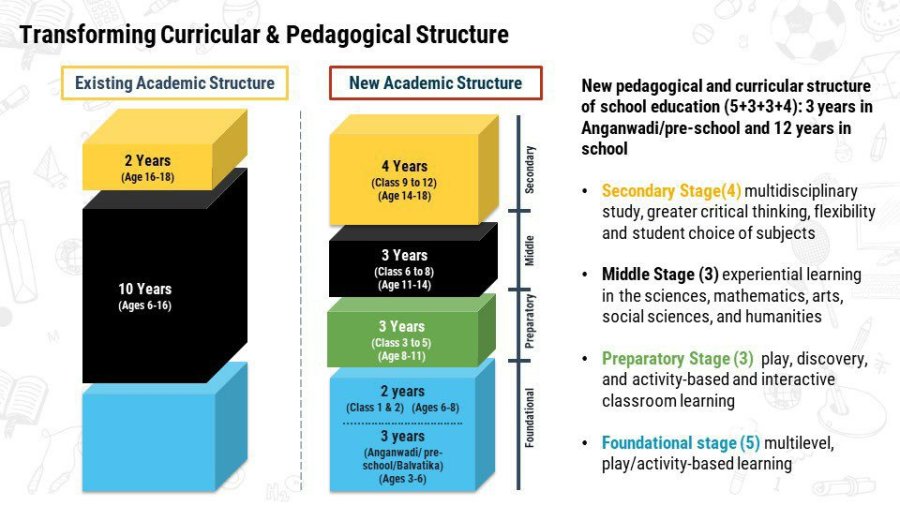
 Thus to meet the need of 21st century , School education System  is  to convert  it to a 5+3+3+4 system  with 3 years  as pre -schooling. In a federal system , any reform can be made only with some  support from state and centre  who have taken the task of building an ambitious Plans. This process will help in eliminating  process of pedagogy , Structural inequalities and rampat commercialisation.  There will be  school examinations in  Grades 3 , 5 and 8  conducted by appropriate authority . A new  national Assessment centre  prakash will set up as  a standard -setting body  and thus the old system of examination of Grade 10 and 12  is  gonna re -designed.

The union cabinet on Wednesday  approved the New  Education policy . One of the major decision , the cabinet has renamed  the ministry of Human Resource and  Development  as ministry of Education. This decision of changing name came due to  recommendations listed in draft  on New Education Policy .
We already know about our education system ,regarding the poor literacy and Numeracy outcomes ,Drop out levels in middle  and Higher education failed to meet the aspirations for multi disciplinary Programmes.
Lets   speak  about  new reforms – 
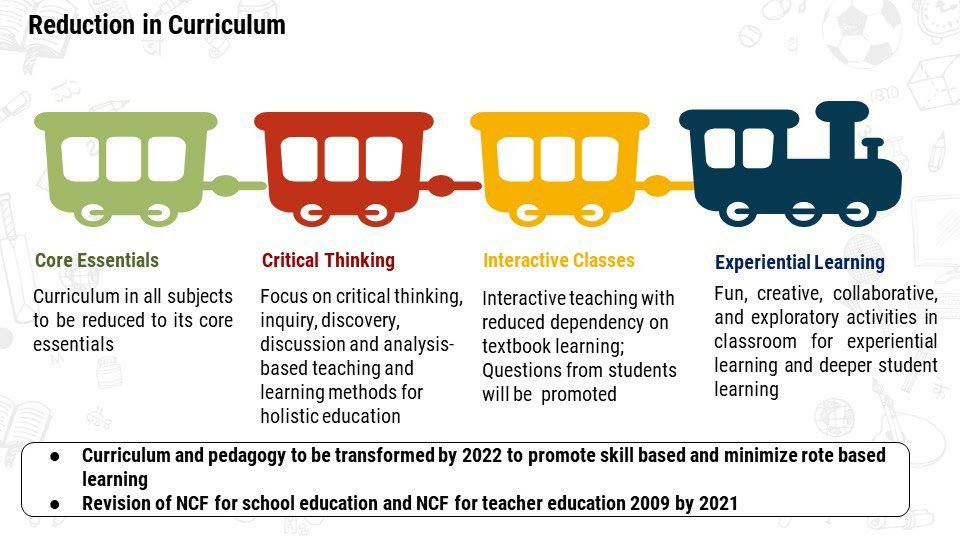
1.Board  exams will test your  actual knowledge  and  not from root .
2.Mother tongue will be available till 5th standard  as instructions 
3.Report card will be on  skills  rather than on mere marks  and statements .
4.Pedagogical structure  reformed   as there will be no streams available
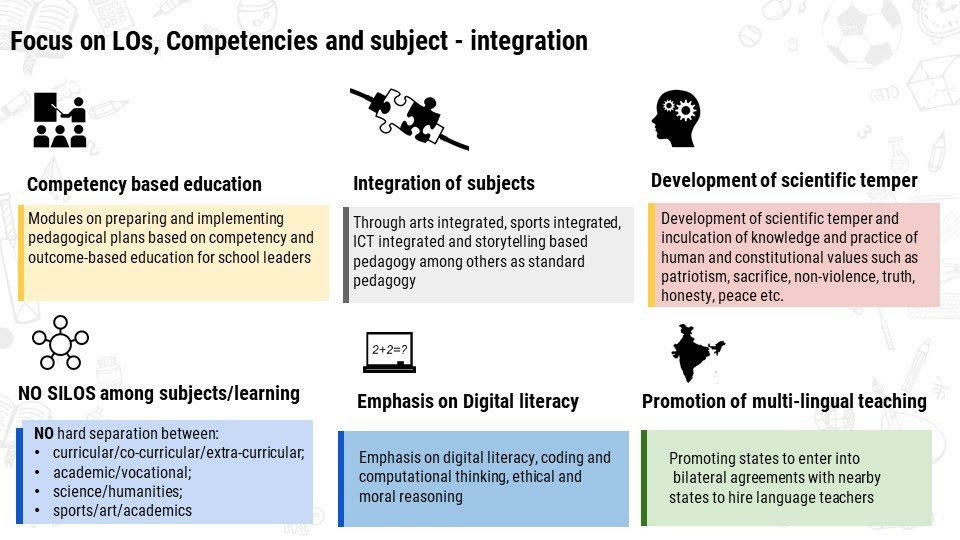
5.All seperation between vocational, acedemic , Curricular , Extra – curricular Will also be removed.
 
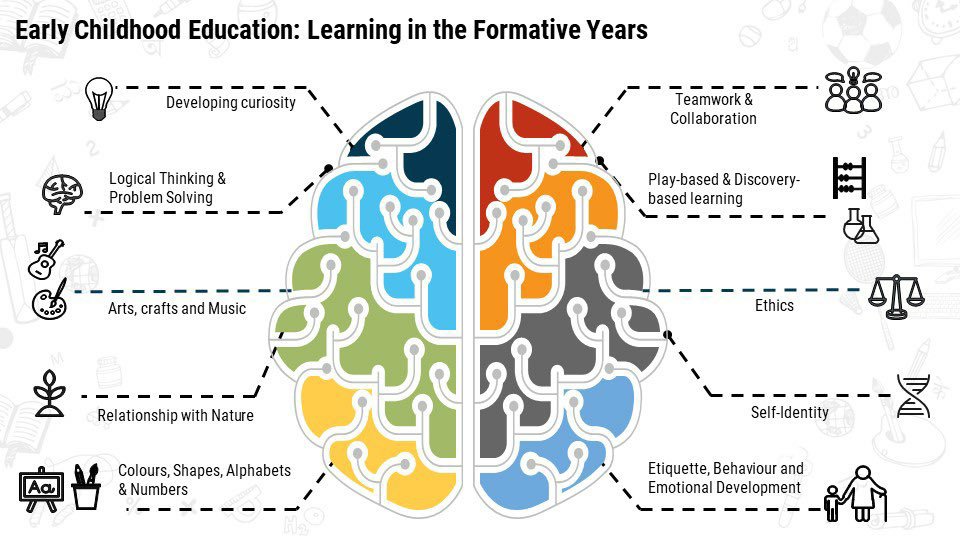
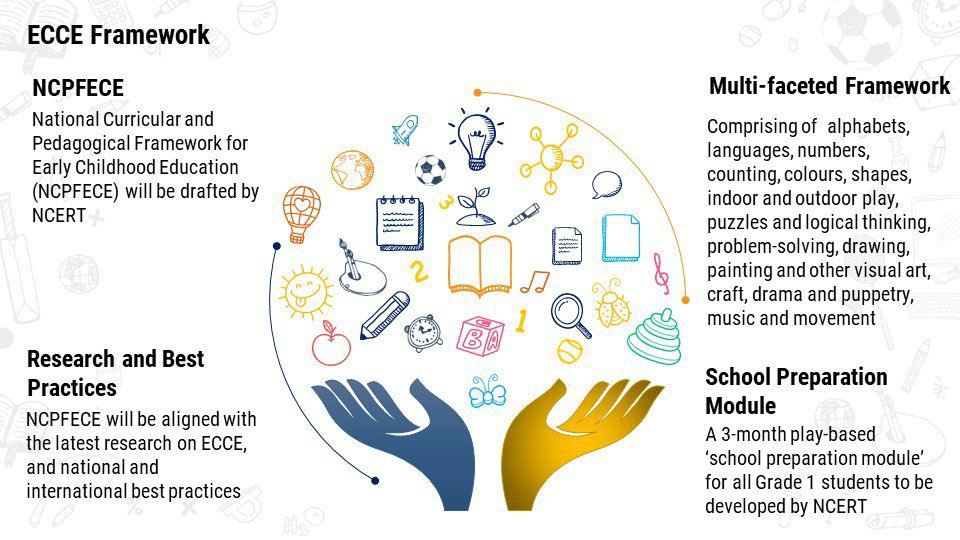
It is a new  national curriculum framework  for ECE , adult Education , and teachers.
  
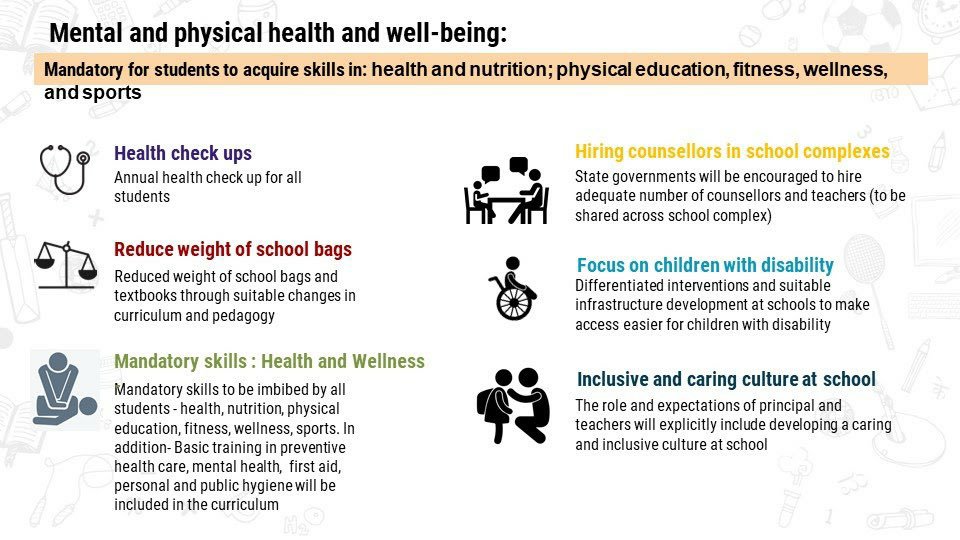
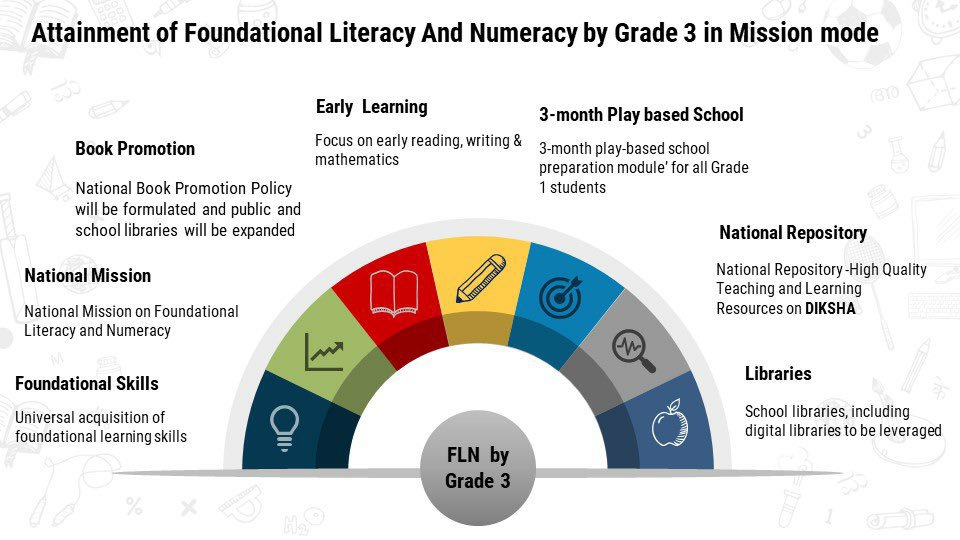
360 Degree Hostilic progress card of child. It is tracking children to progress their Learning Outcomes. NTA to introduce common  enterance examination for admission to  HEIs. National professional standards for teachers . Book promotion policy and Digital  libraries. Transparent online self disclosure  for public oversight and  accountability.Public investment to reach 6 %  in Education sector . Fee fixation with Board regulation system .NEP will generate little friction like provision of an energy -filled breakfast , in addition to the nutritious mid – day meal , to help children achieve better learning outcomes. Creation of inclusion funds to help socially  and educationally disadvantaged people for pursuing Education.
Reforms in Higher Education
1.UG Programme -3 to 4 years 
2. P G programme -1 to 2 years
3 . M phil to be discontinued
4.Integrated 5 years bachelor’s / masters
 5. Multiple entry and exit 
6. Credit transfer
7. Flexibility of subjects 
8. Autonomous degree granting college.
9. All degrees will be of 4 years.

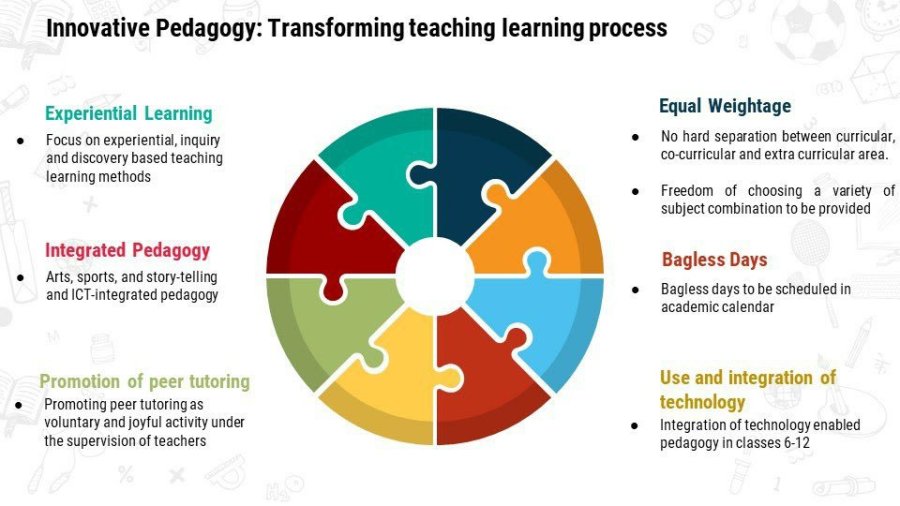
 Among all others , the deadline of achieving universal literacy and numeracy by 2025  should be a top priority goal  for progress. Bagless day to be encouraged throughout  the year for school students . The three languages will be learnt by students on their choice , state and region. Variable model for semester , annual and module papers. Exam will be twice a year, no more board  exam stress.
 The present Education system runned for 34 years from  1986 , its  after 34 years  new reform introduced in educational line. Our Government have the vision of creating  the country with youth ‘s of high quality education  and make global superior knowledge country.

NEW EDUCATION POLICY 2020

The NEW EDUCATION POLICY 2020 was passed on 29 July 2020, Wednesday by the Union Cabinet chaired by the Prime Minister Narendra Modi. The policy aims to bring reform in the schools and higher education systems in India, as stated by the Ministry of Human Resource Development. It is a replacement for the National Policy on Education 1986. The aim of the policy is to create an education system which has a direct contribution in transformation of the country, to provide high-quality education to all, and to make India a global knowledge superpower. The cabinet has also approved to change the name of the HRD ministry to Education Ministry. 
The key highlights of the policy are as follows:
1.     Mother tongue or local or regional language to be the medium for instructions till class fifth (or if preferable till class eighth and beyond). Sanskrit shall e offered at all the levels of the school and higher education as an option however; the policy clearly states that no language shall be imposed on any student.
2.   The 10+2 structure has been replaced with the 5+3+3+4 structure, which includes 12 years of school and three years of the pre-school. The division is as follows – Foundational Stage (ages 3-8), Pre-Primary stage (ages 8-11), Preparatory Stage (ages 11-14), and Secondary Stage (ages 14-18).
3.   School students now have to only sit for three exams at classes 3, 5, and 8, rather than sitting in exams every year. The assessment for other years will have a regular and formative style that promotes learning and development as well as tests higher-order skills of the students.
4.   For classes 10 and 12, the board exams will continue to take place but they will be re-designed with a ‘holistic development’ and the standards for the same will be established by a new national assessment centre – PARAKH (Performance Assessment, Review, and Analysis of Knowledge for Holistic Development.
5.   A singular regulatory body i.e. Higher Education Council of India (HECI) will be set up to regulate all higher education institutions except for legal and medical colleges. The goal of the council is to increase the enrolment rate in college from 26.3% to 50% (by 2035). The main focus will be on the institutions that have more than 3000 students.
6.  The HECI will have 4 independent bodies – National Higher Education Regulatory Council for regulation, General Education Council to set the standards, Higher Education Grants Council for funding, and the National Accreditation Council for accreditation.
7.   The policy aims to reduce the load of the curriculum on the students and allowing them to become ‘multi-disciplinary’ and ‘multi-lingual’. There will also be no distinction between arts and science streams, or between the curricular or extracurricular activities, or between the vocational and academic streams.
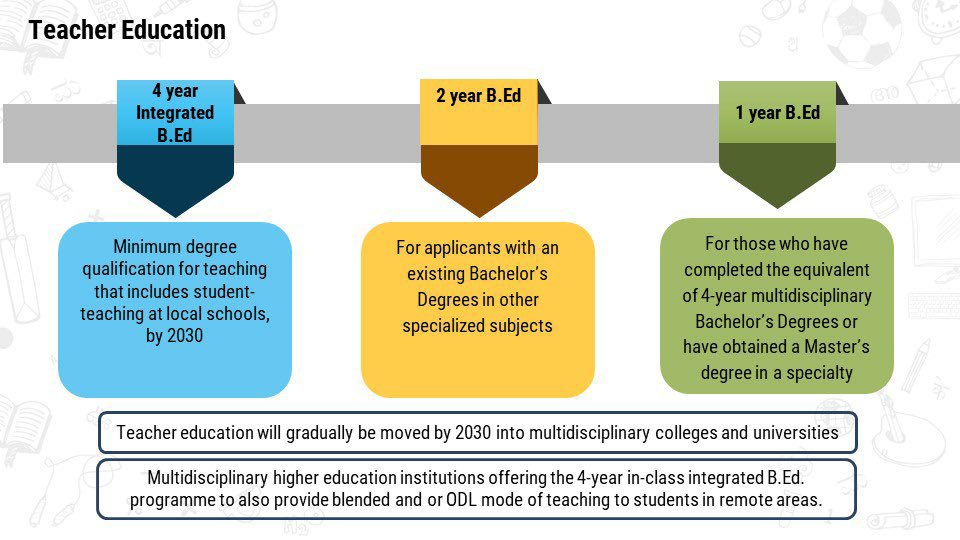
8.  It also proposes a 4 year under graduate programme with multiple exit options for the students to have flexibility. A multi disciplinary bachelors’ degree will be given after completing 4 years of study. A diploma will be given to those who exit the degree after two years. A vocational/professional course degree will be given to those who leave after 12 months of studying. Also the MPhil (Masters of Philosophy) courses are to be discontinued.
9.  For the reason of quality, there will be common regulations for both the private and the public higher education institutions in the country. There will also be a Common Entrance Exam that will be conducted by the National Testing Agency (NTA) for admissions to universities and higher education institutions.
10. There will also be establishment of more online courses in regional languages. Virtual labs will also be developed and a National Education Technology Forum(NEFT) will also be created.

Guidelines to be followed by Police while making an Arrest


Arrest involves the restriction of liberty of a person arrested and therefore, infringes the basic human rights of liberty. Nevertheless the Constitution of India as well as International human rights law recognize the power of the State to arrest any person as a part of its primary role of maintaining law and order. The Constitution requires a just, fair and reasonable procedure established by the law under which alone such deprivation of liberty is permissible. Although Article 22(1) of the Constitution provides that every person placed under arrest shall be informed as soon as may be the ground of arrest and shall not be denied the right to consult and be defended by a lawyer of his choice and S.50 of the Code of Criminal Procedure, 1973 (Cr. PC) requires a police officer arresting any person to “ forthwith communicate to him full particulars of the offence for which he is arrested or other grounds for such arrest”. in actual practice these requirements are observed more in the breach. Likewise, the requirement of production of the arrested person before the court promptly which is mandated both under the Constitution [Article22(2)] and the Cr. PC (Section 57] is also not adhered to strictly.

A large number of complaints pertaining to Human Rights violations are in the area of abuse of police powers, particularly those of arrest and detention. It has, therefore, become necessary, with a view to narrowing the gap between law and practice, to prescribe guidelines regarding arrest even while at the same time not unduly curtailing the power of the police to effectively maintain and enforce law and order and proper investigation.

GUIDELINES LAID DOWN BY THE HON’BLE SUPREME COURT IN D.K. BASU CASE:

The Hon’ble Supreme Court, in D.K. Basu Vs State of West Bengal , has laid down specific guidelines required to be followed while making arrests.

THE HON’BLE SUPREME COURT GUIDELINES on arrest:

The principles laid down by the Hon’ble Supreme Court are given here under:

(i) The police personnel carrying out the arrest and handling the interrogation of the arrestee should bear accurate, visible and clear identification and name tags with their designations. The particulars of all such police personnel who handle interrogation of the arrestee should bear accurate, visible and clear identification and name tags with their designation. The particular of all such personnel who handle interrogation of the arrestee must be recorded in a register.

(ii) That the police officer carrying out the arrest shall prepare a memo of arrest at the time of arrest and such memo shall be attested by at least one witness, who may be either a member of the family of the arrestee or a respectable person of the locality from where the arrest is made. It shall also be counter signed by the arrestee and shall contain the time and date of arrest.

(iii) A person who has been arrested or detained and is being held in custody in a police station or interrogation centre or other lock up, shall be entitled to have one friend or relative or other person known to him or having interest in his welfare being informed, as soon as practicable, that he has been arrested and is being detained at the particular place, unless the attesting witness of the memo of arrest is himself such a friend or a relative of the arrestee.

(iv) The time, place of arrest and venue of custody of an arrestee must be notified by the police where the next friend or relative of the arrestee lives outside the district or town through the Legal Aids Organization in the District and the police station of the area concerned telegraphically within a period of 8 to 12 hours after the arrest.

(v) The person arrested must be made aware of his right to have someone informed of his arrest or detention as soon as he is put under arrest or is detained.

(vi) An entry must be made in the diary at the place of detention regarding the arrest of the person which shall also disclosed the name of the next friend of the person who has been informed of the arrest and the names land particulars of the police officials in whose custody the arrestee is.

(vii) The arrestee should, where he so request, be also examines at the time of his arrest and major and minor injuries, if any present on his /her body, must be recorded at that time. The Inspector Memo’ must be signed both by the arrestee and the police officer effecting the arrest and its copy provided to the arrestee.

(viii) The arrestee should be subjected to medical examination by the trained doctor every 48 hours during his detention In custody by a doctor on the panel of approved doctor appointed by Director, Health Services of the concerned State or Union Territory, Director, Health Services should prepare such a panel for all Tehsils and Districts as well.

(ix) Copies of all the documents including the memo of arrest, referred to above, should be sent to the Magistrate for his record.

(x) The arrestee may be permitted to meet his lawyer during interrogation, though not throughout the interrogation.

(xi) A police control room should be provided at all district and State headquarters where information regarding the arrest and the place of custody of the arrestee shall be communicated by the officer causing the arrest, within 12 hours of effecting the arrest and at the police control room it should be displayed on a conspicuous notice board.

The New Education Policy 2020

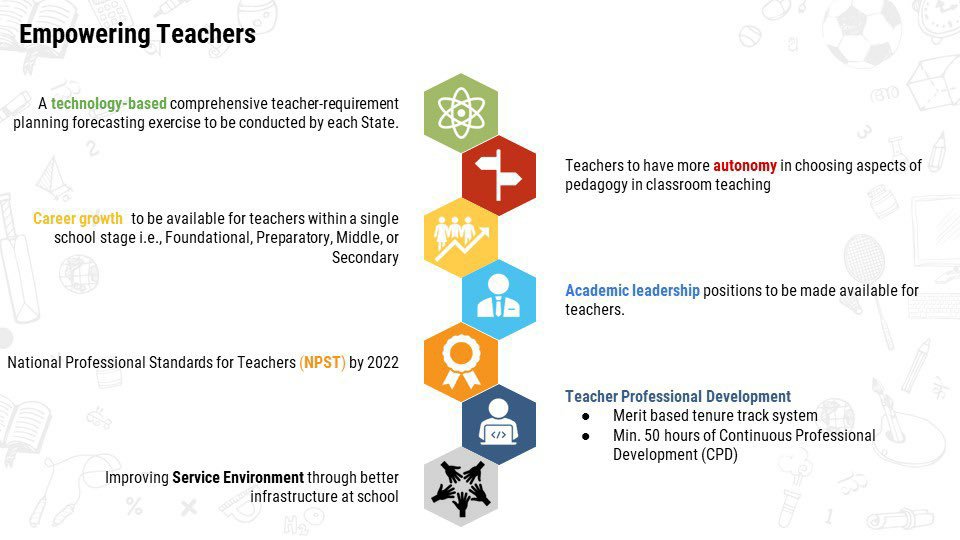
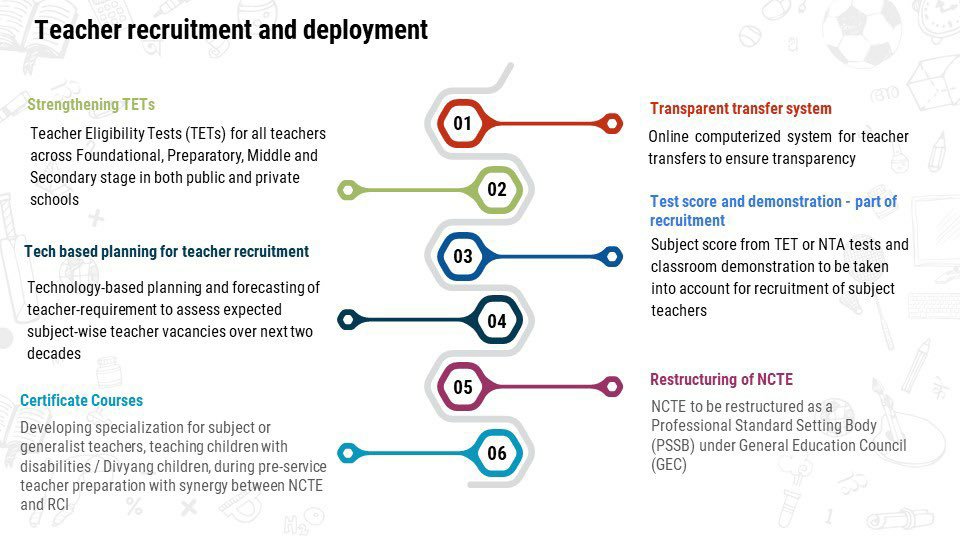
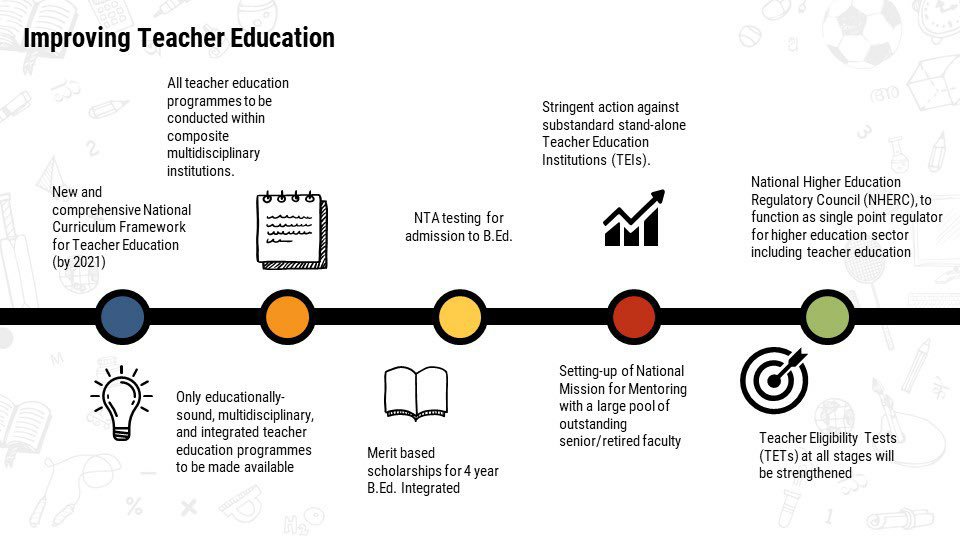
The New Education Policy, NEP 2020, has been approved by the Union Cabinet. The new policy will come into effect by 2030. Union Ministers Prakash Javadekar and Ramesh Pokhriyal Nishank, together unveiled it and shared the details. The Ministry of Human Resource Management, MHRD has also been renamed as Education Ministry.

The draft of NEP 2020, has been prepared by a panel of experts led by former Indian Space Research Organisation (ISRO) chief K Kasturirangan and reviewed by the Prime Minister Narendra Modi.
The existing education policy was framed in 1986 and revised in 1992. 

Right to Privacy


Privacy is a fundamental human right, enshrined in numerous international human rights instruments. It is central to the protection of human dignity and forms the basis of any democratic society. It also supports and reinforces other rights, such as freedom of expression, information and association.  Activities that restrict the right to privacy, such as surveillance and censorship, can only be justified when they are prescribed by law, necessary to achieve a legitimate aim, and proportionate to the aim pursued.


As innovations in information technology have enabled previously unimagined forms of collecting, storing and sharing personal data, the right to privacy has evolved to encapsulate State obligations related to the protection of personal data.  A number of international instruments enshrine data protection principles, and many domestic legislatures have incorporated such principles into national law.


Privacy also has implication for the freedom of opinion and expression. The Report of the Special Rapporteur on the promotion and protection of the right to freedom of opinion and expression emphasises that the “right to privacy is often understood as an essential requirement for the realization of the right to freedom of expression. Undue interference with individual’s privacy can both directly and indirectly limit the free development and exchange of ideas.”


The Constitution of India does not specifically guarantee a right to privacy, however through various judgements over the years the Courts of the country have interpreted the other rights in the Constitution to be giving rise to a (limited) right to privacy – primarily through Article 21 – the right to life and liberty. In 2015, this interpretation was challenged and referred to a larger Bench of the Supreme Court (the highest Court in the country) in the writ petition Justice K.S Puttaswamy & Another vs. Union of India and Others, the case is currently pending in the Supreme Court.


The constitutional right to privacy in India is subject to a number of restrictions. These restrictions have been culled out through the interpretation of various provisions and judgements of the Supreme Court of India:


• The right to privacy can be restricted by procedure established by law which procedure would have to be just, fair and reasonable (Maneka Gandhi v. Union of India);

• Reasonable restrictions can be imposed on the right to privacy in the interests of the sovereignty and integrity of India, the security of the State, friendly relations with foreign States, public order, decency or morality, or in relation to contempt of court, defamation or incitement to an offence; (Article 19(2) of the Constitution of India, 1950)

• The right to privacy can be restricted if there is an important countervailing interest which is superior (Gobind v. State of M.P.);

• The right to privacy can be restricted if there is a compelling state interest to be served (Gobind v. State of M.P.);

• The protection available under the right to privacy may not be available to a person who voluntarily thrusts her/himself into controversy (R. Rajagopal v. Union of India).

• Like most fundamental rights in the Indian Constitution, the right to privacy has been mostly interpreted as a vertical right applicable only against the State, as defined under Article 12 of the Constitution, and not against private citizens. (Zoroastrian Cooperative Housing Society v District Registrar)

Burdens of online classes

I have just been promoted to the second year of my postgraduate course and our dean was very much proactive in launching the online platform by buying a Zoom subscription, providing access to the online private library and even bought subscriptions to buy e-books. A necessary amount of fees was also reduced although there is no reimbursement of the internet or Wi-Fi charges. Around 2-4 classes of duration 90 minutes are usually scheduled each day, with a couple of days off each week. Faculties usually provide assignments with deadlines and we have to prepare presentations almost every week. Everything which one usually does in a MBA college, we are doing everything and even the faculties are trying to replicate the entire offline model of MBA into an online model. Truth to be spoken, they have been successful in their endeavours, but to what extent?

With each passing day, such online classes are becoming more of a burden. Attending classes every day, for such long hours as well as trying to grasp new topics is becoming increasingly difficult. Even though the faculties are trying to make things easy, there is something about this online platform that makes the entire teaching process a mile less effective. Recent trends suggest that the attention span of a normal 25 years old human being ranges from 10 to 20 minutes. This trend is well observed when we are studying a class environment, usually surrounded by friends who help us getting through the class. But coming to the online mode, what usually happens is our attention span gets drastically reduced and since there is no check with the reality, we often drift away from what exactly is happening in the class. What spikes our frustration is the absence of non-verbal cues during the class activities or during presentation. In classes, we can see our audience and change ourselves accordingly, but in online mode, it seems like a one way communication – we only speak without any response from the opposite end. And to add to that, we always face a fear of losing internet connection in the middle of class. And God forbid, the days when that happens, we have no other options but to succumb to our own senses to try and to understand what we have missed.

But that is not all. Post graduate study is so designed that group work is more of necessity which reduces time and increases effectiveness of our study. Studying solo in our rooms is making things harder, and this is piling up day by day.

But what is more frightening and despairing is that unlike the corporate, schools and colleges does not have any mental wellness programs. Hours of online classes with studying solo in our rooms is creating a mental challenge coupled with anxiety and stress. What actually is happening now is that students are trying to cram everything but what is the effectiveness? Are we really being able to retain anything at the end of the day? There is no doubt that the faculties are trying their best, but somewhere they have failed to consider the mental challenge that we are facing in the meantime.

Online class is perfectly fine for those curriculum which have been designed in that way. It does not work, or at least we are not ready to embrace this form as a substitute of offline mode of classes.

Source – Self

Typhoid and low levels of Serotonin

Vaishali Singh

It’s the seventh time I got detected positive with typhoid, the first time my Widal test came out to be positive was when I was in 5th standard and today I am in the second year of my college it’s been more than 10 years but the problem is still there, the typhoid bacteria Salmonella typhi, activates in favourable condition, for 2 years I had no typhoid but still the problems related to intestine were there, I always suffer from stomach and digestion related problems and overtime these problems decreased the amount of serotonin in my body, my poor metabolism and digestive problems ultimately caused me low levels of serotonin which keeps me frustrated and unhappy for long period of time, most of the times I feel so empty, unhappy and lonely, for years I never understood that it was a clinical problem as I never gave it my attention but the research and deep analysis of 2 days made me understood that every mental health problem has connection to your physical health, the low levels of serotonin makes one feel depressed, broken, restless, emotional and unhappy, and overtime this problem can lead to severe problems which can destroy your mental peace so always take it seriously, you feel low most of the times because your feeling can may have a huge connection with your physical health, now the solution to my problem is to keep your body fit with regular Yoga, exercises and most importantly the healthy food, the another important thing is to do the meditation sessions to boost the serotonin, since this february my health condition is poor and I am struggling to make myself happy but today I understood the proper reason so now I can hope I’ll be better with continuos efforts.

Thank you for reading it, the purpose of putting it here was to aware you that if you’re suffering from Typhoid, or any other disease which affects your intestine or may be any other organ, can lead to decrease in your serotonin level and can cause you depression or severe anxiety but don’t be sad instead work for it, first of all just take time to get recover from that health condition then focus upon healthy food, workout and meditation overtime you will be healed.

What is Serotonin? Serotonin is a neurotransmitter, it’s involved in numerous core physical processes such as the regulation of sleep, appetite, and aggression. For more details read this link, https://www.integrativepsychiatry.net/product-category/neurotransmitters/serotonin/