Entrepreneur

The word entrepreneur has its origin in the French language. It refers to the organiser of musical or other entertainments. An entrepreneur is one who organises, manages, and assumes the risks of an enterprise. An entrepreneur visualises a business, takes bold steps to establish undertaking, coordinates the various factors of production and gives it a start.Entrepreneurs are the owners of the business Who Contribute the capital and bear the risk of uncertainties in business life. Entrepreneur is action – oriented and highly motivated. He has the ability to evaluate business opportunities, to gather the necessary resources to take advantage of them and to initiate appropriate action to ensure success. Entrepreneur is associated with innovations.He is the main factor of production. Entrepreneur takes decision regarding what to produce, how to produce, where to produce and for whom to produce. He mobilises other factors of production namely, land, labour, capital, organisation and initiates production process. He is responsible for both the profit or the loss. In India, Birla, Tata, Modi are big entrepreneurs.
Many people dream of becoming entrepreneurs someday. But it made me realize that there other factors that needs to be taken into consideration. We need to ask ourselves are we ready to take the challenge to the outside world. Not everyone have the vision, innovation and creativity to become an entrepreneur. The individual must have a positive attitude and accept the responsibility, have discipline to meet their goals, and take action when the opportunity presents itself. Many prefer a job security and rely on a weekly paycheck, while entrepreneurs will take risks and doesn ‘t have that luxury to know the amount of their income.

Starting your own business can be exciting and it can become a well- rewarded experience. Being your own business includes great benefits,
Businesses trying to survive the current economic crisis need to pursue competitive advantages and empower them. Competitive advantage results from matching core competencies to the opportunities. The entrepreneur that I interviewed uses her experience, quality, consistency and overall learned what the customers really need and demand. Jane’s skills and experience enable her to respond faster to market changes. Jane has remarkable negotiation and sales skills that make her a most competitive in the market. There are also questions that you need to ask yourself to determine if you are ready to take the next step. Are you able to think of new ideas? Can you imagine new ways of solving problems? Entrepreneurs should think creatively. If you have ideas learn how take advantage of new opportunities. Be your own boss also means that you are responsible for making difficult decisions. The business world involves uncertainty. Do you avoid the uncertainty in life at all costs? If so, owning your own business is not the best.


BLOGGING

How To Become A Blogger?

Since the advent of internet, people have access to all kinds of information as well as global audience. On the one hand there are people who enjoy reading this information and on the other hand there are people who are taking advantage of the access to global audience to communicate their thoughts and knowledge. These people are known as bloggers. Contrary to popular belief, a blogger is not only a person who writes but someone who uses any medium to communicate their thoughts like a photographer for example.

There are billions of people across globe writing about billions of things and you could be one of them. Being a blogger gives you a sense of freedom to express what’s inside you and let people know that they are not alone. In no time blogging has become one of the most popular career choices among youth. Blogging is original, it’s personal. it offers a fresh perspective, so no wonder it is the choice of majority of people. To become a blogger it is necessary to develop interest in writing. No one is born a writer but this habit is developed over time. A successful blogger is an avid reader. One who reads knows how the writers manipulate their words and proceed with their thoughts. In order to be a blogger you must consider the following points:

  • Pick your genre: You must decide the kind of blogger you want to be. You can be a fashion blogger, a food blogger, a travel blogger, a motivational writer, or any other area that is of your interest.
  • Pick a name: Pick a name for your website that resembles the kind of blogs you wish to write.
  • Register your blog: Next step is to get your blog registered on the website of your choice.
  • Write your first post: Now it is time to write your first blog. Make sure it aligns with the theme of your blog and use as many keywords as possible to attract audience. You can be as creative as possible. Remember it only gets better after your first post.
  • Promote your blog: This is the most crucial step if you wish to advance your career as a blogger. Promote the website as much as you can. Put up social media posts, forward it to your friends, do as much as you can. These efforts will only improve your chances of becoming a successful blogger.
  • Handling writer’s block: There will come a time when you would be short of ideas and you would wish to stop but handling that writer’s block is part of being a writer. Don’t let it discourage you. Keep calm and keep going.

The above points might not feel daunting the first time but the moment you make up your mind to follow through, the real challenge begins. There greater the audience, the greater the responsibility to deliver original content. As a writer, your integrity is at stake and you must refrain from copying and stealing someone else’s work unless you plan on giving them due credit. Be true to yourself and most importantly be true to your audience. It takes a lot of research and reading to write a blog and for this reason it is not everyone’s cup of tea. It does not matter if blogging is your side hobby or your career goal, you must choose to become a blogger only if you are fully committed to it. There are a lot of employment opportunities for freshers as well as established bloggers. So, if you have a knack for writing and coming up with original ideas, blogging is the job for you.

Positive Psychology

Positive psychology is one of the newest branches of psychology to emerge. This particular area of psychology focuses on how to help human beings prosper and lead healthy, happy lives. While many other branches of psychology tend to focus on dysfunction and abnormal behaviour, positive psychology is centered on helping people become happier. Positive psychology is designed to “complement and extend the problem-focused psychology that has been dominant for decades,” explained the late Christopher Peterson, author of “A Primer in Positive Psychology” and professor at the University of Michigan, in a 2008 article published in Psychology Today. “Positive psychology is…a call for psychological science and practice to be as concerned with strength as with weakness; as interested in building the best things in life as in repairing the worst; and as concerned with making the lives of normal people fulfilling as with healing pathology,” Peterson wrote.

According to leading authorities in the field, Martin Seligman and Mihaly Csikszentmihalyi, positive psychology will help achieve “scientific understanding and effective interventions to build thriving in individuals, families, and communities.” In order to understand the field of positive psychology, it is essential to start by learning more about its major theories, applications, and history.

History of Positive Psychology

“Before World War II, psychology had three distinct missions: curing mental illness, making the lives of all people more productive and fulfilling, and identifying and nurturing high talent,” wrote Seligman and Mihaly Csikszenmihalyi in 2000. Shortly after WWII, the primary focus of psychology shifted to the first priority: treating abnormal behavior and mental illness. In the 1950s, humanist thinkers like Carl Rogers, Erich Formm and Abraham Maslow helped renew interest in the other two areas by developing theories that focused on happiness and the positive aspects of human nature.

General interest in positive psychology has grown tremendously since the concept was introduced. Today, more and more people are searching for information on how they can become more fulfilled and achieve their full potential.

Uses

Positive psychology can have a range of real-world applications in areas including eduction, therapy, self-help, stress management, and workplace issues. Some of the major topics of interest in positive psychology include: Character strengths and virtues, Flow, Gratifications, Gratitude, Happiness, Pleasure, Helplessness, Hope, Mindfulness, Optimism, Positive thinking, Resilience .

Impact of Positive Psychology

Some of the major findings of positive psychology include: Money doesn’t necessarily buy well-being, but spending money on other people can make individuals happier, People are generally happy, Some of the best ways to combat disappointments and setbacks include strong social relationships and character strengths, While happiness is influenced by genetics, people can learn to be happier by developing optimism, gratitude, and altruism, Work can be important to well-being, especially when people are able to engage in work that is purposeful and meaningful.

Potential Pitfalls

Positive psychology is often confused with positive thinking, and misconstrued as self-help tactics rather than research-backed theories. Positive thinking is a way of thinking ourselves into better behavior and greater resilience, rather than behaving our way into a different frame of mind. Positive psychology, on the other hand, is the scientific study of what makes people thrive. It focuses on behaviors that can lead to a more optimized frame of mind as well as on thought patterns that lead to more functional behaviors.

“STARTUP INDIA SEED FUND SCHEME” an initiative by govt for startups

SISFS , was launched by shri Piyush Goyal minister of Commerce & Industry, Consumer Affairs & Food & Public Distribution and Textiles

We all are know to India’s journey of giving opportunity to startups . Though we have may startups firms in India , but they don’t survive in long run , one of the main reason behind this is Indian startup ecosystem suffers from capital inadequacy in the seed and ‘Proof of Concept’ development stage. The capital required at this stage often presents a make or break situation for startups with good business ideas. Many innovative business ideas fail to take off due to the absence of this critical capital required at an early stage. The problem starts with seed funding , here is a short note on what is seed funding :

Seed funding : For growing a tree we need seed , so as to grow our business we need capital , and that is too at an early stage , Seed funding, or seed capital, is a relatively small amount of money that is used to start a business, fund research, or develop a product. The term’s reference to a “seed” is quite fitting. A tiny seed can someday grow into a lush forest. A tiny investment can help a struggling startup grow into a successful enterprise.

About the SISF Scheme: The Startup India Seed Fund Scheme aims to provide financial assistance to startups for proof of concept, prototype development, product trials, market entry and commercialization. On February 5, 2021, the Government of India made an official announcement about the approval of SISFS. It has been approved for a period of four years and was implemented with effect from April 1, 2021. Under the guidance of our honorable prime minister , Shri Narender Modi ji & Shri Piyush Goyal , minister of commerce & industry , this scheme was launched.

  • The Scheme aims to provide financial assistance to startups at the very initial stage of their project
  • It has been approved for a time period of four years, starting from 2021-22
  • Rs. 945 Crore corpus will be divided over the next 4 years for providing seed funding to eligible startups through eligible incubators across India
  • It is expected that the Startup India Seed Fund Scheme shall help over 3600 startups in the country
  • This scheme is in line with the Atmanirbhar Bharat Campaign launched in May 2020
  • Seed Fund to an eligible startup by the incubator shall be disbursed as follows:
    • Up to Rs. 20 Lakhs as a grant for validation of Proof of Concept, or prototype development, or product trials
    • Up to Rs. 50 Lakhs of investment for market entry, commercialization, or scaling up through convertible debentures or debt or debt-linked instruments

Who are eligible for SISFS ?

The eligibility criteria for a startup to apply under the Startup India Seed Fund Scheme shall be as follows:

  • The startup must be recognised by the Department for Promotion of Industry and Internal Trade (DPIIT)
  • It must have incorporated not more than 2 years ago at the time of application
  • Preference would be given to startups creating innovative solutions in sectors such as social impact, waste management, water management, financial inclusion, education, agriculture, food processing, biotechnology, healthcare, energy, mobility, defense, space, railways, oil and gas, textiles, etc.
  • The startup should not have received more than Rs 10 lakh of monetary support under any other Central or State Government scheme
  • Shareholding by Indian promoters in the startup should be at least 51% at the time of application to the incubator for the scheme

How will SISFS work ?

1. Department for Promotion of Industry and Internal Trade

The Seed Fund will be disbursed to eligible startups through eligible incubators across India DPIIT

Nodal Department EAC

2. Experts Advisory Committee

Government Representatives & Industry Experts Incubators

3. Govt assisted/Not-Govt assisted Incubators

Operational for at least 2-3 years Startups

4. DPIIT-recognized Startups

Incorporated less than 2 years ago

Elon Musk

Elon Musk(born June 28, 1971) is an businessman. He was born in South Africa. He moved to Canada and later became an American citizen. Musk is the current CEO & Chief Product Architect of Tesla, Inc., a company that makes electric vehicles. He is also the CEO of Solar City, a company that makes solar panels, and the CEO & CTO of SpaceX, an aerospace company. In August 2020, Bloomberg ranked Musk third among the richest people on the planet with net worth to be $198 billion. In January 2021, Musk became the richest person in the world with a net worth of US$209 billion.

When Jeff Bezos first started his virtual venture, he wanted to call the company Cadabra, as in abracadabra. He phoned his Seattle lawyer to try out the name, but the attorney misheard Bezos and replied, “Cadaver! Why would you want to call your company that?” Bezos quickly reconsidered and adopted the name Amazon.com, after the world’s second-largest river.


Despite Amazon’s stunning revenue numbers—the company’s gross profit in 2019 neared $115 billion—it hardly ever declares a major profit, as Bezos’ strategy has always been to reinvest profits into the company’s growth. But that doesn’t bother Jeff Bezos. “To be profitable [now] would be would be a bad decision,” he told PC Week. “This is a critical formative time if you believe in investing in the future.” By expanding the site’s offerings far beyond it’s initial book inventory, Bezos has turned Amazon into the largest online retailer in the world. “There are always three or four brands that matter,” Bezos told PC Week. “With the lead we have today, we should be the No. 1 player.”

Amazon’s runaway growth has made Jeff Bezos the richest man in the world. By owning 12 percent of the company, Bezos’ net worth is estimated to be $116 billion. He maintains the world’s richest man status despite going through a divorce in with wife MacKenzie, who received 4% of Amazon in the settlement (valued at $38 billion). But you wouldn’t know how rich Bezos is from his pay stub. He has collected the same $81,840 salary from the company for over two decades.

Rags to riches

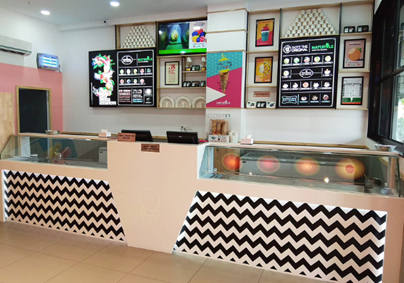
If there’s one dessert that every person on this planet loves, it’s an ice cream! But one Mumbai-based label is giving every ice cream company a run for its money. Naturals Ice Cream companywhich started with an investment of Rs 2 lakh, now has a turnover of Rs 300 crore. 

Renowned for its cafe-like ice cream parlors, Naturals has 129 stores in all major cities of India, including Mumbai, Bengaluru, Hyderabad, and Delhi

“You don’t have to wait for the ‘big idea’. It is important to start and build upon the small ideas to create the biggest wins,” very well said by Raghunandan Kamath, the Founder of Naturals Ice Cream, hails from Mangaluru. The boy of a fruit vendor, Raghunandan learnt to distinguish good fruits early on. Shortly, his eldest brother came to Mumbai to make it big. He unveiled a cafe in Santa Cruz, and put Raghunandan in charge of the ice cream counter.

Raghunandan soon understood that ice cream was a unique and exotic dessert that grabbed the fancy of the working class, and was a symbol of elitism

In 1983, after getting married, he decided to start something of his own, and thus, Naturals Ice Cream came into existence in 1984.

Today, Raghunandan’s sons, Srinivas Kamath and Siddhant Kamathare assisting him operate the enterprise across India. 

While ice cream comes across as the ultimate sweet-tooth experience, production it is not very tough. For the past 37 years, Kamath has been leveraging small ideas to build his empire. 

At a time when ice creams were a rare, albeit prized possession and only aristocratic families had access to them, Kamath sold Pav Bhaji with ice cream. This pioneering brand also refrained their brand from artificial colours, flavours and preservatives that its competitors were using. 

Kamath keenly observed his surroundings to make ‘Naturals’ a household name — whether it was learning to pick quality fruits like his father, using his mother’s traditional hacks or taking customer feedback seriously.  

Today, his wife, Annapurna and sons, Siddhant and Srinivas also serve on the management board. Their staff of 125 members produce close to 20 tonnes of ice creams daily.

Originally from Puttur taluka of Mangalore in Karnataka, Kamath was the youngest of seven siblings. His mother was a homemaker and his father was a fruit vendor. The family of eight also cultivated some fruits on their one-acre land but their monthly earnings were as low as Rs 100.

The prospect of education looked insubstantial. Students of Classes 1 to 5 in Kamath’s school were taught together and despite failing in his exams, he was promoted. However, it was the lessons outside the classroom that Kamath liked the most. 

The COVID-19 pandemic saw a dip in sales for the brand’s business, but Siddhant, his brother, and their father are not new to challenges. In 1993, an income tax query on the business turned out to be a big blow for the company. “We incurred several losses because my father was not aware of several taxation policies,” Siddhant adds.

However, the family started on its road to recovery by giving out five franchises of the business.

Similarly, in 1991, when the economy had just opened, allowing foreign companies to open a business in India, ice cream companies like Baskin Robbins and Haagen Dazs posed a lot of difficulties for Naturals. 

There were no ‘MBA-level’ tactics used by this courageous businessman who simply wanted to sell fruit-flavoured ice cream. By moving into a niche segment like the ice cream market, which was largely overshadowed by a handful of brands, Kamath took a huge risk and his courage paid off !

reference- https://www.thebetterindia.com/258947/naturals-icecream-order-online-fruit-vendor-raghunandan-kamath-success-story/

https://yourstory.com/smbstory/indian-ice-cream-brands-naturals-ice-cream-mumbai/amp

Blue Origin Trip: People, Earth, Space and Environment

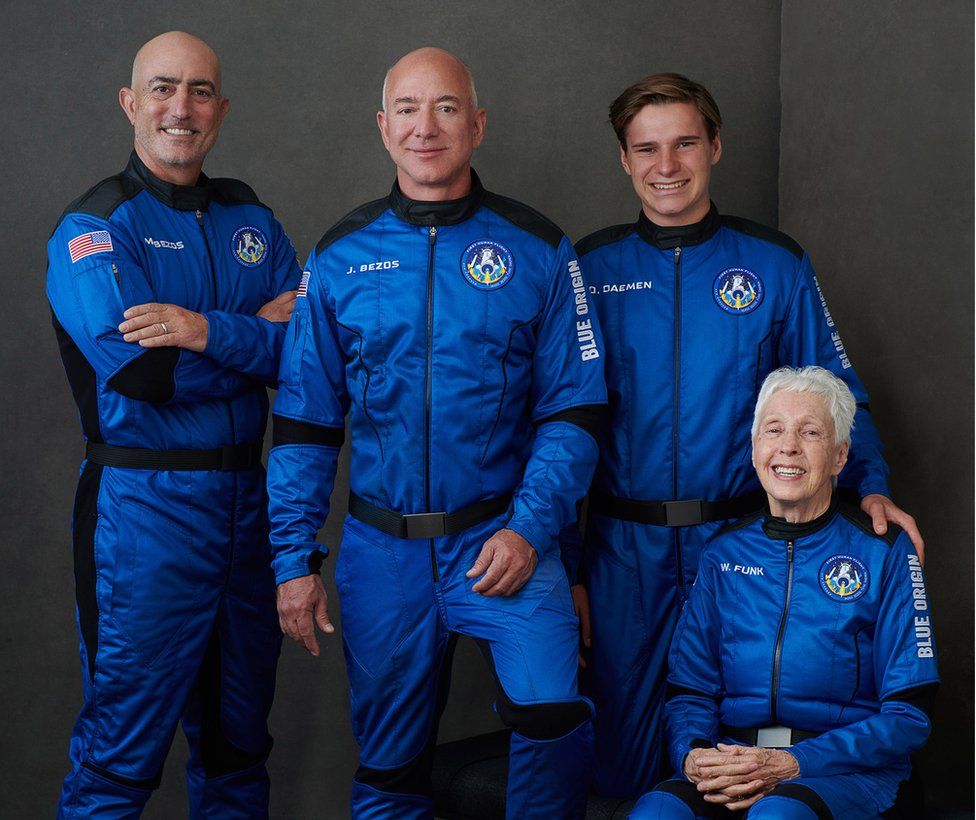
Jeff Bezos, the founder of Amazon and Blue Origin, the richest man on the planet and a lot many adjectives that are used for him – finally and quite successfully monetized space travel in the eyes of the Earthlings.

Jeff Bezos launches to space aboard New Shepard rocket ship - BBC News
Commercial Astronaut Bezos in his maiden space voyage.

To begin with, he thanked and congratulated all earthlings for this success. He added that it was we, the people and all the employees of Amazon who had paid for it. Well, he isn’t exactly lying. And we could be thankful to him too, for he has successfully monetized space travel – something we all wanted to hear as kids – well maybe not the monetization part. But it will be this monetization that will fuel more companies to enter into the market. Elon Musk has already worked a lot on reusable space crafts, not to forget that many space agencies – the most prominent being ISRO in India are working to create cheaper means of launching cargo and satellites into space and there are many private space-based start-ups opening up too. Maybe in a decade, space travel will be accessible to at least the upper middle class across the planet.

But should we really thank Jeff Bezos? Opening space for travel opens space for greater amount of debris and maybe a push for institutions all around the world to find out ways to tackle an already existing problem. To add to that, Space travel and Musks’s goal of colonising Mars are but only more incentives to reduce budget on the environment in the long run. Sounds like a dystopian Science Fiction but history points out to the facts that when man was not bound by citizenship laws, forests and agrarian lands have gone barren only because they had options. It is this history that has pushed us towards all the environmental litigations we know of. Will we be as enthusiastic about them if Mars colonies were a reality? As Musk has himself repeatedly stressed that Earth might no longer be livable. Well, scientifically, it is livable upto another 4.5 billion years. But we, the people and the way in which we living beings influence the climate might not allow the planet to see more than 500 years from now. And we are not to be shamed about it. Our education, our governments and our media is more accountable than we are. These are the institutions that tell us what and how the world is. And unfortunately, we believe that is the way the world is.

So, should we or should we not support a scientific and technological advancement?

The answers don’t really lie with anyone. While Bezos travelled to space and Musk revolutionised reusability of the crafts, we still saw public demonstrations in South America against the change in fishing litigations, India against the allegedly anti-environment and corporate-friendly revisions in Environment Impact Assessment Law draft and in Brazil against the government’s decision to not do a lot about the Amazon fires. Humanity still loves this Earth and while in a distant future, capitalism can shame people for doing so, it is increasingly unsuccessful right now. And let us not only keep it that way, but also create ways to add to that love.

4 MUST READ BOOKS TO START YOUR OWN STARTUP

1. ZERO TO ONE

Zero to One presents at once an optimistic view of the future of progress in American and a new way of thinking about innovation. It starts by learning to ask the question that lead you to find value in unexpected places.

2. THE LEAN STARTUP

Rather than wasting time creating elaborate  business plans, the lean startup offers entrepreneurs- in companies of all sizes – a way to test their vision continuously, to adopt and adjust before its too late. The author provides scientific approach to creating and managing successful startups in a age when companies need to innovate more than ever.

3. THE FOUNDERS DILEMMAS

The founder dilemmas draws on the inside stories of founders like EVAN WILLIAMS of twitter and TIM WESTERGREN of Pandora, while mining quantitative data on almost ten thousand founders.

People problems are the leading cause of failure in startups. This book offers solutions.

4. HOOKED

The author of this book provides practical insights to create user habits that stick , actionable steps for building products people love, fascinating examples from the iPhone to Twitter, Pinterest to Bible app, and many other habit forming products.

QUESTIONS YOU NEED TO AS YOURSELF BEFORE STARTING A BUSINESS

1. Why are you starting the business?

First of all defining the why behind what you are doing is most important, If you aren’t clear about why you are doing what you are doing then its better to quitting that thing.


2. What value are you going to add in other peoples life?

Ask yourself whether you are going to add value to other peoples life, whether you are going to bring comfort in others life. If the answer is yes, then definitely your business will sustain in the market.

3. How well are you mentally prepared to start the business?

For starting a business you need to be mentally strong enough. Running a business includes a lot of problem solving tasks, pressure ,bear losses, patience. Therefore you need to be mentally strong enough to handle all such situations.

4. Is there any easier way ?

Most entrepreneurs think if the problem is hard then there should be a complicated solution to the complicated problem but if your are creating any product then always think how you can make it more easier for its end consumers.

5. Is it really worth it ?

Ask yourself that it is actually worth it doing this particular thing because you are going to spend a lot of time on that thing, I know you can’t predict this too early but being realistic is more important that being optimistic.

International MUN recruiting interns?

Gear up and apply now

Yes! You heard it right, international Model United Nations is offering an Official Campus Ambassador Internship at IMUN.

What is IMUN?

International MUN is recognized by the United Nations & has hosted MUN conferences in 5 different countries in the last 3 years i.e in Thailand, Vietnam, Egypt, China & Malaysia.

About IMUN internship?

5 weeks work from home internship with official internship certificate, letter of recommendation and many more. 5 weeks internship program that enables you to learn organisation management, International diplomacy and everything related to the world of United Nations. In this internship period every intern have to promote IMUN and IMUN Conferences through your social media accounts, through your friends.

This internship is a way to understand global issues, interacting with other culture and people.

Great performers receive best of IMUN certificate recognized by United Nations, letter of recommendation, appreciation, incentives, an opportunity to join IMUN team in different countries all sponsored and etc

What will you learn from this internship?

The main question comes in our mind is what new things we will learn from this internship.

Being an intern at IMUN you will learn leadership skills, social media marketing, digital marketing, communication skills, public speaking skills, networking and many more. Interns will also get an certificate after completing the internship, the international certificate from United Nations based on their performance. It will also prepare you for your career and help you to get a good job.

How can I apply?

You can apply through this link given below https://www.instagram.com/p/CGE5diCDSdT/?utm_medium=share_sheet

For more details you can check their official Instagram account @International_MUN

https://instagram.com/imunintern?utm_medium=copy_link

So hurry up, grab this golden opportunity and apply today…

International Model United Nations Conferences

Way towards success

IMUN conferences a way towards success. A platform where your voice matters. Before IMUN conference we have to know about IMUN first.

What is International MUN?

International MUN is recognized by the United Nations & has hosted MUN conferences in 5 different countries in the last 3 years i.e in Thailand, Vietnam, Egypt, China & Malaysia. 

About IMUN conferences.

IMUN conferences is a platform where students (or anyone) are tasked to solve global issues like women empowerment, gender equality through research drafting, lobbying and debate to pass a suitable ‘resolution’.
This conferences are held on sat-sun every week. After completing the whole registration process you will get a mail, in that mail they will give you the meeting link and the topics for the conference. You have to select one topic and have to research about that respective topic.
e.g. I completed my whole registration process, got a mail and selected a topic. Suppose my topic is women empowerment, so I have to research about that topic like what are the issues and how can we solve those issues?. So on a day of online conference I will represent india (if I get india) and the women empowerment in India. I have to discuss the problems and respective solutions about the topic with other members. If you don’t wants to talk it’s okay, you just have to interact with the members.

What is an International Model United Nations (IMUN) conference and Why should someone participate in it ?

International MUN online conference is a 2-day model UN conference where participants from around the world present solutions to global issues. They can choose topics of their choices in every conference. In a 2-day conference, they research about the topics, debate, network with other participants from different countries etc.

Participants also get study materials, free MUN training sessions, experts QnA and position paper submissions. At the end of the conference, all participants receive participation certificates recognised by the Australian embassy and the United Nations. The best participants receive two certificates, one is participation certificate and another is award certificate.

What are the benefits of attending IMUN conferences?

Participating in IMUN conferences helps students to develop leadership skills, communication skills, public speaking, writing, research and many more. You will get a international certificate of participation by United Nation which will help you to get a good job. Interesting with foreign students, discussing and solving global issues with them what would be more interesting than this!!

How can I register?
You can register through the link attached below

https://www.internationalmun.org/RegistrationForm.php?mark=YN4558

So hurry up and register today..

Environmental laws in india

Either Stable burning in various states accrued the air pollution in Delhi and created a gas chamber around NCR ; SC came upon a committee to observe scenario , Or 4 industries inflicting stream pollution were shut down by Maharashtra pollution board . Everybody has responsive to environmental problems as higher than . The key solution for resilience to environmental issues are provided by government in various legislations , enactments and provisions on environment laws .


In republic of India environmental law is concern with the policy and law for protection of the environment . It aims for achieving carbon free economy through taking measures for reducing climate change. All the acts under this laws are safeguards in ensuring effective management of the environment and its multiple ecosystems . It provides for preventing environmental damage .


Natural resources in the earth were unscathed from millions of years. It were remain pure until the industrialized started . After the industrialization this resources have been exploited in Spain of 100 years only . From 19th century, the environment (air , water and land ) is directly exploited by rapidly growing population at alarming-rates.


environment includes water, air and land and the inter-relationship which exists among and between water, air and land, and human beings, other living creatures, plants, microorganisms and property , as mentioned in section 2 of environmental protection Act of 1986 . Environment is a wide sphere , it consists of social, economically , political , religious dimensions .


Addressed area of environmental laws in India :

1. Quality of water : For the prevention and control of water pollution and to maintain or restore wholesomeness of water in the country the water act of 1974 was enacted. It further provides for the establishment of Boards ( CPCB and SPCB ) for the prevention and control of water pollution with a view to carry out the aforesaid purposes. This act prohibits the discharge of pollutants into water bodies beyond a given standard, it also lays down fine and penalties for non-compliance.

2. Reduction of air pollution and maintaining air quality : The Air (Prevention and Control of Pollution) Act, 1981 (the “Air Act”) is an act to provide for the prevention , protection and abatement of air pollution .It provides for establishment of Boards at the Central and State levels with a view to carrying out the aforesaid purposes.

3. Hazardous Waste management : legislations that directly or indirectly deal with hazardous waste management are the Factories Act, 1948, the Public Liability Insurance Act, 1991, the National Environment Tribunal Act, 1995 and rules and notifications under the Environmental Act.

4. Containment cleanup, damage mitigation : preventing future damage to the environment is undeniably the primary objective of environmental law, mitigating and reducing existing damage is also important. This area most often deals with issues like toxic leaks and oil spills. The central objective of this branch of environmental law is deciding liability, planning an appropriate response, and also determining the best process of investigation and monitoring in the overall clean up process. This area also concerns itself with the study and assessment of risk in the long term, to better mitigate any future accidents and risks.

5. Sustainability of resources : United Nations has put great emphasis on ensuring the sustainability of resources. For this vision , it has advocated the formation of various legal principles and legislation. In this regards concept of environmental impact assessment introduced .

Noble legislations and enactments on environment law in India :


Laws on Forest and wild life protection:
• The Indian Forest Act, 1927 ; The Wildlife Protection Act, 1972; The Forest (Conservation) Act, 1980 ; The Environment (Protection) Act, 1986; The National Green Tribunal Act, 2010.


Laws on Water pollution :
• The Water (Prevention and Control of Pollution) Act, 1974.


Laws on air pollution :
• The Air (Prevention and Control of Pollution) Act, 1981 (the “Air Act”)


Laws on hazardous waste management :
• Biomedical Waste (Management and Handling) Rules, 1998 ; Municipal Solid Wastes (Management and Handling) Rules, 2000 ; Batteries (Management & Handling) Rules, 2001 ; Hazardous Wastes (Management, Handling and Transboundary) Rules, 2008 ; E – Waste (Management and Handling) Rules, 2011 .
Laws on wetlands


Ramsar convention (1971) : This convention was initiated to push for greater conservation and sustainable use of wetlands ; Wetlands (Conservation and Management) Rules, 2017.
Constitutional provisions on environment laws


Part IVA (Art 51A-Fundamental Duties) of the constitution casts a duty on every citizen of India to protect and improve the natural environment including forests, lakes, rivers and wildlife, and to have compassion for living creatures.


• the Constitution of India under Part IV (Art 48A-Directive Principles of State Policies) stipulates that the State shall endeavour to protect and improve the environment and to safeguard the forests and wildlife of the country.

environment makes human life possible, and our cultural environment helps define who we are. It is therefore essential that our population and economic growth are environmentally sustainable.

Internships-What is expected vs What we get

Internships are an opportunity for the freshers to get an insight into the corporate world by performing assigned tasks and duties. They provide real world experience to the college students to prepare for their future.

Usually, internships are unpaid. Even then the students apply and work for the companies just to gain experience in a field (since jobs demand experience). However this is becoming a problem now. How ? Read on to understand the issues that both the students and the companies are facing.

Be it big or small, profitable or non-profitable; companies make a call for the interns whenever they need the workers. But the problem is that it is not easy to get an internship. Getting a good job was already a trauma but internships too are going the same way.

Students search for internships that address their concern. Majorly they require a good internship that offer a certificate of completion along with a letter of recommendation(LOR) to them while supporting skill development. Getting a paid internship is a feather in the cap. But it is becoming rare to have all these features in a single offer.

What is the issue about Internships ?

Aspirant’s point of view

  • The offered internships don’t match the requirements and those which match, are not offered to the aspirant.
  • The task or work is manual and doesn’t support individual growth.
  • LOR is not provided after completion
  • No skill development
  • Good internships demand good skills from the candidate- Those willing to learn it don’t get the opportunity
  • Fear of fraudpersonal info gets public through applications and resume
  • Full time work with no incentives gives pressure and tension
  • No direct communication
  • Some also require experience of work.

These are major issues faced by the interns applying for the internships which is why the employment rate is low even when the youth is ready to work. They work without being paid for the internships, with full dedication, just to gain some experience for jobs but the sad part is that the internships have also put forward the requirements of experience in various fields. Now, where would people go to learn something new! Of course they need practical knowledge since the books only cannot guide in how to fix a place for yourself in the world. You definitely need some practical knowledge and experience of the operations in this world.

Employers’ point of view

The companies want those individuals in their organisation who are capable of handling its daily operations, deal with clients, manage funds, etc. For this they seek good interns with proven ability of handling tasks and complete work on time. No firm hire people who don’t know about the corporate world or doesn’t have advanced knowledge since their aim is to succeed, not to teach.

This makes up the gap between the job seekers and givers. The givers are either too expecting or are underestimating the potential of the applicants whereas the seekers are either not interested in the job or they don’t have the required skills.

What is the need of the hour is that there must be a platform where the focus is on skill development without pressurizing the people. The aim should be to make the youth capable of working in the corporate world. Also, the firms should volunteer such programmes where the interns be provided with proper training and incentives while working. This would ultimately increase the worth of the organisation, both economically (through trained individuals) and socially (by working for the welfare of the society and its people). The employment rate and productivity will see a rise.

Only together we can achieve the goals. We all should show responsibility on our part and work for collective welfare. The gaps need to be filled. No one is born perfect but it is the environment that makes us worthy. Let’s create an environment where opportunities are available for everyone and all the resources are tapped. Each of us make a useful resource. What we need is a platform to early access it and put it to work. There is surely a place for everyone in this world!

The impact of Covid-19 on Small Businesses

The Covid-19 pandemic has had an impact on almost every industry in the world. The IMF’s World Pandemic Uncertainty Index for Q1 2020, which stands at 13.46, is comfortably higher than any prior pandemics in the last two decades. During the SARS pandemic in Q2, 2003, the previous high was 4.40. The Uncertainty Index has always been linked to economic consequences, and the pandemic is no exception.

While small firms are projected to be the hardest hit, many of them are seeking to reinvent themselves by embracing technology and focusing on customers. However, not everyone will be able to use the online mode. During the shutdown, many companies were unable to duplicate their previous working model; it is critical to find a new approach.

These organizations are now developing new channels that do not require physical engagement to keep their clients motivated, having previously depended heavily on social interaction and group involvement to keep motivation levels high. For instance, forming WhatsApp groups, presenting role models, hosting online introductory sessions for new members, and holding contests such as plank challenges, surya-namaskar challenges, and skipping challenges, and publicizing victors on social media are all examples.

The ongoing battle to suppress the world’s second-largest coronavirus outbreak in India has stifled demand, disrupted supply networks, and changed consumer behaviors. Many small firms are developing or changing their business models to cope with the new terrain and uncertainties brought on by virus protocols.

After a boom in WhatsApp orders for carrom boards (an Indian game akin to pool with little discs that are flicked into corner pockets) and home exercise equipment, the company, which regularly employs ten people but is suddenly down to four, decided to offer free delivery.

Photo by cottonbro on Pexels.com

In this moment of crisis, you might also look for goods that are readily available and can be used as needed. Even the tiniest of details can make a significant difference in the global economy’s recovery during these difficult times. To combat this pandemic, stay cheerful, don’t lose hope, be vigilant, and have a lot of patience.

COVID19 is being fought by everyone, and the entire globe is fighting together to remove it. Treat lockdown as an era of creativity, learning, and wisdom that will help humanity grow into a brighter future.

Because to the enormous economic recession induced by COVID 19, businesses have incurred significant losses and many have lost their jobs. We cannot continue to wait without doing action. As a result, we must become more aware, decisive, and proactive, as well as consider enterprises that can be started from home during lockdown for students, working class, or post-retirement.

Following are some of the best small business ideas that can be started after lockdown:

Healthcare Product Sales
With the implementation of lockdown, the manufacturing of homemade or small-scale masks and hand sanitizers has risen dramatically to fulfil the rising demand for a variety of face masks and hand sanitizers. Several entrepreneurs, small company owners, self-employed professionals, and MSMEs have decided to start making face masks and hand sanitizers instead of closing their present enterprises during the lockdown. Business owners or manufacturers can contact local shops, merchants, and wholesalers directly to sell their products to local customers.

Door-to-door delivery service In the coming years, the internet delivery sector will flourish, and customers will prefer to buy things online rather than visiting grocery stores, malls, and shopping complexes, where there is a higher risk of infection. Doorstep delivery is the best alternative business during the lockdown period, in which various types of delivery services can be initiated, such as essential items delivery, grocery delivery, pharmaceuticals delivery and alcohol delivery. Respective licenses shall be required to be obtained from concerned authority to start a specific delivery business.

Food Delivery or Tiffin Service The Indian Central Government recently gave restaurants and food outlets access to sell meals via online platforms and have it delivered by delivery companies. You can also start a new business by opening a kitchen that serves a popular or desired cuisine in your neighborhood. The initial expenditure is minimal, as it only necessitates the acquisition of raw materials from a trained and professional source.

Paintings or Art work Artists have plenty of time to show off their skills through paintings or other forms of art. Artists have all of the necessary materials and only need to create a virtual display online to sell their work and deliver it to the customer’s address. Artists can host an event and showcase their talent if they have enough space to display their paintings.

While nearly all consumers surveyed (95 percent) are ready to wait out the continued limitations, only 61 percent agree with the continued lockdown measures, indicating a desire to return to normalcy, according to the survey.

HOW TO FILE A PATENT IN INDIA?

If any one have created or invented a process, product or service that can be defined as an original invention, then it is important to get it patented because it helps to safeguard ones invention.  It can protect any product, design or process that meets certain specifications according to its originality, practicality, suitability, and utility.  In most cases, a patent can protect an invention for up to 20 years. This time period starts soon as you file your patent.  The first and foremost thing that a person must do for getting a patent is to file a formal application of Patent at patent office. 

However, patent registrations are not applicable for all inventions because the invention should satisfy specific criteria to obtain a patent in India. So, let us know about who can file a patent and what types of inventions get patented in a clear way.

WHO CAN FILE FOR A PATENT ?

A patent registration application for an invention can be made by the people either alone or jointly. Most of the patents were applied by the true inventor or the assignee of first inventor and sometimes it can also be applied by the representative of the deceased true and first inventor assignee. In the case of a proprietorship firm, the application should be made in the proprietors’ name and if it is a partnership firm, then the names of all personally responsible partners must be included in the patent application. Most importantly the applicant is required to disclose the name, address, and nationality of the true and first inventor.

WHAT CAN BE PATENTED?

The Patent Act states that for an invention to be patentable, the invention must be a new product or process that involves an inventive step and can be used in the industry. For an invention to obtain patent registration, it should be technical and the invention should possess utility so that it can be used either in industry or market. The invention must possess novelty i.e the specified invention should not published in India or elsewhere priorly. These all should be cross checked before filing the patent application in India.

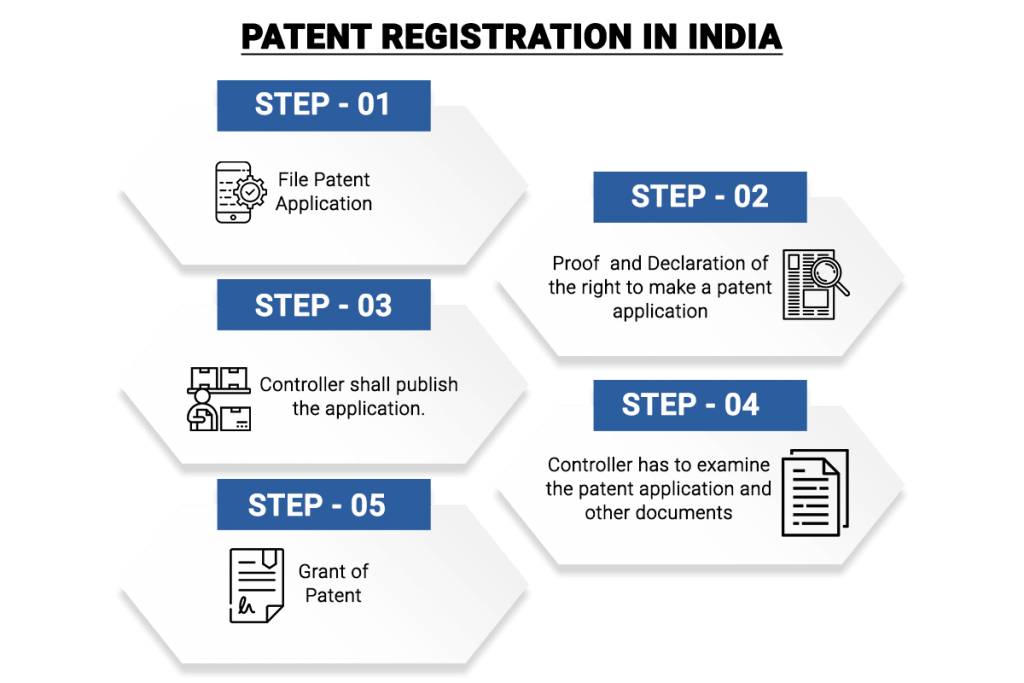
PATENT APPLICATION PROCEDURE:

Step 1 – PATENTABILITY OPINION:

Before you begin the patent registration process, you need to check if your invention is patentable. This means that you need to check if another individual has filed a patent for a similar technology for which you are filing. Performing an in-depth patentability search helps you to understand whether you have a chance of getting a patent for your invention or not.

Step 2 – DRAFTING & FILING THE PATENT APPLICATION:

After successfully completing the first step, you can begin the patent application process. Indian applicants need to fill Indian Patent Application Form 1 and along with that you need to provide a Form 2 mandatorily for specifying the type of patent where you can choose between a provisional and complete patent application, based on the stage of invention. This means that if your invention is still under testing then, you need to apply for a provisional patent application where you can get a period of 12 months to complete the invention and can file for a complete patent.

You need to pay special attention when you are drafting your patent application and should include clauses like usability and outcome of the invention in detail. It is also necessary to include the intention to get license on the invention while drafting the patent application and be meticulous in including all the clauses that prevent the competition from others who use same technology.

Step 3 – PUBLISHING THE PATENT APPLICATION :

After submitting all the documents, the patent application is safely secured by the Indian Patent Office and applied patent is then published in an official patent journal after a period of 18 months approximately. However, inventors who wish to have their patent application published before this 18 month period can submit Form 9 (form that requests for early publication) so that the application can be published in official patent journal within 1 month of making request.

Step 4 – EXAMINING THE PATENT APPLICATION:

Before granting the patent, the patent application needs to be examined thoroughly. As per rules of the patent application process in India, applied patent should examined based on the merits of the invention and described in the patent specification form. Unlike the publication process, this is not an automatic process and the applicant needs to make a request to examine their patent application by submitting Form 18 because the patent office queues the application form for examination only after a formal request for examination is made.

When the application lands on the examiner’s desk, it is scrutinized according to the Patent Act and underlying rules along with that the examiner also searches for similar technologies to ensure the invention satisfies patentability criteria or not. After reviewing the application, the first examination report is submitted. The examiner lists his objections in detail which can further extend the application process by another 6- 9 months.

Step 5 – DECISION TO GRANT PATENT:

Once the examiner finds no objections in the patent application, he grants the patent and then the patent is then published in the official patent gazette.

Step 6 – RENEWING THE PATENT:

The patent holder also needs to renew his patent by paying an annual renewal fee. In India, it is possible to renew your patent for a period of 20 years at maximum, from the date the patent was first filed.

OVERVIEW OF PATENT PROCEDURE

CONCLUSION:

Finally, the patent filing process is long and complex, one must remember its importance in the long run. The entire process can take anywhere in between 3-5 years. However, This process is created with the intention of ensuring that the inventor gets credit for his invention and also ensures that no other individual can claim rights over the invention. The legal rights that an inventor earn through patent can prevent competitors from using the invention for financial benefits. In any wrong case the related true inventor of invention can also sue on such individuals and claim compensation for using invention without their approval.

So, guys this is the procedure to file a patent in India and I have tried my level best to make you understand about the patent procedure