International Day Against Drug Abuse And Illicit Trafficking is observed on 26 June every year with the aim of creating awareness about issues related to drugs and strengthening action in order to make the world free of drug abuse.
The 2021 theme….
The theme ‘ Share facts on drugs, Save lives’ has been promoted for combating misinformation and sharing drugs related facts as well as solutions for treatment to fight against the problem all over the world.
It aims to accomplish a vision of health for all based on Science and highlights important statistics from the yearly World Drug Report.
Significance….
International Day Against Drug Abuse and Illicit Trafficking is utilized to instill a feeling of responsibility in individuals all around the world, particularly children and teens. All around the globe, events are held in schools, colleges, workplaces and public areas to raise awareness of the overall issue, as well as the risks of drugs and their usage.
The United Nations, through its anti-drug misuse arm, the United Nation Office on Drugs and Crime raises awareness, advises authorities to avoid feeling the Narcotics Industry, and combats drug trafficking under the cover of legal medicinal enterprises.
Environment refers to the physical elements. It includes the land, water and air. It is the living ecosystem that maintains the existence of human life. The term environment is derived from a French word ‘Environia” which means to surround. In other words environment can be defined as the sum total of all the living and non-living things and their effects that influence human life.
The main environmental issues faced in India are pollutions namely air pollution, water pollution, noise pollution, disposing chemical waste improperly, leakage of harmful gases, etc. are just few among the environmental problems.
Pollutions refer to imbalance caused in the environment through the actions of humans. This imbalance can lead to health-related issues which can affect the future generations. It is caused by man-made activities. It is necessary to protect the environment because the present generations are mere care-takers of the future generations. It is their responsibility to give the earth to the future in a proper and healthy manner. Let us try to understand the different types of pollution and their effects on the environment.
AirPollution: Air pollution is the release of pollutants such as gases, particles, biological molecules, etc. in to the air that is harmful to human health and the environment. In other words, it refers to the contamination of air by harmful gases, dust and smoke which affect biotic and abiotic things. It is necessary to maintain the correct amount of gases present in the atmosphere such as 78% of nitrogen, 21% of oxygen and the remaining is other gases. When there is an increase of other gases in the atmosphere it can result in global warming, ozone layer depletion, cancer diseases, breathing issues, skin problems, acid rains, asthma, etc. For example: Delhi is the existing example of air pollution. It causes a new weather in Delhi know as smog which is a mixture of smoke (emitted from vehicles, factories and other sources) and fog. It causes serious health issues for the people living there.
Gases released from factories causing air pollution
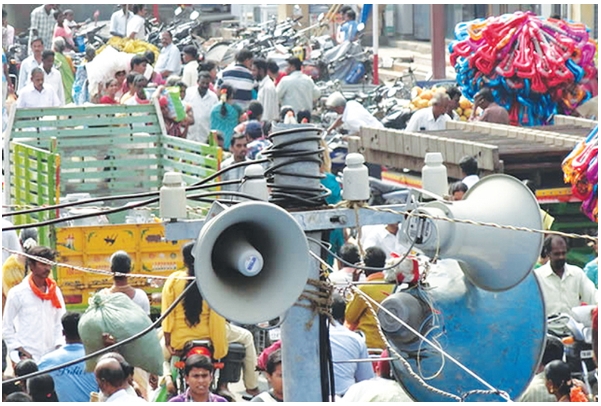
NoisePollution: Noise pollution or Sound Pollution refers to that unwanted sound that interferes with a person’s peaceful existence. India is a developing country. Movement of people and goods for such economic and urban development is necessary. As a result, there is immense noise produced by the trains, buses, vehicles, trucks, airplanes, huge rallies for various reasons, etc. In residential areas we can see loud music played by residents. High noises levels can lead to cardiovascular and permanent hear impairment. It can even cause change in the behavioural aspect of a person. It can cause stress, lack of sleep, and other harmful effects on the health of an individual. Moreover, this earth not only belongs to humans. Loud noises can frighten animals as well; it can cause sudden heart attacks to such animals.
Noise Pollution caused by the crowd
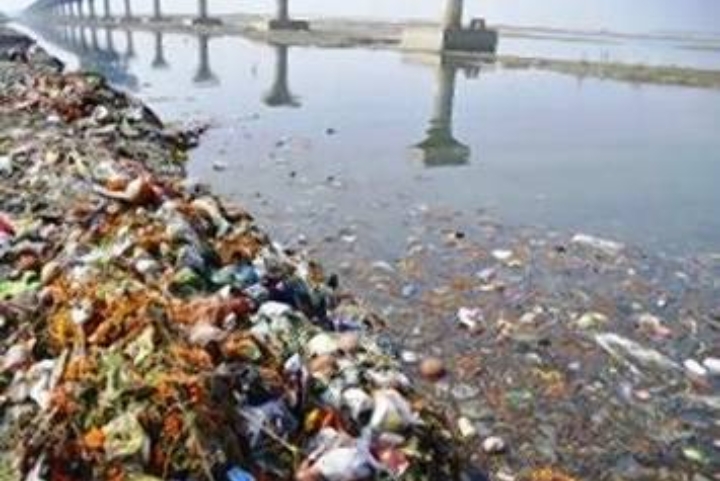
Water Pollution:. Water pollution is the contamination of water bodies with man-made affluents, chemicals, waste, etc. Such disposal is harmful for humans and the living organisms in such water-bodies. There are instances of where the court has stopped an industry from functioning due to improper disposable of waste in the locality. The effect of water pollution often leads to death, skin rashes, pinkeye, respiratory infections, tuberculosis, etc. Three-fourth of the Earth is covered with water. But less than 1% of the earth’s freshwater is accessible to us.
Water Pollution
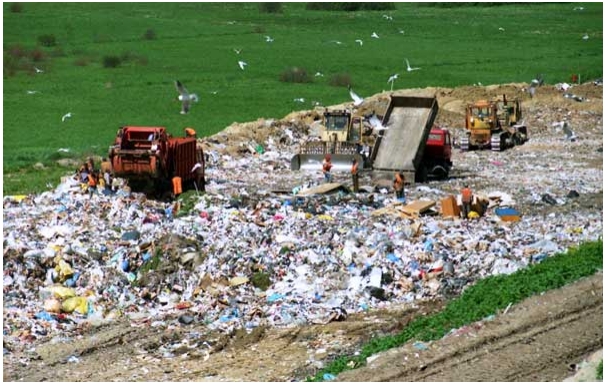
Land Pollution: This pollution is on-process and the effects such pollution will be evident at an unexpected situation. The land is abused and deteriorating constantly. This is caused by the solid wastes, untreated chemical affluents, etc. In other words, it is the degradation or destruction of the soil and groundwater.
Land Pollution
Destruction of the environment can lead to various calamities. In order to prevent such disaster or calamities, laws are implemented to protect the environment for the livelihood of present and future generations. Environmental Protection Act, 1986:- Section 2(a) states that environment includes water, air and land and the inter-relationship which exists among and between water, air and land, and human beings, other living creatures, plants and property.
After India got independence from British rule, formed its own constitution by 1950 but The leaders of the country gave more priority to the economic development and elimination of poverty in the country. As a consequence the constitution did not deal much about the environmental aspects. It was only in 1972, during a United Nations Conference on Human Environment held at Stockholm led to adoption of various measures to preserve the environment and prevent pollution. Accordingly, Indian Parliament inserted two Articles, i.e., 48A and 51A in the Constitution of India in 1976.
* Article 48 A states that the State shall endeavour to protect and improve the environment and to safeguard the forests and wild life of the country. *Article 51A: This article mentions the Fundamental Duties that should be followed by the citizens. It also mentions to protect and improve the natural environment including forest, lakes, rivers and wild life, and to have compassion for living creatures. *Apart from these two articles, Article 21 of the constitution includes the right to clean and healthy environment.
Over the past decade, social media has managed to secure a special position in our hearts. Like every other evolutions in the world, the way we use social media platforms also evolves. With the quick growth of social media, trends change every second day and thus brands and individuals are in a hurry to adopt them fast!
Major Trends…
1) Augmented Reality
Augmented reality (AR) is an interactive experience of a real-world environment where the objects that reside in the real world are enhanced by computer-generated perceptual information, sometimes across multiple sensory modalities, including visual and auditory.
How it is used in different ways in social media?
Now, during the pandemic times, it wasn’t easy for people to go out for shopping and try out the things they wanted to purchase. So Augmented Reality became an important feature in social media apps so that consumers can try out the business products from their respective homes.
Popular furniture company IKEA using AR.
MORE COMMON EXAMPLES OF AR IN SOCIAL MEDIA
Mark Zuckerberg, founder of Facebook, recently said Augmented Reality has slowly become the company’s “topmost priority” . We have already witnessed how social media apps like Snapchat and Instagram have become more AR oriented– all the face filters that we use on such social media apps are nothing but small facets of Augmented Reality.
Credit: The Verge
2)VIRTUAL REALITY
Virtual reality (VR) refers to a computer- generated simulation in which a person can interact within an artificial three-dimensional environment using electronic devices, such as special goggles with a screen or gloves fitted with sensors. Users have a realistic feeling experience when it comes to Virtual Reality.
VIRTUAL REALITY IN SOCIAL MEDIA
A) VR CHAT VRChat is a free-to- play massively multiplayer online virtual reality social media platform. It allows players to interact with others as 3D character models. Users can interact via text chats and then play the games according to their needs.
Credits: Business Insider
B) FACEBBOOK SPACE It allows an integration with Facebook, which makes it easy to invite our friends and acquaintances to the VR world. Three people can actually interact using a VR device. This has however now been discontinued.
3)Shopping through Social Media
Many new brands and business firms deal with their consumers entirely though social media platforms like Facebook and Instagram.
Both these social media platforms provide services like a complete e- commerce portal and also allows business firms to show their products on the platforms while attaching a link to the firm’s official website. Customers can view products, see prices and can directly order products from these social media platforms.
Credits: Cosmetics Business
4) News Culture on Social Media
This is one of the most popular trends we tend to see these days on social media. People spent most of their times in social media and therefore many mainstream media channels maintain good interaction with their audiences on social media platforms like Instagram, Facebook and Twitter via video stories, pictorial presentations and like.
Many new media houses are completely based on social media. People mostly get to know about recent happenings through social media. Twitter as compared to any other social media platform has distinctively been credited for instantaneous news.
Facebook page of ABP News
5) Hash-tag Culture
This is another form of social media trend that can be seen these days where interested groups make a hash-tag phrase (for example: #xyz) regarding their concerned matters. This has widely been witnessed on Twitter and Instagram where users make their interested topics “trendy” on social media. This is especially done on Twitter to bring anything to public notice.
You want to endorse and promote your brand and products on a large scale. What is the best method you will use nowadays?
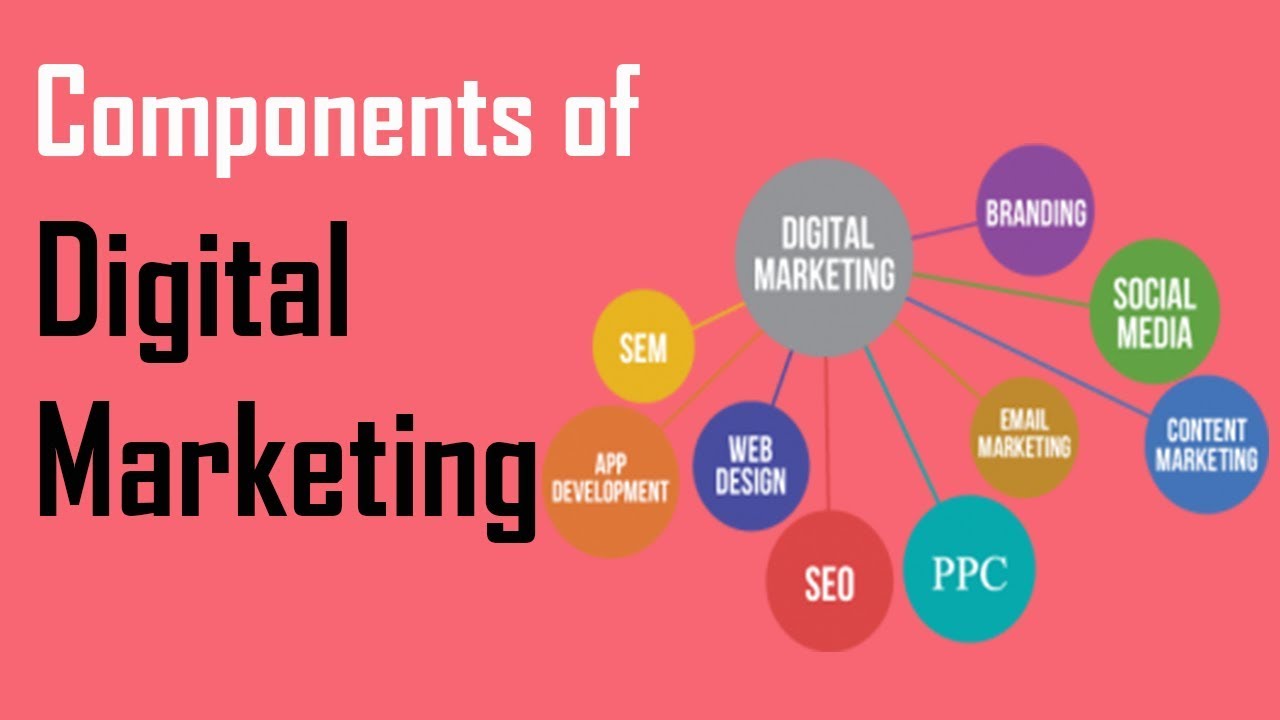
Digital marketing is the component of marketing that utilizes the internet and online-based digital technologies such as desktop computers, mobile phones, and other digital media and platforms to promote products and services. Its development during the 1990s and 2000s changed the way brands and businesses use technology for marketing. As digital platforms became increasingly incorporated into marketing plans and everyday life, and as people increasingly use digital devices instead of visiting physical shops, digital marketing campaigns have become prevalent, employing combinations of search engine optimization (SEO), search engine marketing (SEM), content marketing, influencer marketing, content automation, campaign marketing, data-driven marketing, e-commerce marketing, social media marketing, social media optimization, e-mail direct marketing, display advertising, e-books, and optical disks and games have become commonplace. Digital marketing extends to non-Internet channels that provide digital media, such as television, mobile phones (SMS and MMS), callback, and on-hold mobile ring tones. The extension to non-Internet channels differentiates digital marketing from online marketing.
At a high level, digital marketing refers to advertising delivered through digital channels such as search engines, websites, social media, email, and mobile apps. Using these online media channels, digital marketing is the method by which companies endorse goods, services, and brands. Consumers heavily rely on digital means to research products. For example, Think with Google marketing insights found that 48% of consumers start their inquiries on search engines, while 33% look to brand websites and 26% search within mobile applications.
PROBLEMS THAT DIGITAL MARKETING MIGHT SOLVE
Problem: I don’t know my audience well enough to get started. Getting to know your audience takes time, and while your marketing team may have developed audience personas that can be of use, consumers actively spending time online may not behave in the way you’d expect. You’ll need to test different language with different targets, keeping in mind that certain descriptors will appeal to different people and their place in the buying cycle. Attune yourself to your audience and you’ll build credibility that will set you apart from the competition.
Problem: I haven’t optimized my channels for SEO. Regardless of your position in the marketing process, it’s important to have an understanding of SEO best practices. In addition to improving search engine ranking, SEO can reinforce and support your campaign testing and optimization to ensure you’re delivering high quality, valuable content that your potential customers want.
Problem: I don’t have a social media strategy. Regardless of whether you want to develop an organic social media strategy, a paid social media strategy, or a blend of the two, it’s important to have some form of social marketing in place. While social media is excellent for branding and engagement, it can also be a useful channel for digital marketing advertisement. Find a niche and a consistent voice, be patient, and as your following increases, the impact of your ads will increase as well.
Problem: My marketing teams are siloed. It’s important to break out of silos to create nimble, fluid structures. Your customers aren’t sequestered in one channel waiting for ads, so your marketing efforts must deploy cross-channel functionality with teams that bring multiple skill sets to the table to engage customers where they are. Each social network and channel includes different audiences and expectations, so marketing efforts may look completely different for each. This includes tone, imagery, offers, and even the time of day you post.
Problem: I’m under pressure from my CMO to report on metrics that support the bottom line. Digital marketing supports a vast universe of metrics that can be utilized to determine the effectiveness of your marketing efforts, but these metrics should be chosen with care. Each case will depend upon your audience makeup and focus on each channel. Keeping this in mind, start by determining your goals for each channel and set metrics your CMO will want to see the most.
COMPONENTS OF DIGITAL MARKETING
Paid search. Paid search, or pay-per-click (PPC) advertising, typically refers to the sponsored result on the top or side of a search engine results page (SERP). These ads charge you for every click and they can be tailored to appear when certain search terms are entered, so your ads are being targeted to audiences seeking something in particular. These ads can be extremely effective, as they rely on data gleaned from individuals’ online behavior and are used to boost website traffic by delivering relevant ads to the right people at the right time. These ads also involve retargeting, meaning that depending on the customers’ actions, marketing automation tools can craft unique, personal cross-platform ads.
Search engine optimization (SEO). SEO is the process of optimizing the content, technical setup, and reach of your website, so that your pages appear at the top of a search engine result for a specific set of keyword terms. Using SEO can drive visitors to your site when they display behavior implying that they’re searching for relevant products, which can be a game changer considering that 90% of people searching haven’t formed an opinion about a brand yet (Status Labs, 2018). While PPC and retargeting have their place, organic online traffic earned through search engine optimization has enormous influence on search rankings and, by extension, organic site traffic. By using keywords and phrases, you can use SEO to massively increase visibility and begin a lasting customer relationship. SEO is defined as increasing a website’s rank in online search results, and thus its organic site traffic, by using popular keywords and phrases. Strong SEO strategies are hugely influential in digital marketing campaigns since visibility is the first step to a lasting customer relationship.
Content marketing. Effective content marketing is not outwardly promotional in nature, but rather serves to educate and inspire consumers who are seeking information. When you offer content that is relevant to your audience, it can secure you as a thought leader and a trustworthy source of information, making it less likely that your other marketing efforts will be lost in the static. In the age of the self-directed buyer, content marketing gets three times more leads than paid search advertising, so it’s well worth the additional effort.
Social media marketing. The key to effective social media marketing goes far beyond simply having active social media accounts. You must also be weaving social elements into every aspect of your marketing efforts to create as many peer-to-peer sharing opportunities as possible. The more your audience is inspired to engage with your content, the more likely they are to share it, potentially inspiring their peers to become customers as well.
Email marketing. After more than two decades, email is still the quickest and most direct way to reach customers with critical information. Today, successful email campaigns must be incredibly engaging, relevant, informative, and entertaining to not get buried in your customer’s inbox. To succeed, your marketing emails should satisfy five core attributes. They must be trustworthy, relevant, conversational, coordinated across channels, and strategic.
Mobile marketing. Mobile devices are kept in our pockets, sit next to our beds, and are checked constantly throughout the day. This makes marketing on mobile incredibly important—two-thirds of consumers can recall a specific brand they have seen advertised on mobile in the last week—but mobile is also very nuanced considering its intimate nature. SMS, MMS, and in-app marketing are all options to reach your customers on their devices, but beyond that, you must consider the coordination of your marketing efforts across your other digital marketing channels.
Marketing automation. Marketing automation is an integral platform that ties all of your digital marketing together. In fact, companies that automate lead management see a 10% or more bump in revenue in six to nine months’ time. Without it, your campaigns will look like an unfinished puzzle with a crucial missing piece. Marketing automation software streamlines and automates marketing tasks and workflow, measures results, and calculates the return on investment (ROI) of your digital campaigns, helping you to grow revenue faster. Marketing automation can help you gain valuable insight into which programs are working and which aren’t, and it will provide metrics to allow you to speak to digital marketing’s efforts on your company’s bottom line.
• World economy shrunk by 3.5% in 2020 – global pandemic. Forced countries to rely on taxations.
• Loopholes are exploited by the multinational national companies (MNCs) to avoid taxation. Tax avoidance – Use of legal methods to minimize the amount of income tax owed by an individual or business. • Global minimum corporate tax – to plug the loopholes in international taxation regime.
G7 Agreement
• Finance Ministers of G7 nations agreed to set a global minimum tax of at least 15% • G7 – Broader efforts under way through the G20/OECD to address tax challenges arising from globalisation and digitalisation of economy. G7 – Canada, France, Germany, Italy, Japan, the United Kingdom and the United States. G20 – forum for the governments and central bank governors from 19 countries and the European Union (EU). OECD – group of countries – discuss and develop economic and social policy.
Need for Global Tax
• Last decade – rapid and relentless march of technological advancement – global communications and connectivity.
• 2016 – digital sphere estimated at $11.5 trillion (over one-sixth of global GDP).
Increase in digitalisation exacerbated the challenge of taxing multinational corporations.
• MNCs avoid taxation by shifting their revenue to tax havens – huge loss of revenue tocountries
• Organisation for Economic Co-operation and Development (OECD) – estimated countries are collectively deprived of $240 billion in tax revenue annually. OECD + G20 – spearheading ‘Inclusive Framework on Base Erosion and Profit Shifting’ – aimed at ending tax avoidance.
• Secretary-General of OECD – Mathias Cormann, welcomed the global tax. Tax avoidance can only be effectively addressed through a multilaterally agreed solution. • Base Erosion and Profit Shifting (BEPS) A tax evading practice by multinational companies – shifting their incomes or profits to their subsidiaries, located in low tax countries. Erosion in tax base & shifting of profits to other countries. Problems: Undermines the fairness and integrity of tax systems. Undermines voluntary compliance by all taxpayers. Affects the developed and developing countries, which mainly relies on corporate income tax.
• Inclusive Framework on BEPS initiated by OECD and G20 grouping A modern international tax framework – ensures profits are taxed where economic activity and value creation occur. 135+ countries implementing 15 Actions. India – a member.
Benefits
• G7 agreed on an equitable allocation of taxing rights. Awards market countries taxing rights on at least 20% of profit exceeding a 10% margin for the largest and most profitable multinational enterprises.
• Highly beneficial to India. India losing more than $10 billion in revenue each year – Tax Justice Network.
Issues
• Local levies on digital transactions Counterproductive to the concept of GMCT.
• Lack of political will to ensure greater fairness and equity in revenue sharing.
It all started when I was in preschool. I never really engaged with the other kids . I always preferred to play by myself, have lunch by myself and do my own things. It took my parents some time to figure out that I was an introvert and so they admitted me into a different school which my cousins attended so that I could meet new people but nothing really changed . I used to cry every time the school bell rang and my cousin had to take me with her to her classroom and she used to sit with me until I stopped crying. Life has not been easy since then. The life of an introvert is not an easy life to live. Introverts are tend to be very misunderstood. Webster dictionary defines introvert as ‘shy and reserved’ which may be true but it’s much broader. Not all introverts are shy and introverts are definitely not failed extrovert, we just need some time to get comfortable with the other person and once it’s done it’s a whole another story.
Interestingly, introverts experience less loneliness than extroverts. Extroverts need people around them all the time but we don’t. We are not socially awkward people who are always looking for reasons to avoid all kinds of social events. For us all those situations or interactions from which nothing can be gained are useless (and then again this is who we are).
Other than the advantage of being at peace there are certain disadvantages of being an introvert . We don’t have many friends and that is why we are the ones who are affected the most when people leave us high and dry but then again we have our own way of dealing with it . I personally believe that if you were happy before someone came into your life, you can be happy after they are gone (which is something everyone should believe in).
We may not have many friends and we may not go out very often but for us the depth of our relationship with our friends is more important than the number . I have 4 or 5 friends but the bond I share with each of them is unique and special and that is what I want. It’s not like I have not tried to find my way out of this lifestyle but this is just who I am and I’ve embraced it .
Social experiment : Place an introvert and an extrovert in a solitary confinement and it is obvious as to who will be the first one to get anxious.
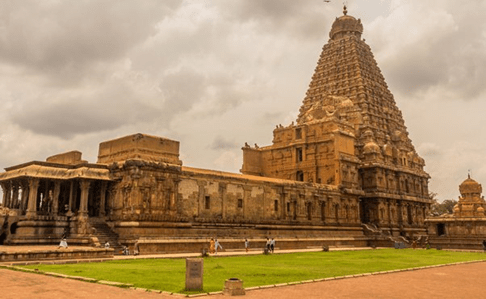
This temple is a perfect illustration of the great heights achieved in the field of architecture by the Chola rulers. It is a homage paid to Lord Shiva and is a display of power of Raja Raja Chola I. The temple is formed of 130,000 tons of GRANITE.
Granite is the best-known igneous rock. The rock is rich in quartz and feldspar; it is the most common plutonic rock of the Earth’s crust, forming by the cooling of magma at depth. The looks obtained from using this stone are versatile. Granite can withstand heat up to 1200 degrees Fahrenheit. Granite is a highly durable siliceous stone. Many of the lighter granite do need to be sealed because the crystals are larger.
Brihadeeswarar Temple is also widely known by name of ‘Big Temple’. This temple completed its 1000 years in the year 2010. The temple is fortified. A long associated myth with this temple temple is that the shadow of the main structure does not fall on the ground. However, this has been proven wrong by scientists. Brihadeeswarar temple, also known as the Tanjore big temple expounds the number of alphabets in Tamil by the distance and height it is designed. The statue of Nandi at the entrance of the temple is carved out of a single stone.
The lingam is often represented as resting on disc shaped platform called a linga on a peetham. An elliptical figure placed atop a circular base called ‘peedam’ also called as “Peetham”.
MODE OF TRANSPORTATION-
1) BY AIR
The nearest airport to Brihadeeshwar Temple is the Tiruchirapalli Airport (65 kms).
2) BY ROAD
Thanjavur can be easily accessed from the nearby cities through bus. There are frequent government and private buses running to Thanjavur throughout the day.
Type 2 diabetes is kind of a metabolic disorder which causes the sugar to accumulate in blood rather than getting used as a body fuel
Yes, you read me right. It is absolutely possible to cure all the health problem associated with your body with the aid of correct lifestyle modifications.
Before understanding what needs to be done we shall preface our readers about what exactly is Type 2 diabetes.
Type 2 diabetes is kind of a metabolic disorder which causes the sugar to accumulate in blood rather than getting used as a body fuel. When we consume any sort of carbohydrate rich foods it enters the digestive tract and gets broken down to glucose. A hormone named as Insulin is released from pancreas and facilitates the entry of glucose into the cell. In case of Type 2 diabetes, cells become resistant to insulin and ignore it’s message to absorb glucose which is also called as Insulin-resistant. Additionally pancreas fails to secrete enough insulin required to trigger these insulin sensitive cells. The major cause of this disease is unhealthy eating habits, no physical movements, hypertension etc. In these circumstances, it is highly beneficial for a person to take charge of their health.
Following are the 5 best proven lifestyle modifications which are found to be effective –
Eating healthy foods – There are few things which needs to be taken care of – firstly, cutting down your carb is important. What we generally consume is simple carbohydrate . Instead we can replace simple carbohydrate foods with complex carbohydrate which includes barley, non starchy vegetables and legumes. Adding them to your diet can also give a boost to your fiber intake.
Reduction in sugar intake– Sugary items, aerated drinks, packaged sugar bars, cakes, wheat bread should be strictly avoided for a better health. Instead, opting for jiggery powder, stevia can serve as a good replacement of sugar. Opting for foods which has low glycemic index and low carbs are important for the long run.
Loosing weight and increase protein intake – The primary goal for a person should be to maintain a proper BMI, anything above your normal BMI is harmful. For that cutting down processed foods, excessive oil and taking protein is the key. Not necessary one needs a whey protein isolate or any nutritional supplements which is used by youngsters or gym- goers these days. Look for natural protein like eggs, fish, soya beans, pulses instead which can help to enhance your lifestyle immensely and promotes a lean body mass.
Diets which are important for diabetes patients-
Green leafy vegetables- Having this in your diet is essential as it is not only a good source of fiber but also have low carbs in it. They are assosciated with loads of essential phytonutrients, mineralsand vitamins. Adding salad to your diet at the beginning of the meal provides a balanced diet to your body.
Nuts- Nuts like almonds, pistachios and walnuts can reduce the blood sugar level as well as risk of diabetes effectively.
Apple cider vinegar – It is made from fermented apple juice and can effectively reduce the blood glucose levels after meals. Additionally it contains certain minerals as well as vitamins and acetic acid which becomes beneficial for them who are suffering from Type 2 diabetes.
Berries- Berries are powerful anti-oxidants along with vitamin C and fiber. They are also essential in regulating the blood glucose levels and are proven effective in diabetes patients.
4. Doing some physical activity– Not necessary you need to join a gym but you can try home workout or yoga. Yoga is very helpful which can strike a balance between your mind and physical strength. Doing physical activities helps to improve metabolism. While you become more active, the muscles in your body takes up all the excess blood sugar as a result it helps in weight loss.
5. Managing stress– When you start taking too much stress you blood sugar level increases which causes your health to detoriate. Each and every things mentioned above are connected to stress. If you’re stressed then you may forget to eat properly or exercise which can do no good to your body. Hence, meditation plays an important role here. Once you start meditating you’ll be able to strike a balance between your stress and personal life. It is the need of the hour to start focusing more on your health rather than paying your bills later to your physicians.
Perspective is a cathartic thing. We all have it, knowingly or unknowingly. It is like a background process that keeps running no matter what. Now what is it exactly? In my view, it’s sometimes nothing more than a preconceived notion.
It seems to be the thin line between sanity and insanity. What’s correct in my perspective might not be correct in yours.
I am a person who believes that anything that doesn’t touch you from the inside, that doesn’t make you think can’t hurt you physically and mentally. The greatest thoughts are the ones which we have when we are silent because that’s the time when we introspect. We keep analyzing everything. That’s my perspective.
Perspective, perspective, perspective…everything you do is either right or wrong in someone’s perspective, including you. All these are notions that are influenced by our cultural background, the people around us and our inner thoughts. All these notions make us jump to conclusions that are often false.
Considering your perspective as the only right one is where we mess up. If I have a notion that dark skinned people aren’t beautiful, then how am I ever going to admire the smile of a dark skinned child? How can I admire the minute details of beauty that nature has bestowed upon us? How will I be able to walk barefoot on rain-soaked grass and enjoy it?
The best thing that we can do is to understand there is beauty in everything and everyone. That will put so many things into place and make this a world for everyone to truly live in and not jst survive. Analyze things, think about them, try to look at the bright side. Understand why you love or hate something. Do not let these notions take control of your thoughts.
Empty your mind before you start something because it helps to not have a pre-conceived notion about something. Allow yourself to see more than just what your eyes want to show you.
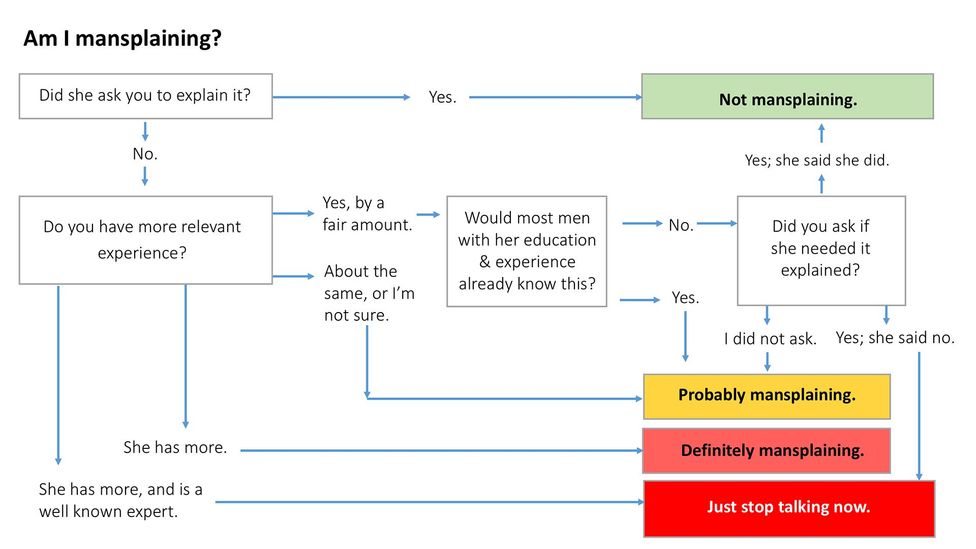
Mansplaining is a portmanteau of the word ‘Man + Explain’. Mansplaining refers to the explanation of something by a man, typically to a woman, in a manner regarded as condescending or patronizing. It stems from an authoritative and privileged belief that men know better, and that women are always ready to be helped and taught. The phenomenon has happened since long but the origin of the word was inspired from an essay by Rebecca Solnit titled MenExplain Thingsto Me. (Published in 2008)
In her essay, Solnit describes an incident which took place while at a party. During a conversation, an older gentleman cuts her off in between and starts explaining on a topic, claiming to know more about it than her. He insists that she read a particular book which supports his evidence. What he did not know was that she was in fact the author of the very book that he was talking about. Ironically, he hadn’t even read the book and had simply read an excerpt from it.
“He was already telling me about the very important book — with that smug look I know so well in a man holding forth, eyes fixed on the fuzzy far horizon of his own authority”
Rebecca Solnit
Although it might seem trivial from the surface, on a deeper level, mansplaining is linked to a larger abuse of patriarchal power. Since knowledge is power, men having held that powerful position for so long assume that they know better and that women are incapable of handling that knowledge of power. It is an offshoot of the societal idea of gender hierarchy where women are expected to be the pleasant audience. Having an opinion for themselves is considered to be an act of ‘questioning the authority’.
A Harvard study conducted in 2004 shows that men are 50% more likely to offer an answer in class and nearly 150% more likely to speak three times or more. This gets carried on and continues from schools to colleges, to workplaces, to politics and basically to any place where expression of ideas is concerned. “….it crushes young women into silence by indicating…that this is not their world. It trains us in self-doubt and self-limitation just as it exercises men’s unsupported overconfidence.”
“Most women fight wars on two fronts, one for whatever the putative topic is and one simply for the right to speak, to have ideas, to be acknowledged to be in possession of facts and truths, to have value, to be a human being.”
Rebecca Solnit
This happens so much so that women are denied of expressing their own lived experiences. More extreme versions of mansplaining can be found in the Middle Eastern countries where women’s testimony has no legal validity. So, if a woman is raped, she cannot testify in court unless there is a male witness to testify for her. As Solnit says, “Credibility is a basic survival tool…Violence is one way to silence people, to deny their voice and their credibility, to assert your right to control over their right to exist.” Thus, on a larger context, it becomes a crime as grave as harassment or an assault.
Image Credit: Kim Goodwin
As with every point raised, some would oppose this by pointing out things like “not all men do it” or “Women do this too”, and it’s true. Anyone, regardless of their gender, talking in a patronizing or condescending manner to someone else is wrong. “… a certain amount of self-doubt is a good tool for correcting, understanding, listening, and progressing — though too much is paralyzing and total self-confidence produces arrogant idiots… There’s a happy medium between these poles to which the genders have been pushed, a warm equatorial belt of give and take where we should all meet.”
This need not even be restricted to Gender. It ties into other identities like race, sexuality, class, disability and age; as terms like whitesplaining also exist. Any enlightening discussion involving mutual participation and exchange of information is good as long as it is done with respect for each other in a non-condescending and non-patronizing manner.
Hello people!! Hope everyone wears mask and maintaining social distancing. We are nearing the end of this pandemic. Be positive. In this blog, we are going to continue our overlook on ISRO.
GSLV:
GSLV is basically like the updated version of the ASLV and has a payload capacity of 5000 kgs. The GSLV has far had 13 launches out of which 8 were successful and 2 were partial failures and 3 were complete failures. The GSLV is used till today to send larger payloads into Geostationary transfer orbit. And that brings us into ISRO’s final rocket which is the GSLV Mark 3. This rocket was designed in the early 2000s and is ISRO’s most powerful rocket which is capable of sending 10,000 kgs into low earth orbit. Similar to the PSLV, the GSLV Mark 3 is quite cost efficient in terms of cost per kilogram. The GSLV Mark 3 costs $51 million per launch meaning that it costs $5100 per kilogram. So far, the GSLV Mark 3 has only had 4 launches and all of them have been a success. It looks like ISRO has significantly improved their reliability compared to their early days.
Anyway, moving onto notable ISRO projects completed with these rockets, we have many satellite programs. The IRS series instance consists of a group of sattilites in Sun synchronous orbit. These satellites allow India to map and monitor natural resources such as fresh water. Another group of satellites managed by ISRO is the INSAT series. This group of sattilites is located in Geostationary transfer orbit and it provides telecommunications and broadcasting capabilities. In fact, INSAT is the largest domestic communication system in the Asia- Pacific region. ISRO also has satellites within their GAGAN satellite navigation system and within IRNSS. These groups provide navigation, communications, surveillance and many more survives to ISRO and India.
Chandrayaan:
ISRO’s satellites are cool and where it gets really more interesting is their Lunar and Martian missions. After early 2000s, ISRO focused on sending humans to the Moon. The first step in this journey was sending a probe to the moon. In 2008, ISRO used a modified version of the PSLV to launch Chandrayaan 1 to the moon and this probe became the first probe to prove the existence of water on the Moon. According to Chandrayaan 1, the Lunar poles hold over 600 billion kilograms of ice. ISRO didn’t attempt another Lunar mission for quite some time, but the next attempt was a massive step up compared to Chandrayaan 1. Chandrayaan 2 was launched in 2019 using the GSLV Mark 3 and it consisted of a lunar orbiter, lander and a rover which were all developed by India. The goal of the mission was to prove ISRO’s ability to complete soft landing on the Moon’s surface. Unfortunately a software glitch would result in the lander deviating from the planned path and crashing into surface of the moon. ISRO is expecting to try another soft landing with Chandrayaan 3 which is expected to take place in 2022.
So there’s people who live in huts, walk barefoot, dress in rags, and beg for money, that doesn’t make the entire country poor. Have you been to Harlem lately? The country has positioned itself as one of the world’s leading emerging economic powers, churning out an impressive number of billionaires. Stop believing the skewed images of the media and take a look for yourself. Are you seriously going to generalize about 1.3 billion people based on a few photos you’ve seen in books or on TV. Poverty is one part of India; it doesn’t define the entire country. Visiting DLF Emporio, Delhi’s answer to LA’s Rodeo Drive might give you a whole new perspective.
2) Traveling in India is dangerous:
But so is Compton, but that doesn’t make the entire U.S. dangerous. Yes, parts of India should be toured with caution, such as the volatile Kashmir region, but for the most part, India is just as dangerous as you make it. If you exercise common sense, you’ll be able to overcome the perils of the country.
3) If you’ve seen the Taj Mahal, you’ve seen India:
You couldn’t be more wrong. Yes, the Taj Mahal is beautiful, and it’s the face of India to many. But as the world’s 7th largest country with a history that spans thousands of years, there can’t possibly be only one site worth visiting. Check out the country’s dynamic urban culture, beaches, mountains, deserts, and the endless forts and palaces, and then say you’ve seen India. Even then, that’s pushing it.
4) All Indians run around trees, singing and dancing:
Good job, Bollywood.
5) Everyone in India engages in spirituality, meditation, and yoga:
Contrary to popular belief, not everyone in India is a yoga guru.
6) Indians don’t speak English:
Sure, their accent is different, and maybe not the most pleasant-sounding, but it’s still English. English is actually one of the country’s official languages. It’s the language of the law. It’s also the primary language used in universities.
7) Indian is a language:
There are hundreds of languages spoken in India, none of which include Indian. Indian is not a language, it’s a demonym that describes people from the country of India.
8) Everyone in India has an arranged marriage:
That would be a false statement. Arranged marriages are still common with many rural and traditional minds, but progressive thought has certainly permeated its way through urban India. Dating may not be as common as the Western world, but it definitely is a lot more common than you may think.
9) India is the land of snake-charmers:
This is probably one of the most photographed scenarios in India, maybe second to the Taj Mahal. In fact, when you see them, mostly in the state of Rajasthan, it’s more of a tourist scene, inspired by this very myth.
10) All Indians are vegetarians:
If that were true, why is chicken tikka masala one of the most famous dishes? It’s probably much easier to find a vegetarian joint in India than the Western world, but yummy dishes with chicken, fish, lamb, and the likes have found fans in many Indians.
11) Hinduism is the only religion in India:
There is a majority culture of Hindus, most definitely. But there are also many Muslims, Christians, Catholics, Jews, etc. represented. Not everyone you meet will be a Hindu. In fact, even Atheism is on the rise.
12) The extent of Indian food is curry:
There are many different types of curry-based dishes, but the Indian cuisine is so much more than that. The cuisine is extremely diverse, and in fact, the dishes commonly eaten in the North are not the ones eaten in the South. Try the masala dosa in the South. And not all Indian food is spicy.
13) India is located in the Middle East:
Quick geography lesson: India is in Asia, south Asia to be precise. Again, you have been informed.
14) The climate of India is extremely hot and humid:
Yes, in parts of the country. But there are many areas, such as the states of Himachal Pradesh and Uttaranchal where the weather is pleasantly temperate, and sometimes freezing, depending on how close you get to the Himalayas.
Conclusion: India is a beautiful country, with its varying set of strengths and weaknesses, just like any other country. Don’t believe what you see in the media, and make judgements only after you’ve visited the country yourself.
Privatisation refers to the process by which the government transfers the productive activity from the public sector to the private sector. It is basically the transfer of ownership from the central government to the private sector. A vast majority of economies have been supporting privatisation and have launched massive privatisation programmes during the last two-three decades ago. The supporters believe that privatisation and disinvestment has many advantages. The first and foremost being improvement in efficiency and performance. Since private sector is profit oriented, the decision making is inclined more towards efficiency. Moreover, privatisation establishes a market for managers which improves the quality of management. Here fixing responsibility is much easier. Public enterprises cannot be held responsible for any lapse i their responsibilities but this is not the case with private sector. That is way the performance of private sector is better. Decision making is faster in private sector in comparison to public sector. Delayed decision making is often equivalent to making no decision at all. The problem of red tapism which is present in public sector is absent in the private sector. In the contemporary businesses environment, it has become important to take spot decisions without wasting time. Remedial measures are also taken early in private sector. Because private sector faces threats of takeover, liquidation, loss of assets etc., the likelihood of taking remedial measures in advance is very common which is not quite often observed in the public sector. The succession is well planned out in private sector. The public sector enterprises however, remain headless for long periods of time. This causes confusion and delayed decision making. Such a situation does not exist in private sector. Privatisation leads to better customer service. This is due to the fact that the survival of a private sector enterprise depends on customer satisfaction, since it is the satisfaction that insures repeated buying and profit generation. For creating sustained markets for themselves, the quality of services offered by private sectors for their customers are quite good. The critiques have however, criticised privatisation and disinvestment on the following grounds. There has been undervaluation of assets. The performance on disinvestment front has been dismal. The main reason for this is the fact that disinvestment was carried out in a hasty, unplanned and hesitant way. It was launched without a required condition of its take off. Adequate efforts were not made for the much needed linkage between public enterprise and capital market. Considerable under pricing of public enterprises shares results in considerable loss to the government. Critiques argue that privatisation leads to unemployment. Supporters call it marginal retrenchment of labour but still, the future employment scenario for labour is a cause of worry. Having low productivity jobs in public sector is a better alternative to unemployment as the later does not increase a nation’s income definitely does not increase welfare of workers. Privatisation of PSUs is more risky. Since private sector is more interested in profit generation, critiques argue they won’t worry much about local labours and the costs would be borne by customers.
Journaling is maintaining a diary or a journal where we express our thoughts, feelings, and emotions. Journaling is like communicating with our thoughts. We often come across people that journal every day. Let us look at why they like maintaining these fancy books.
Clears the mind: A lot of the time our brain is preoccupied with thoughts and it can often come in the middle of our work. So writing down our thoughts and feelings on a piece of paper will help us acknowledge them and come up with a solution as well. When I would feel low I would write my thoughts and, it almost felt like I was venting problems to a friend. In the end, when I was done writing about any issue, I would honestly feel good. Journaling doesn’t make the problem go away but our mind feels more clear.
Something to look back at: Growing up I had written a few journals. I wouldn’t journal daily, but I would write if there was a special occasion or a family trip. Now when I read about those moments it feels like I am reliving them. It has so much detailed explanation of things that I wouldn’t have remembered otherwise. Reading old journals is always a great trip down memory lane. I always thank my younger self for writing those things down.
Makes us stronger: We often write down our hard times. So, when we look back and read those problems it makes us realise how caught up we were in them and we thought they was the worst thing happening to us. But, then we get over it, it makes us realise that problems come and go and we are strong enough to overcome anything.
If you are someone who wants to start journaling, you can start by getting yourself a diary, notebook of your choice. You can bring pens of different colours and some things to decorate it with. It’s up to you how you design your journal.
Here are a few things you can write about in your journal:
Daily goals: Goals keep us motivated, they ensure that we complete all our daily tasks. You can write your daily tasks in the morning then by the end of the day you can check if you completed them or not.
Ideas: You can write any creative ideas for your work. When I come up with a great idea for my article I like to note it down. So on days where I have nothing to write, I check my journal for reference.
Be creative: You can also have a bucket list section in your journal where you tick the things you have done. You can try new things in life and write about them. The new things don’t have to be as complicated as sky diving, even trying a new flavour of ice cream is included.
Problems: It is a great place to write about your problems. Below that you can also write the solution to it, where you write a few ideas on how you are planning to overcome the situation.
Grateful: Writing things we are grateful for every day is a positive start to the day. The things you are grateful for can be as easy as a roof above my head, or my family.
Once you start journaling you will notice a lot of positive changes in your life. You will also know more about yourself. It will also make you more productive because you will be giving yourself and your goals more time. Journaling is a safe space you need in your life.
(Sample information about bank for project assignment .)
Introduction :-
Chamber’s Twentieth Century Dictionary defines a bank as an ” institution of keeping , lending and exchanging etc. of money .”
Banks play an important role in financial stability and the economy of a country. It is a financial institution that accepts deposits from the public and creates a demand deposit while simultaneously making loans.
The word has it’s origin from Old High Germanic origin banc, banke meaning “bench, counter”. Though some people trace its origin from the French word “Banque “.and the Italian word ‘Banca.
History of banking :-
The First stage of banking system :-
It was a merchant banker who first established the system of banking by trading commodities rather than money . Their trading activities required the remittances of money from one place to another ,for this they issued “ hundis“( letter of transfer ) to remit the funds . In India such merchant bankers were known as “Seths “ Although , before 1640 the practice of self saving and self keeping were found in the temple of Babylon .
The Second stage :-
The next to merchant bankers in the establishment of the banking system were goldsmiths . The goldsmith started charging something for taking care of money and bullion . He started issuing receipts as evidence for receiving valuables . He started lending gold and silver as there were no marks of the owner . Goldsmith receipts became like cheques as a medium of exchange and a means of payment.
The Third stage :-
Next to the goldsmith were moneylenders to strengthen the growth of the banking system.The moneylenders became the bankers who started performing the two functions of modern banking ,that is accepting deposits and advancing loans .
The first bank called the ‘Bank of Venice ‘ was established in Venice , Italy I’m 1157 to finance the monarch in his wars . But modern banking began with the English goldsmith’s after 1640 . The first bank in India was the ‘Bank of Hindustan ‘ started in 1770 by Alexander& Company; an English agency house in Calcutta . But the first bank in the modern sense was established in the Bengal Presidency as the Bank of Bengal in 1806.
Definition :-
Many Economists have defined banks highlighting its various functions .
According to Crowther , ” The banker’s business is to take the debts of other people to offer his own in exchange ,and thereby create money “.
Kent defines a bank as ” an organ whose principal operations are concerned with the accommodation of the temporarily idle money of the general public for the purpose of advancing to others for expenditures “
Sayers define bank as ,” Ordinary banking business consists of changing cash for bank deposits and bank deposits for cash ; transferring bank deposits from one person or cooperation ( one ‘depositor ‘) to another ; giving bank deposits in exchange for bills of exchange , government bonds , the secured or unsecured promises of businessmen to repay etc. ” .
Cairn Cross stated bank as , “ Bank is a financial intermediary institution which deals in loans and advances”.
In words of P.A. Samuelson , “ Bank provides service to its clients and in turn receives perquisites in different forms. ”
Indian Company Law 1936 defines Bank as “ a banking company which receives deposits through current account or any other forms and allows withdrawal through cheques or promissory notes “.
Thus , a bank is an institution which accepts deposits from the public and in turn advances loans by creating credit . It is different from other financial institutions as other institutions do not create credit .
Types of Bank :-
Banks can be classified on the basis of :- functions , consumer , structure , ownership and organisation .
The above flow chart shows various classification of banks .
Functions of bank :-
Bank as an institution of keeping , changing , lending and creating money , performs various functions all together .
Functions of bank are divided into two categories :-
1:Primary functions.
2:Secondary Functions
Primary Functions of Bank :-
Primary function of bank include major two functions :-
A:-. Accepting of deposits B:- Advancing loans .
A:- Accepting deposits :-
This is the oldest function of a bank. While banking was developing into an institution bankers used to charge a commission for keeping the money in its custody . Accepting of Deposit is considered to be the fundamental function of a bank . The bank accepts the deposit by the public , guaranteeing safety and interest .
Banks accept different types of deposits from the public . These deposits can be divided as the following :-
1: Saving Deposits :-
Saving deposit is a deposit on which the bank pays small interest to the depositors who are usually small savers . The process of opening the account for saving deposits can be said as a plain sailing process . It can be opened in a single name or in joint names. The depositors just need to maintain minimum balance . This type of deposit is suitable for small savers and wage earners .Such deposit encourages saving habits among the public. The rate of interest is low and there is no restriction on the number and amount of withdrawals.
2:Fixed Deposits:
Fixed deposits are mainly for savers who do not need money for stipulated periods from 6 months to longer periods ranging up to 10 years or more. Money is deposited for a fixed tenure . Bankers pay higher rates of interest on such deposits and the rate increases with the length of the time period of the fixed deposit But there is always a limit of the interest rate which can be paid . There is no withdrawal money allowed during the maturity period . In case depositors withdraw before maturity, banks levy a penalty for premature withdrawal.
3:Current Deposits:
Businesses keep deposits in their current account . They can withdraw any amount standing to their credit in current deposit by cheques without notice . These deposits act as a short term loan to meet urgent needs. The bank does not pay interest on such accounts but charges a high-interest rate along with the charges for overdraft facility on a nominal sum for services rendered to its customers.
4:Recurring Deposits:
This type of deposit is mainly made by salaried paid persons or traders . Certain amount of money is deposited in the bank at a regular interval. Money can be withdrawn only after the expiry of a certain period. A higher rate of interest is paid on the deposit .
B:- Advancing Loans.
Another of the primary functions of a bank is to advance loans to its customers .A bank earns profit and carries on its business by lending a certain percentage of cash lying in deposits at a higher interest rate than it pays on such deposits. Bank offers the following types of Loans and Advances:-
1: Cash Credits:
The bank advances loans to businessmen or individuals against certain specified securities .i.e against mortgage of certain property tangible assets or guarantees. It is a short term loan facility up to a specific limit . Cash credit can be given to any type of account holder as well as to those who do not have an account with a bank. The amount of the loan is credited to the current account of the borrower . Interest is charged on the amount withdrawn . The borrower can withdraw cash through cheques according to his requirements.
2:.Call Loans :-
These are very short term loans advanced to bill brokers for not more than fifteen days . They are advanced against first class bills or securities . Such loans can be reduced at very short notice .
3: Bank Overdraft:
A bank often permits to draw cheques for a sum greater than the balance lying in his current account . This is done by providing the overdraft facility up to a specific amount . This facility is for current account holders. The interest for overdraft is paid only on the borrowed amount for the period .An overdraft facility is granted against collateral security.
4: Discounting the Bill of Exchange:
It is a type of short term loan, where the bank provides money to the creditor holding a bill of exchange by discounting the bill of exchange . The bank gets the payment on maturity of the bill from the drawee or acceptor of the bill .
Secondary Functions of Bank:-
Secondary functions of the bank have the same level of importance as the primary function. The secondary functions are also classified into two parts:
A:- Agency functions B :- Utility Functions
A:- Agency Functions of Bank
The bank provides various Agency services to its customers . Banks are considered as agents for their customers . Various Agency services of bank include :-
• Transfer of Funds that include mobilising of funds from one branch/place to another .
• Collection and Payment :- of dividend, salary , pension , rents , electricity bills , bills of exchange , the money of the cheques through the clearing section of the customer’s.
• Bank also buys and sells the shares and debentures of the clients and debits or credits the account. This is known as portfolio management.
• Bank acts as an income tax consultant to its clients as well as acts as a trustee and executor of property and will of its customers.
(For some services the bank charges a normal fee while it renders others free of charge .)
B:- Utility Functions of Bank
• Besides other services banks also perform a number of other services . It acts like the custodian of the valuables of its customers by providing them lockers where they can keep their jewellery and valuable documents .
• It issues various forms of credit instruments such as cheques , drafts , travellers cheques etc which facilitate transactions.
• Bank also acts as a referee to clients and issues letters of credit.
• It also deals in foreign exchanges ,social welfare programmes, project reports etc.
• Banks also publish journals which provide statistical information about the money market and business trends of the economy .
Function that differs a bank to other financial institutions.
Other than the primary and secondary functions the most important function of a bank which distinguishes it with other financial institutions is the Credit Creation .
Credit creation :-
Credit creation is one of the most important functions performed by commercial banks. It separates a bank from other financial institutions . In simple terms credit creation is the expansion of deposits. A bank expands the demand deposit into multiple cash reserves as demand deposits are the principal medium of exchange.
In words of Newly ” Credit Creation refers to the power of commercial bank to expand secondary deposits either through the process of making loans or through investment in securities ”
Note :- the function of banks can be used in the sense of a commercial bank functions .

























 Eduindex
You must be logged in to post a comment.