AGNI:THE FAMILY OF BALLISTIC MISSILES

The name Agni(meaning fire) was given after one of the 5 elements in nature(Agni, Vayu, Prithvi, Akash, Jala). Agni missiles are medium to intercontinental-range ballistic missiles, developed under the Integrated Guided Missile Development Programme, INDIA. The family of missiles consists of AGNI I, AGNI II, AGNI III, AGNI IV, AGNI V, AGNI P, AGNI VI. And here is a brief description of each one of them.

India night-tests Agni-I missile

Agni I:

Agni I is an intermediate-range ballistic missile, it is 14.8 m long, with a diameter of 1.3 meters, and weighs 22,000 kgs. With a maximum payload of 1,000 kgs, the missile could extend its range up to 1,200 km of distance. Agni I is used by the SCF of the Indian Army. It is made of all-carbon composite materials to protect the payload during its re-entry stage. It is designed to be launched from Transporter-Erector-Launcher (TEL) vehicles, either by road or rail-mobile through transportation. The development of this missile began in 1999, and was first tested in January 2002 from a TEL vehicle at the Interim Test Range on Wheelers’ Island of India’s eastern coast. This missile has relatively high accuracy, simplicity, and due to its combination of an inertial guidance system with a terminal phase radar correlation targeting system on its warhead. 
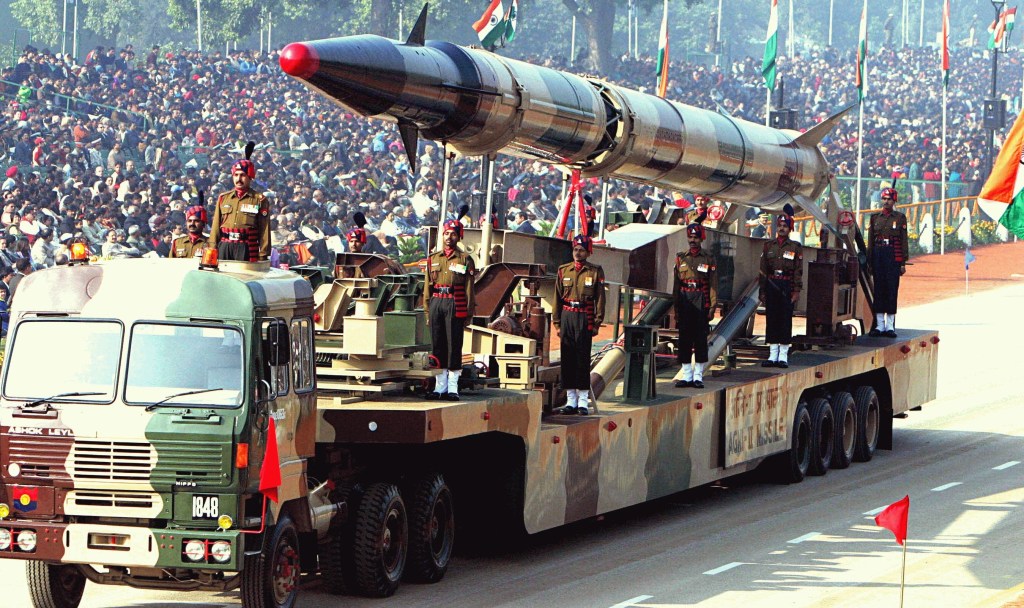
Agni II missile

Agni II:

Agni II is a medium-range, two-and-half-stage solid propellent ballistic missile, and is 20 m long, with a diameter of 1 m, and weighs around 26,000 kg. With a payload of 820-2,000 kgs, the missile could extend its range from 2,000 to 3,500 km. Agni II was first tested on 11th April 1999 at the Wheelers’ Island of the Odisha coast using IC-4 launch pad, over the range 2,000 to 2,200 km. The Agni II uses a combination of inertial navigation and GPS in its guidance module as well as dual-frequency radar correlation for terminal guidance. The 20-meter-long, two-stage ballistic missile has a strike range of 2,000 km to 3,000 km during the night trail of a nuclear-capable intermediate-range ballistic missile on 16th Nov 2019.

Agni-3 ballistic missile successfully launched by India’s Strategic Forces Command (SFC) from Wheeler Island, off the coast of Odisha on September 21, 2012.

Agni III:

Agni III is an intermediate-range, two-stage solid propellent ballistic missile, it is shorter (17 m and wider and 2 m in diameter) compared to other missiles (Agni I and Agni II), and weighs up to 44,000 kg. With a payload of 2,500 kg, Agni III could extend its range from 2,000 to 3,000 km. It is made using advanced carbon composite materials, while the second-stage booster is made of iron-based steel alloy. Agni-III was first tested on 9th July 2006 from Wheeler Island on the coast of the eastern state of Odisha, by Rail-mobile, possible road-based TEL( Transporter-Erector-Launcher). It was again tested on 12th April 2007 successfully, again from Wheeler Island. The third successive trail-test was fired on 7th May 2008 from Wheelers island, which had a range of 3,500 km, taking a warhead of 1.5 tonnes. It is the most accurate strategic ballistic missile which increases the “kill efficiency” of the weapon. It was reported that with a low payload Agni III and hit a target of over 3,500 km.
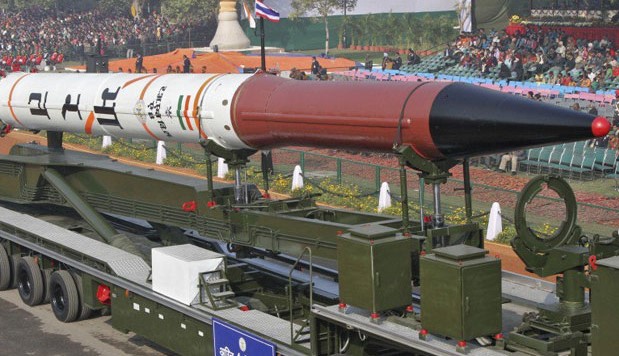
Agni IV missile

Agni IV:

Agni IV is an intermediate-range, two-stage nuclear-capable ballistic missile, it is 20 m long, with a diameter of 1 m, and weighs up to 17,000 kg. It was previously called as Agni II prime. Agni IV was first tested on 15th November 2011 and on 19 September 2012 from Wheeler Island(Abdul Kalam Island) off the coast of the eastern state of Orissa. It could reach the target up to the range of 3,500–4,000 km with a payload of 800–1,000 kg. On 20th January 2014, that is during its third test, the missile was lifted off from the launcher and after reaching an altitude of over 800 km, and impacted near the target in the Indian ocean with a remarkable accuracy carrying a payload of 900 kg. Agni IV is equipped with state-of-the-art technologies, that include indigenously developed ring laser gyro and composite rocket motor.
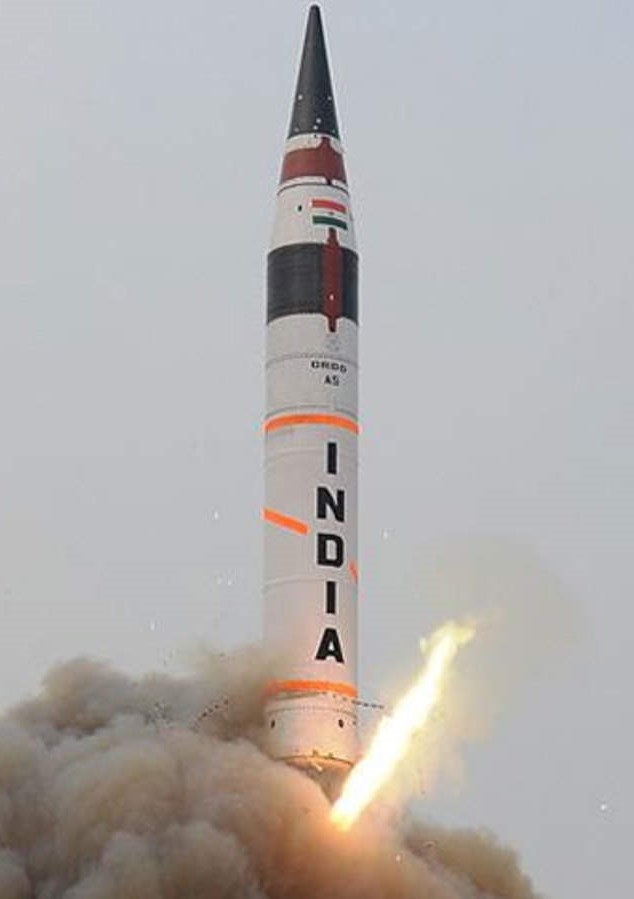
Agni V missile

Agni V:

Agni V is an intercontinental-range, three-stage solid-fuel ballistic missile, it is 17 m long, with a diameter of 2 m, and weighs up to 50,000 kg, developed by the Defense Research and Development Organisation of India. It could reach a target of more than 5,500 km. It was first test-fired on 19th April 2012, from Abdul Kalam Island formerly known as Wheelers Island off the coast of Odisha. It is a canister launch missile system and ensures that it has the requisite operational flexibility and can be swiftly transported and fired from anywhere. The second test launch of Agni-V was completed on 15th September 2013 and the canisterized version was launched in January 2015.

Agni P missile

Agni P:

Agni prime is a medium-range, two-stage solid-fueled ballistic missile, it is half of the weight of Agni III, developed by the Defense Research and Development Organisation, India. Both the first and second stage of the missile was made of composite materials. It could extend its range up to 1,000-2,000 km. As per DRDO, Agni-Prime is a new generation advanced variant of the Agni family, launched on 28th June 2021. “Being a canister-launched missile, Agni-P will give the armed forces the requisite operational flexibility to swiftly transport and fire it from anywhere they want. The test at 10:55 met all mission objectives with a high level of accuracy,” says DRDO. This missile has followed the Textbook trajectory with a great level of accuracy.

Agni VI under development

Agni VI:

Agni VI will be a four-stage intercontinental ballistic missile, currently in the hardware development phase and expected to have a Multiple Independently targetable Reentry Vehicle(MIRV) as well as a Maneuverable Reentry Vehicle(MaRV). It is expected as the latest and most advanced version among the Agni Missiles.

References:

http://www.indianexpress.com/news/india-successfully-testfires-agni-i-ballist/715859/

https://timesofindia.indiatimes.com/india/india-successfully-test-fires-new-generation-agni-p-ballistic-missile/articleshow/83914848.cms

https://en.wikipedia.org/wiki/Agni_(missile)

https://frontline.thehindu.com/dispatches/india-successfully-test-fires-agni-prime-missile/article35022926.ece

credits to the right owner of the images used.

SOCIAL MEDIA

Needs and merits

The ability to build real relationships is one of the most important aspects of social media and a key factor in attracting people of all ages, genders and nationalities. It is an important part of developing healthy social networks and powerful social network tools. People can share their business, products and services with the world as long as they stay connected and use social media. Social networks allow people to communicate, and everyone can update and report at any time. Companies make full use of social media to improve your online reputation and greatly help increase sales and personal income.

  • You need to make sure to use all social media platforms to gain insight into the needs of your customers. To make the most of social media for your business, make sure you have a content marketing plan. If you need content on any social media platform, you can use social media asset management tools to create high-quality content.
  • You can also use social media to track what people say on social media. Although social media is mainly used by the public, the government also uses it to raise public awareness.
  • Although the use of social media for teaching can be distracting, educators can do everything they can to guide students to develop good habits and practices, Benefit. Regarding the advantages provided by social networks.
  • If you consistently and continuously invest time and effort, you will see the real benefits of social media marketing. Social media can give your business a huge advantage by helping you connect with your target audience. It can cover a large number of people, but for social media, it is also a media sharing network.
  • Social media advertising is one of the two components used together to attract potential customers and spread information and brand awareness. Different from classic ads. When you actively post on social media pages, social media marketing is easy.

SOCIAL MEDIA AS A BLESSING

There are some people who actually make a good or can say the best use of the social media. Like if we talk about the young entrepreneurs who have just begun with a start up but is lacking in public attraction and funding so they create a short 30seconds advertisement and attach it with the trending apps which work through network connection . Talking about the awareness ;both the social media and mass media have been playing their roles very well by keeping their viewers updated with the latest screamers , exposing the Scams ,scandals , and even the worse parts of humanity .

Mental Wellness

According to WHO ,mental Wellness means that your mind is in order and functioning in your best intrest .You are able to think ,feel and act in ways that create a positive impact on your social and physical well-being.According to report by WHO , depression is the most common illness worldwide ,with more than 264 million people affected.Close to 800,000 people die due to suicide every year .Suicide is the second leading cause of death in 15-29 years-olds.A friendly reminder to check in on your family and friends to make sure they doing okay and they know you’re there for them .

History of Unix

Origins of Unix

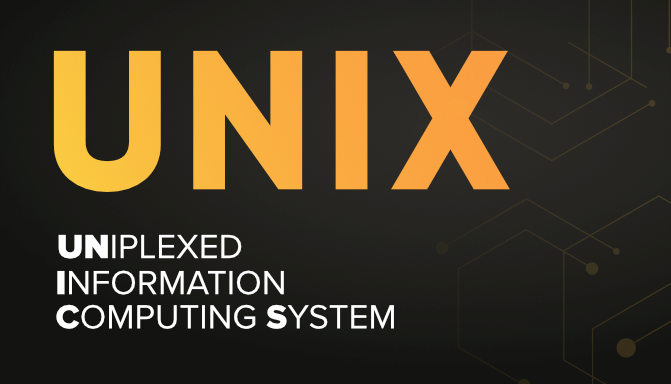
UNIX development was started in 1969 at Bell Laboratories in New Jersey. Bell Laboratories was (1964–1968) involved on the development of a multi-user, time-sharing operating system called Multics (Multiplexed Information and Computing System). Multics was a failure. In early 1969, Bell Labs withdrew from the Multics project.

Bell Labs researchers who had worked on Multics (Ken Thompson, Dennis Ritchie, Douglas McIlroy, Joseph Ossanna, and others) still wanted to develop an operating system for their own and Bell Labs’ programming, job control, and resource usage needs. When Multics was withdrawn Ken Thompson and Dennis Ritchie needed to rewrite an operating system in order to play space travel on another smaller machine (a DEC PDP7 [Programmed Data Processor 4K memory for user programs). The result was a system called UNICS (UNiplexed Information and Computing Service) which was an
’emasculated Multics’.

Unix Development

The first version of Unix was written in the low-level PDP-7 assembler language. Later, a language called TMG was developed for the PDP-7 by R. M. McClure. Using TMG to develop a FORTRAN compiler, Ken Thompson instead ended up developing a compiler for a new high-level language he called B, based on the earlier BCPL language developed by Martin Richard. When the PDP-11 computer arrived at Bell Labs, Dennis Ritchie built on B to create a new language called C. Unix components were later rewritten in C, and finally with the kernel itself in 1973.

Since it began to escape from AT&T’s Bell Laboratories in the early 1970’s, the success of the UNIX operating system has led to many different versions: recipients of the (at that time free) UNIX system code all began developing their own different versions in their own, different, ways for use and sale. Universities, research institutes, government bodies
and computer companies all began using the powerful UNIX system to develop many of the technologies which today are part of a UNIX system. By the late 1970’s, a ripple effect had come into play.

Key Factors

1969 The Beginning

The history of UNIX starts back in 1969, when Ken Thompson, Dennis Ritchie and others started working on the “little-used PDP-7 in a corner” at Bell Labs and what was to become UNIX.

1980 Xenix

Microsoft introduces Xenix. 32V and 4BSD introduced.

1983 System V

Computer Research Group (CRG), UNIX System Group (USG) and a third group merge to become UNIX System Development Lab.
AT&T announces UNIX System V, the first supported release. Installed base 45,000.

1991

UNIX System Laboratories (USL) becomes a company – majority owned by AT&T. Linus Torvalds commences Linux development.
Solaris 1.0 debuts.

1998 UNIX 98

The Open Group introduces the UNIX 98 family of brands, including Base, Workstation and Server. First UNIX 98 registered products shipped by Sun, IBM and NCR. The Open Source movement starts to take off with announcements from Netscape and IBM. UnixWare 7 and IRIX 6.5 ship.

2007

Apple Mac OS X certified to UNIX 03.

What is Firewall and its types

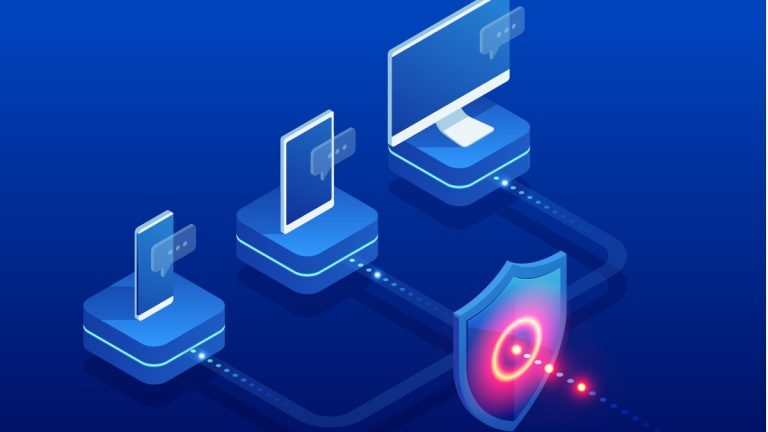
A firewall forms a barrier through which the traffic going in each direction must pass. A firewall security policy dictates which traffic is authorized to pass in each direction. A firewall may be designed to operate as a filter at the level of IP packets, or may operate at a higher protocol layer. Firewalls can be an effective means of protecting a local system or network of systems from network-based security threats while at the same time affording access to the outside world via wide area networks and the Internet.

TYPES OF FIREWALLS

  1. Packet Filtering Firewall

It is simplest, fastest firewall component. It is Foundation of any firewall system. Examine each IP packet (no context) and permit or deny according to rules. Hence restrict access to services (ports). A packet filtering firewall applies a set of rules to each incoming and outgoing IP packet and then forwards or discards the packet. The firewall is typically configured to filter packets going in both directions (from and to the internal network).

2. Stateful Packet Filters

A traditional packet filter makes filtering decisions on an individual packet basis and does not take into consideration
any higher layer context. To understand what is meant by context and why a traditional packet filter is limited with regard to context, a little background is needed. Most standardized applications that run on top of TCP follow a client/server model. A stateful packet inspection firewall reviews the same packet information as a packet filtering firewall, but also records information about TCP connections.

3. Application Level Gateway (or Proxy)

An application-level gateway, also called an application proxy, acts as a relay of application-level traffic. Application-level gateways tend to be more secure than packet filters. Rather than trying to deal with the numerous possible
combinations that are to be allowed and forbidden at the TCP and IP level, the application-level gateway need only scrutinize a few allowable applications. In addition, it is easy to log and audit all incoming traffic at the application level. A prime disadvantage of this type of gateway is the additional processing overhead on each connection.

4. Circuit Level Gateway

This can be a stand-alone system or it can be a specialized function performed by an application-level gateway for certain. A circuit-level gateway does not permit an end-to-end TCP connection; rather, the gateway sets up two TCP connections,
 Between itself and a TCP user on an inner host.
 Between itself and a TCP user on an outside host.

Virtual Reality: Its history and future

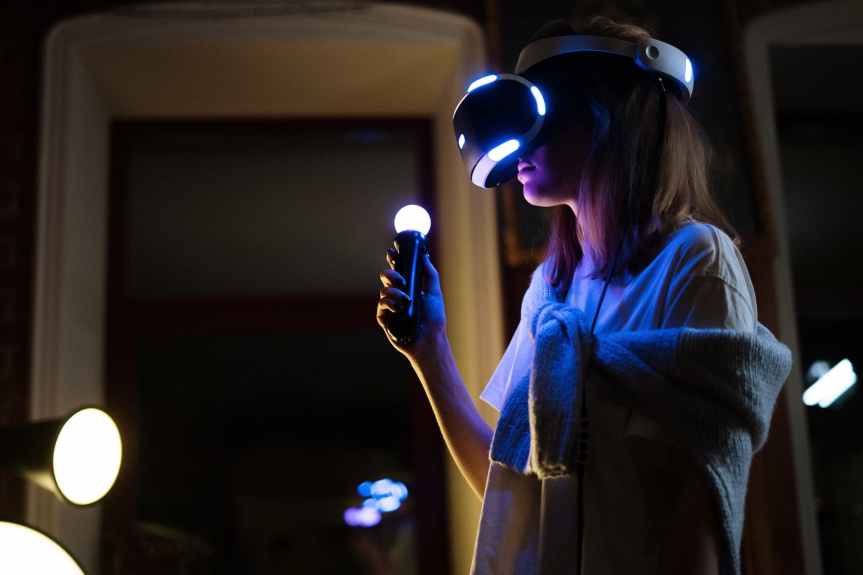
Virtual Reality has a brief yet rich history with many ups and downs. Even though the formal name was defined much later, there had been many attempts that resembled the Virtual Reality that we know it as today. Let’s first define the goal of Virtual Reality. It is to trick the brain to believe that something is real with the help of virtual elements, these elements can be auditory (sound) or visual (sight). But there are many parallel definitions of VR but one of the essential differentiating factors of Virtual Reality compared to other forms of media is that VR has some sort of interactivity. Unlike Movies or 3D movies where a person can only view but not interact, VR facilitates the freedom to touch, interact and control what a person sees on their screen.

History of VR

The fascination with VR goes way back to the 1930s when science fiction writer Stanley G. Weinbaum wrote a story where he mentions about Pygmalion’s spectacles. The wearer would be able to experience the virtual world. VR was further popularized by the popular Sci-fi movie, Star Trek: The Next Generation and its Holodeck.  

­One of the first examples of VR HMD (Head Mounted Display) was ‘Sword of Damocles’ developed by Ivan Sutherland and his student Bob Sproull. The HMD was connected to a computer. The contraption setup was intimidating, cumbersome, and heavy. The graphics that were shown if the HMD were quite simplistic and trivial, but it was a convincing step towards the VR we know today. The term ‘VR’ was popularized in the 1980s by Jaron Lanier. By the end of the 1980s, NASA with the assistance of Crystal River Engineering, created Project VIEW. It was a VR simulator that was developed to train the astronauts. The 1990s saw the use of VR in multimedia and mainstream commercial spaces. Numerous virtual reality arcades were introduced in the public spaces where players could play games with immersive stereoscopic 3D visuals. The mid-1990s saw the VR foray by console manufacturers. Nintendo and SEGA both showcased their VR gaming headsets but both were a commercial failure due to technical limitations and lack of software support.

In 2012 Oculus Kickstarter had raised 2.5 million dollars and this gave the startup a monetary jumpstart that previous VR projects were not able to attain. In 2014 Facebook bought the Oculus and this ensured that the VR startup would be adequately funded in their VR developments. 2014 also saw the launch of numerous other VR developments like Google cardboard, Sony PSVR and Samsung Gear VR. In 2016 HTC released its advanced VR headset, HTC Vive. Now the focus was to make VR truly standalone free from the assistance of a dedicated computer or a smartphone.

The Future

The Future of VR looks bright, there are many factors for this but one of the major factors is the price of VR has significantly gone down. There are continual developments in the sphere of VR and various new technological innovations are attempting to make the adoption of VR much more seamless, comfortable and intuitive to use. The use of VR is not just limited to gaming but now VR is also used for many commercial and business purposes. Recently Microsoft signed an agreement with the US government to supply 120,000 semi-custom versions of Hololens VR/AR headsets. VR is increasingly used in the health and manufacturing sectors as well. With a compound annual growth of 21.6% from 2020 to 2027, it seems that VR is only going to get more mainstream in the future.

References:

https://nix-united.com/blog/the-past-present-future-of-virtual-reality/

https://www.vrs.org.uk/virtual-reality/history.html

Wireless Sensor Networks (WSN)

Sensors, a controller, and a communication system make up a typical sensor network. Wireless Sensor Networks, or simply WSNs, are networks in which the communication mechanism in a Sensor Network is implemented using a Wireless protocol.

Sensor Nodes are placed in high density and frequently in huge quantities to provide sensing, data processing, embedded computing, and communication in a Wireless Sensor Network.

Elements of WSN

A typical wireless sensor network is made up of two parts. They are as follows:

  • Sensor Node
  • Network Architecture

Sensor Node

In a WSN, a Sensor Node has four fundamental components. They are as follows:

  • Power Supply
  • Sensor
  • Processing Unit
  • Communication System

The sensor takes analog data from the physical environment, which is then converted to digital data by an ADC. The main processing unit, which is generally a microprocessor or a microcontroller, processes and manipulates data intelligently.

A communication system consists of a radio system for data transmission and receiving, which is generally a short-range radio. Due to the fact that all of the components are low-power electronics.

Sensor Nodes include not just the sensing component, but also key characteristics like as processing, communication, and storage.

Network Architecture

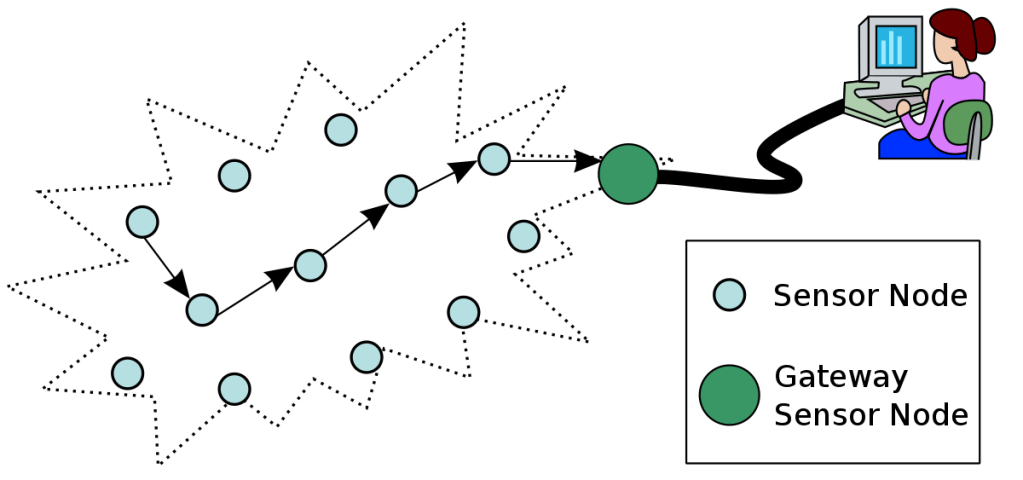
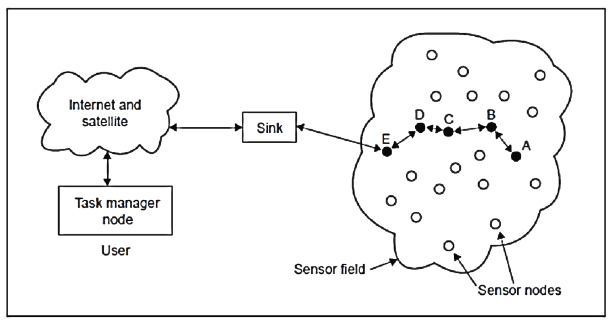
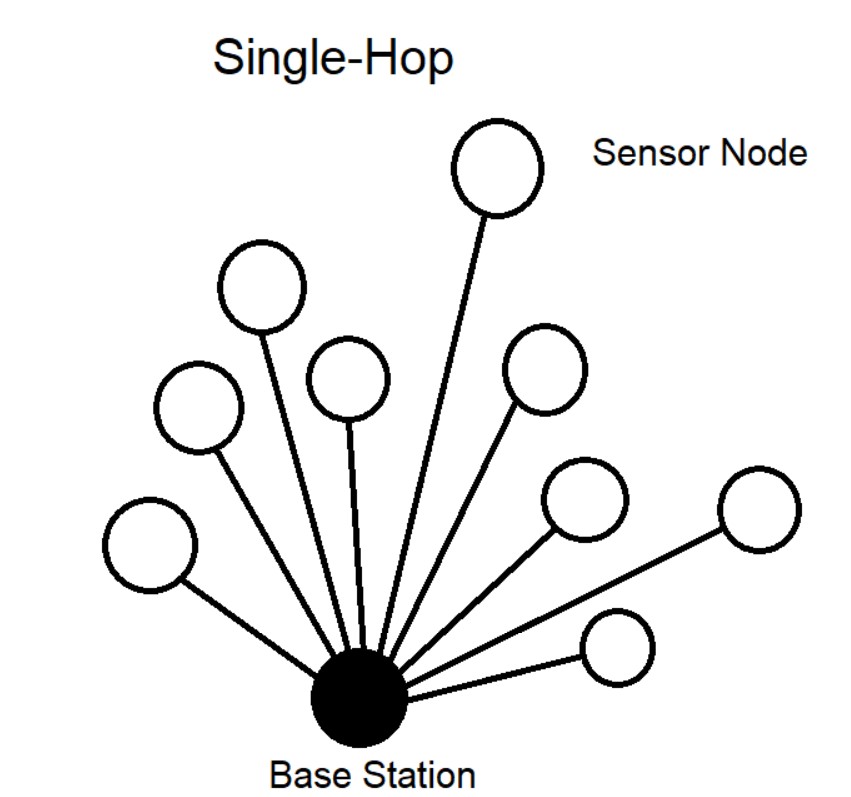
The networking of these sensor nodes is requirements is to ensure when a large number of sensor nodes are put in a broad region to cooperatively monitor a physical environment. A sensor node in a WSN uses wireless communication to connect not only with other sensor nodes but also with a Base Station.

The base station delivers orders to the sensor nodes, and the sensor nodes collaborate to complete the task. The sensor nodes relay the data back to the base station after gathering the required information.

A base station can also connect to other networks through the internet. A base station receives data from sensor nodes and conducts basic data processing before sending the updated information to the user through the internet.

A single-hop network design is one in which each sensor node is linked to the base station.

In Multi-hop network architecture, the data is sent through one or more intermediary nodes.

Network Topologies in WSN

A few alternative network topologies utilized in WSNs are listed below.

Star Topology

Every node in the network is connected to a single central node, known as a hub or switch, in a star architecture.

Tree Topology

A tree topology is a hierarchical network in which the top node is a single root node, which is connected to numerous nodes at the next level, and so on.

Mesh Topology

Apart from delivering its own data, each node in a mesh architecture also functions as a relay receiving data from other linked nodes. Fully Connected Mesh and Partially Connected Mesh are the two types of mesh topologies.

Each node in a fully connected mesh topology is connected to all other nodes, whereas a node in a partially connected mesh topology is connected to one or more surrounding nodes.

(The left diagram is fully connected mesh topology and the right diagram is partially connected mesh topology.)

Applications of Wireless Sensor Networks

Wireless Sensor Networks have an almost limitless number of uses. Heating, ventilation, and air conditioning (HVAC), air traffic control (ATC), automotive sensors, earthquake detection, disaster management, tsunami alert systems, industrial automation, personal health care, weather sensing, and monitoring are just a few of the applications of wireless sensor networks.

SPACE-TIME-GRAVITY

Gravity is the curvature of space time-

According to Albert Einstein’s general theory of relativity, gravity is no longer a force that acts on massive bodies, as viewed by Isaac Newton’s universal gravitation. Instead, general relativity links gravity to the geometry of spacetime itself, and particularly to its curvature.

In classical physics, time proceeds constantly and independently for all objects. In relativity, spacetime is a four-dimensional continuum combining the familiar three dimensions of space with the dimension of time.

To account for gravity in relativity, the structure of this four-dimensional spacetime must be extended beyond the rules of classical geometry, where parallel lines never meet and the sum of a triangle’s angles is 180°. In general relativity, spacetime is not ‘flat’ but is curved by the presence of massive bodies.

This artistic representation visualises spacetime as a simplified, two-dimensional surface, which is being distorted by the presence of three massive bodies, represented as coloured spheres. The distortion caused by each sphere is proportional to its mass.

The curvature of spacetime influences the motion of massive bodies within it; in turn, as massive bodies move in spacetime, the curvature changes and the geometry of spacetime is in constant evolution. Gravity then provides a description of the dynamic interaction between matter and spacetime.

Micro Electro Mechanical Systems (MEMS)

Micro Electro Mechanical Systems (MEMS) is a manufacturing technology for microscale devices such as sensors, actuators, transducers, gears, switches, pumps, etc.

Basically, MEMS are microscopic integrated devices made up of electronics, electrical, and mechanical parts that work together to fulfil a single functional need, based on a technique known as Microsystems Technology (MST).

These MEMS-based devices are typically only a few micrometers in size (between 1 to 100 micrometers).

MEMS Sensors

One of the most essential components of today’s digital world is sensors. Because all computing and processing is done using digital signals, there has to be a bridge between the analog and digital worlds. Sensors bridge this gap by observing the temporal impacts of analog physical factors and producing a piece of useful information (to the computer).

A Sensor is a device that includes fundamental sensing elements that sense a physical property such as temperature or humidity and transform it into an electrical signal. A signal processing device, such as an amplifier, filter, or ADC, or a combination of these elements, is also included in a sensor.

When it comes to MEMS Sensors, a Micromachined Microsensor, or simply a MEMS Sensor, is one that is designed and manufactured utilising MEMS Technology.

Types of MEMS Sensors

The automobile sector is a major user of MEMS technology. Modern automobiles include a variety of sensors, the most of which are MEMS-based. Some of them are:

  • IMU or Inertial Measurement Units (they are a combination of MEMS Accelerometer and MEMS Gyroscope) are used to measure pitch, yaw, and roll for autonomous driving.
  • Accelerometers used for  airbag deployment and electronic stability control.
  • We use pressure and inertial sensor for braking control.
  • Magnetometer are used for the navigational direction.
  • By using airflow sensor, air intake is being monitored.
  • Pressure sensor are used in system for monitoring tyre pressure.
  • Impact and crash sensor are used for airbag deployment and detection of impact.
  • We use fuel sensor for indicator of fuel level.
  • Temperature sensor are used for automatic climate control and monitoring of engine temperature.
  • MEMS Microphone are used for noise cancellation and communication.

Applications of MEMS

Different sensors, such as pressure, temperature, vibration, and chemical sensors, are made using MEMS technology.

MEMS Sensors like accelerometers, gyroscopes, and e-compass are popular in ships, vehicles, planes, helicopters, and drones.

Sensors, actuators, generators, energy sources, biochemical and medicinal systems, and oscillators all use MEMS. MEMS applications include the following:

  • MEMS accelerometers, MEMS pressure sensors, MEMS pressure sensors, MEMS gyroscopes, MEMS, tilt and other types of MEMS resonant sensors are examples of sensors.
  • MEMS switches, micro-grippers, micro-levers, and micro-pumps, are examples of actuators.
  • MEMS fuels cells, MEMS vibration energy harvesters, and MEMS radioisotope power generators are examples of generators and energy sources.
  • MEMS biosensors, MEMS air microfluidic and particle sensors,  lab-on-chips,  are examples of biochemical and biomedical systems.
  • MEMS oscillators are used in applications that need precise timekeeping and frequency control.

One of the breakthrough innovations is the idea of combining sensors, actuators, electrical (and electronic), and mechanical components on a single chip. MEMS technology will enable the creation of smart devices having Microsensor perception, Microactuator control, and Microelectronics computational capabilities.

THE SCIENTIFIC AND NORMATIVE VALUES ON JUVENILE JUSTICE

Recent breakthroughs in neuroscience, particularly enhanced Magnetic Resonance Imaging (MRI) techniques, have given scientists and policymakers a more comprehensive knowledge of how our brains evolve from birth to adulthood. While these studies are still in their early stages, they have already demonstrated that the brain continues to develop long after an individual becomes a legal adult (i.e., at the age of 18), and that the slow maturation process that occurs in the social context is mirrored by a slow maturation process in the neural domain. Despite the tentative nature and ambiguous meaning of this information (i.e., we don’t yet understand the actual link between brain structure and behavior), neuroscience is becoming increasingly involved in long-standing debates about juvenile justice and the extent to which adolescents can be held legally responsible for their actions. Roper v. Simmons, in which the Supreme Court prohibited the death penalty for juvenile criminals under the age of 18, is the most significant example of this tendency to date. Christopher Simmons’ prosecution, sentencing, and habeas corpus petition were the focus of the case after he brutally murdered an elderly woman during a burglary when he was 17 years old. Although the execution of minors was historically regarded acceptable in American culture, the Court ruled that a national consensus had evolved that such a penalty was cruel and unusual, and thus violated the Eighth Amendment. The majority agreed with Simmons’ assertion that teenagers lack the emotional, intellectual, and biological maturity required to be consistently categorized as criminals. Adolescents should be punished for their misdeeds, but they should not have to pay the ultimate price for impulses they couldn’t control. Simmons’ claim was based on fresh brain imaging findings that suggests the adolescent brain is not as mature as the adult brain.

Neuroscience was conspicuously absent from this debate. Developments in brain research that investigate problems of culpability and “blameworthiness” of adolescent offenders are increasingly informing juvenile justice policy around the world. Simmons was 17 years old in 1993 when he robbed a woman, tied her up with electrical cord and duct tape, and flung her over a bridge, similar to the juvenile implicated in the December 16, 2012 gang rape in New Delhi. He was convicted and condemned to death by a Missouri court in 1994 when the case went to trial. By 2004, the Simmons case had reached the United States Supreme Court, which ruled a year later in a historic judgment that capital punishment for crimes committed while under the age of 18 was unconstitutional. To determine the “age of knowledge,” the decision relied on neuroscience and advances in brain science. So, what does science need to say about the Indian government’s decision to permit 16-18 year olds to be tried and sentenced as adults? Simply said, science does not support the decision.

The age of understanding in India is 18 years old, according to the Juvenile Justice (Care and Protection of Children) Act of 2000. And so, legally, a person beyond that age might be held fully liable for his actions. However, neuro-scientific developments within the past decade prove that brain development continues till the person is well into his twenties.

In 2007, the National Institute of Mental Health (NIMH) in the United States examined the brains of over 1,000 healthy children aged 3 to 18. Researchers conducted the Magnetic Resonance Imaging (MRI) scans and followed the particular physical changes within the adolescent brain; believe that brain maturation peaks around the age of 25. “Part of the brain that assists organization, planning, and strategizing is not completed being built yet,” according to a 2005 research titled Adolescence, Brain Development, and Legal Culpability. It’s a little unfair to expect [adolescents] to have adult organizational skills or decision-making abilities before their brains are finished developing.” According to available neuro-scientific data, the frontal lobe, especially the prefrontal cortex, is among the last parts of the brain to completely mature. The frontal lobes are in charge of impulse control, decision-making, judgment, and emotions, and are thus critical when determining “culpability” in cases of juvenile delinquency. Further, we now know conclusively that teenagers tend to be impulsive and susceptible to mood swings because the limbic system — which processes emotions — remains developing.

Many research works have established that under conditions of chronic and severe stress in rats, the prefrontal cortex can shrink by up to 40 per cent leading in brain cells in this area losing their capacity to process information properly. The hippocampus, which is crucial for forming memories of daily facts and events, additionally damaged during a similar fashion.

Thus, the parts of the brain that is crucial for processing information about specific events, and making careful decisions based on them — such as applying the brakes on high-risk behavior — are severely compromised. The amygdala, the emotional centre of the brain that is involved in fear, anxiety, and aggression, on the other hand, is pushed in the other way by stress by making its neurons grow bigger and stronger. Surprisingly, MRI imaging reveals that people with stress disorders experience identical alterations in their brains.

Wonders of Western Ghats

Western Ghats, mountain range which is older than the Himalayas, is present parallel to the western coast of Indian peninsula covering 160,000 square km area in a stretch of 1600km. Western Ghats travel through the states of Karnataka, Goa, Tamil Nadu, Kerala, Maharashtra, and Gujarat. UNESCO identifies it as a World Heritage site and it is one of the hotspots of biological diversity in the world. The mountain influences the country’s monsoon. Western Ghats has a rich biodiversity. There are so many species of flora and fauna endemic to the place and make it rich.

Western Ghats has over 7,402 flowering plants species, 1,814 non-flowering plant species, 139 species of mammals, 179 amphibian species, 6,000 insect species and 290 freshwater fish species. There are at least 325 globally threatened species present.

SOME OF THE WONDER SPECIES OF WESTERN GHATS
  1. BENGAL TIGERS: Bengal tigers are known for their beauty and power. they are native to Indian subcontinent. These predators are present in western Ghats also. Western Ghats are home to 10% of the tiger population. they live in the tiger reserve. Ranthambor national park has 585 tigers.
  2. KING COBRA: This is the worlds largest venomous snake. This lives in rainforests and scrubs and grasslands of western Ghats. Adult king cobras are 3.18-4m long and weigh between 11 and 20lbs. Male snakes are little longer than females. They are snake eaters and also eat lizards rats etc. This is the only snake that builds nest for its eggs. Their behavior include aggressiveness and shy nature. It has enough venom to kill an elephant.
  3. INDIAN WILD DOG: It is one of the most dangerous wild animal of Western Ghats. They are classified as endangered and the main reason is habitat destruction. They are also called as Dhole. They can be seen in jungle roads, river beds etc. It has large round ears and hooded eyes. It is a highly social and co-operative animal.
  4. LION TAILED MACAQUE: This animal is endemic to Western Ghats and it is one of the endangered species. their population is below 4000. They are an old world monkey. This magnificent animal is the proof for the wonderful biodiversity of the western Ghats. These are omnivores but fruits are the major part of their diet. These get a part of their required moisture by licking the leaves.
  5. INDIAN GIANT SQUIRRAL: They are also called Malabar giant squirrel. Bhima Shankar wildlife sanctuary has a noticeable population. They mostly live on trees. They build their spherical nest with leaves and twigs. they have a long bushy tail. They are mostly seen solitary or sometimes in pair. They feed on nuts, fruits and bird eggs.
  6. PURPLE FROG: It is also an endangered species because of habitat loss. this species is formally described recently in 2003. They have a bloated body, short hind legs and sucker like mouthparts. Local people consume tadpoles of this frog. These frogs are found in damp soil which is well aerated and loose. Only 135 individuals are identified in which only 3 are females.
  7. MALBAR GREY HORNBILL: This is also endemic to Western Ghats. They have large beak. They are found in dense forest and are mostly fungivores. They are mostly 45cm in length and weigh 240-340g.

Healthy Foods To Avoid Stress!

[ By Bhoomika Saini ]

Feeling Stressed?

Maybe Healthy Eating Is The Key.

It's not about eating. It's about using the food to deal with anxiety and stress.

Staying at home during the time of this pandemic invited a lot of stress and anxiety for every individual. Since, many of us had become lazy during this time. We have stopped eating healthy as it is easy to order unhealthy food from online stores rather than cooking healthy and learning at home. This habit made us unhealthy, also it is harming our health day by day. Stress along with unhealthy eating is like inviting problems in your own home.

A healthy diet builds a solid, more enduring foundation for your body by reducing oxidation and inflammation and by helping to reduce weight gain.

There are many ways that can reduce your stress and make you feel better. Here, we’ll be discussing about one of them. And it’ll begin from eating healthy during the time of stress. Healthy food can bring wonders to oneself, so stop eating unhealthy food and start eating healthy today. One step to drive away your stress shall begin from here.

Also, there’s a huge difference between eating healthy during stress and stressful eating. One can be beneficial and other one could bring huge disadvantages to you. Moreover, adding some exercise in the routine wouldn’t hurt much.

So, here are some foods that can help you to avoid unhealthy eating and to drive your stress away.

Stay healthy , stay fit
Stay healthy ,stay fit

  1. Sweet Potato– To calm down the stress, sweet potato might work well as it contains potassium, beta-carotene and other vitamins that also reduces the urge to eat carbohydrates and sweets, thus helping you to avoid the urge to eat more.
  2. Eggs- They are packed with vitamins, minerals, amino acids and antioxidants that play an important role in relieving stress.
  3. Chickpeas- They are packed with stress-fighting vitamins and minerals, including magnesium, potassium, B vitamins, zinc, selenium, manganese, and copper that can help in stress reduction.
  4. Dark Chocolate- Many experts say that it helps in reducing stress as it contains flavonoids and magnesium that may reduce the depression symptoms too.
  5. Turmeric- Curcumin in tumeric may help lower anxiety by reducing inflammation and oxidative stress that often increase in people experiencing mood disorders, such as anxiety and depression.
  6. Yogurt- It contains healthful bacteria, Lactobacillus and Bifidobacteria. There is emerging that these bacteria and fermented products have positive effects on brain health.
  7. Green Tea- Theanine in green tea has anti-anxiety and calming effects and may increase the production of serotonin and dopamine.
  8. Warm milk- It has loads of B vitamins that reduce anxiety and improve mood. For instance, vitamin B6 (pyridoxine) raises serotonin levels to perk you up.
  9. Nuts- Nuts are full of nutrients, including B vitamins, along with healthy fatty acids. B vitamins are an important part of a healthy diet and can help reduce stress.
  10. Citrus foods- Flavonoids found in citrus fruits have anti-inflammatory capabilities that are thought to help protect against the chain of events that causes the nervous system to deteriorate.
  11. Oatmeal- Oatmeal is warm and comforting-and it also helps your brain generate the destressing neurotransmitter serotonin.
  12. Green Leafy Vegetables- Green leafy vegetables like spinach contain folate, which produces dopamine, a pleasure-inducing brain chemical, helping you to keep calm.

Start eating right today to nourish your body. So, first step to drive your stress away starts today.

Green Economics

Over the past five years or so the issue of climate change has moved from a peripheral concern of scientists and environmentalists to being a central issue in global policy making. It was the realization that the way our economy operates is causing pollution on a scale that threatens our very survival that first motivated the development of a green approach to the economy. We are in an era of declining oil supplies and increased competition for those that
remain. This raises concerns about the future of an economy that is entirely dependent on oil and a wider recognition of the importance of using our limited resources wisely. This was the other motivation for the development of green economics. In addition, green economists have been concerned about the way an economic system based on competition has led to widening inequalities between rich and poor on a global as well as a national scale, and the inevitable tension and conflict this inequality generates.

Green economics is a methodology of economics that supports the harmonious interaction between humans and nature and attempts to meet the needs of both simultaneously. Green economic theories encompass a wide range of ideas all dealing with the interconnected relationship between people and the environment. Green economists assert that the basis for all economic decisions should be in some way tied to the ecosystem, and that natural capital, such as water, gold, natural gas, silver, or oil, etc. and ecological services have economic value.

The term green economics is a broad one but it encompasses any theory that views the economy as a component of the environment in which it is based. The United Nations Environment Program(UNEP) defines a green economy as “low carbon, resource efficient, and socially inclusive.” As such, green economists generally take a broad and holistic approach to understanding and modeling economies, paying as much attention to the natural resources that fuel the economy as they do to the way the economy itself functions.

While the idea of an equitable economy powered by renewable energy sources is alluring, green economics has its share of critics. They claim that green economics’ attempts to decouple economic growth from environmental destruction have not been very successful. Most economic growth has occurred on the back of non-renewable technologies and energy sources. Weaning the world, especially developing economies, from them requires effort and has not been an entirely successful endeavor. The emphasis on green jobs as a social justice solution is also fallacious, according to some. The raw material for green energy in several cases comes from rare earth minerals mined in inhospitable conditions by workers who are paid cheaply. An example of this is electric car maker Tesla, whose car batteries are made using raw materials mined from Congo, a region wracked by civil war. Another criticism of green economics is that it is focused on a technological approach to solutions and, consequently, its market is dominated by companies with access to the technology.

Trainings and Internships In Technical Fields

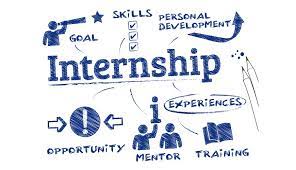
In the early days of our university, we will all live in a fantasy world, where we will feel that we have everything we want. The future is bleak If we start the internship after the first year of study, whether it is a remote internship or a full-time internship, this situation can be easily resolved. Choose according to your convenience and university practice.

“Your greatest opportunity may be by your side”-Napoleon Hill

Your interns can choose from several trusted websites such as:

  • Internshala
  • Letsintern

In the college, we will have a group of friends and we will be happy to play with them. In the workplace, this may or may not happen, but you have to adapt to the environment as soon as possible to deal with different types of people. I’m sure some companies offer internship extensions and full-time performance based on the attitude of interns, depending on their Attitude Pages An easy process If this is a paid internship, you will understand the value of the funds you have used in the past, which will help you make better use of the economy. During the internship, you will need you to manage your studies, study and test results. Although once you have mastered the multitasking and time management skills that can be solved in real-time with World Problems , the process may seem daunting at first, but if your internship skills are not too passionate for Asmara, then your internship skills are also something Good things signal that they ignored the option very early. Work hard, study, and then forget to make the most of it. Don’t hesitate, don’t be afraid to start again. Because experts say you don’t start from scratch, but from experience.

You can learn how to apply the knowledge you have acquired during an internship to your future workplaces. In addition to this, it is an excellent learning curve for young graduates and students while meeting new people and making connections in the professional world

How dangerous the Coronavirus is?

He has killed more than 4,000 people in a short period of time. This is the worst epidemic in years. The whole world was destroyed. The new type of coronavirus pneumonia is a dry cough but no runny nose. This is the easiest way to identify the death of Wuhan virus (COVID-19) at 30-35 degrees, so please drink plenty of hot water. You can let your friends and family drink plenty of hot water to prevent it. Please spend a long time in the sun. Recently it was a cold period of the year, and I drank hot wine. Getting into the water is also very convenient. Drinking warm water is effective for most viruses.

1 This virus is quite large (cell diameter is about 400-500 nm), so any ordinary mask (not just the N95 function) should be able to filter it out. The infected person sneezes in front of you, walks 3 meters (approximately 10 feet), and then touches the ground and stops flying 659872 If the virus falls on a metal surface, it will survive for at least 12 hours, please wash your hands thoroughly with soap and leave you with water. No disinfectant 3 Virus can remain active on tissues for 612 hours Ordinary washing powder should kill the virus. Winter clothes that do not need to be washed every day can be exposed to the sun for 4 hours to kill the virus.

2 Then the virus mixed with nasal fluid and dripped into the lungs along the trachea, causing pneumonia. This process takes 5 to 6 days.

3 Pneumonia causes high fever and shortness of breath. Stuffy nose is not the norm. I feel like I am drowning in the water If you feel this way, it is important to see a doctor immediately. Prevention: The most common route of infection is by contact with objects in public places, so you need to wash your hands frequently. The virus can only survive on your hands for 510 minutes. But during these 510 minutes, you may cause a lot of harm (you may rub your eyes or pick your nose unknowingly)

4 In addition to washing your hands frequently, you can also rinse your mouth with Betadine to kill or reduce the bacteria still in your throat (Before) it drips into the lungs)

5 Follow the traditional Indian way of life and live according to moral principles and values. India’s traditional values ​​and lifestyle are the best way to combat these deadly diseases.This virus is just a warning. Nature may have more such diseases in the future. This is nature’s response to human overuse of nature. Do not eat after sunset. You are a vegetarian and always drink boiled water. You eat freshly prepared food. You are very scientific about what to eat and what not to eat. They use muh-batti (a kind of mask). For thousands of years, you are now in the news